Question
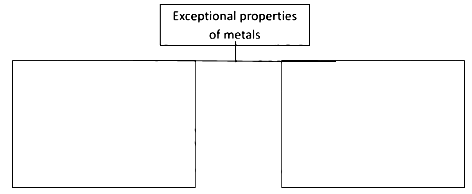
Complete the following flowchart.
Answer

Exceptional properties of metals
Properties Exceptions

1. Physical state: Metals exist mainly in a solid state at room temperature.
2. Hardness: Metals are generally hard.
3. Melting and boiling point: Metals have high melting and boiling points.

1. Mercury and gallium exist in a liquid state at room temperature.
2. Lithium, sodium and potassium are metals which can be cut with a knife as they are very soft.
3. Sodium, potassium, mercury, and gallium have very low melting and boiling points.

Need a full question paper?

Generate a complete, print-ready paper with questions like this in minutes — across 16+ boards, with answer keys.
Start Generating Free

Similar questions

Give the position, size and nature of image formed by a concave lens when the object is placed:
  1. Anywhere between optical centre and infinity.
  2. At infinit.
What is meant by dominant genes and recessive genes? Give one example of each.
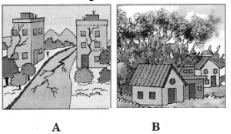
Observe the images ‘A’ and ‘B’ and answer the following questions.
Image

(i) Which disasters are shown in the images ?
(ii) Which primary precautions will you take in case of disaster shown in ‘A’?
(iii) Which type of first-aid is offered to the injured people in disaster ‘B’?
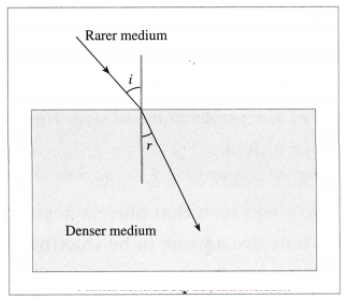
An object $2\ cm$ tall is placed on the axis of a convex lens of focal length $5\ cm$ at a distance of $10\ m$ from the optical centre of the lens. Find the nature, position and size of the image formed. Which case of image formation by convex lenses is illustrated by this example?
Derive the expression for the heat produced due to a current ‘I’ flowing for a time interval ‘t’ through a resistor ‘R’ having a potential difference ‘V’ across its ends. With which name is this relation known?
A plane mirror is kept at the bottom of a trough with water in it as shown in the following figure (Fig. 6.12). The ray of light emerging from a source at the point S outside the trough reaches the point A on the surface of water. Draw a neat ray diagram to show the subsequent path of light and complete the ray diagram.
Image

What is the difference between mass and weight of an object? Will the mass and weight of an object on the earth be the same as their values on Mars? Why?
High and low tides are regular phenomena.
What will happen if slow moving neutrons are made to strike the atoms of a heavy element $_{92}U^{235}$? What?
Write the IUPAC names of the following structural formulae: $\mathrm{CH}_3-\mathrm{CH}_2-\mathrm{CH}_2-\mathrm{CHO}$