Question
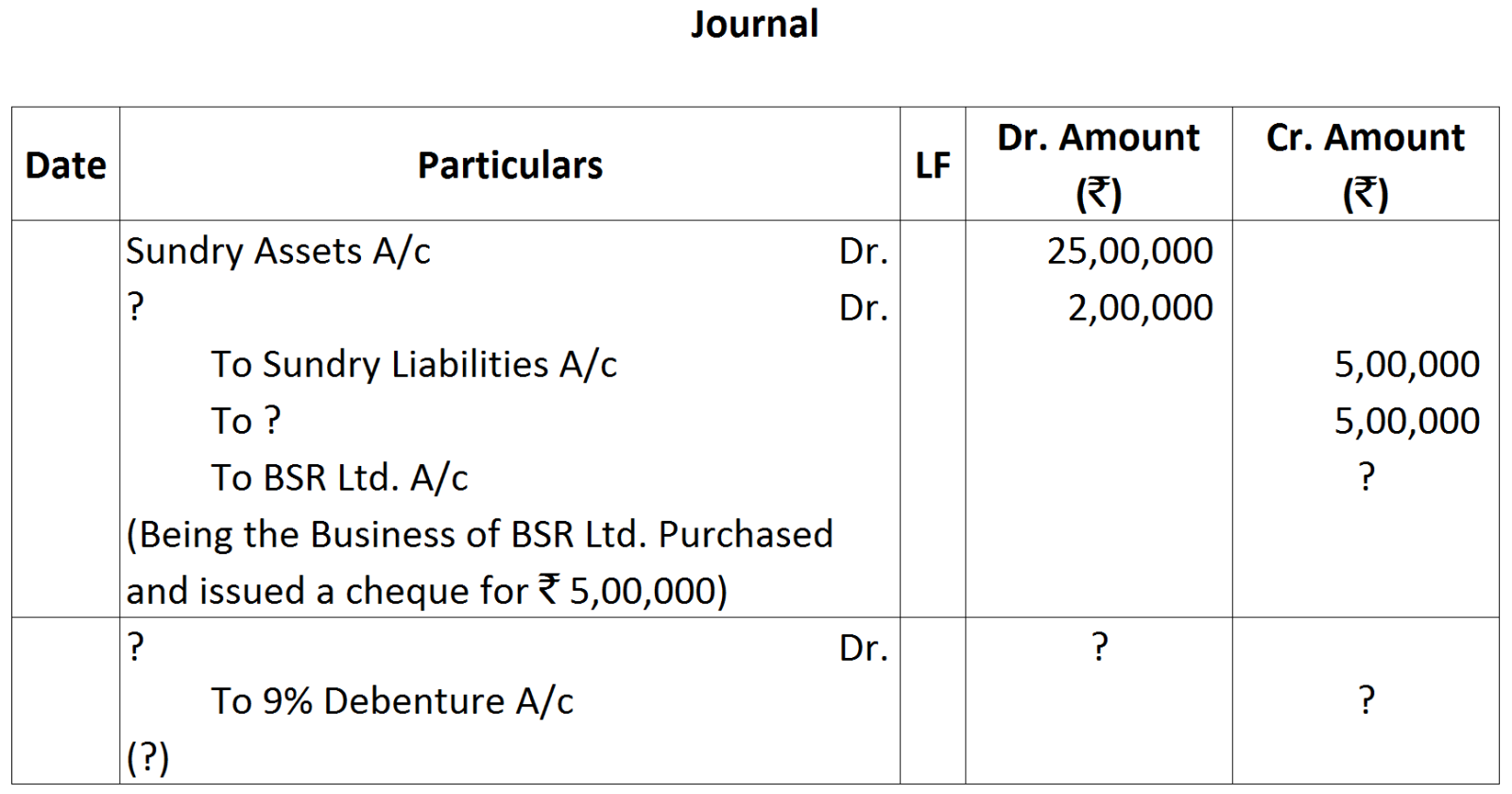
Complete the following Journal entries:
Answer

Get the step-by-step solution for this question inside the Vidyadip app.

Get the answer in the app

Need a full question paper?

Generate a complete, print-ready paper with questions like this in minutes — across 16+ boards, with answer keys.
Start Generating Free

Similar questions

Calculate Return on Capital Employed from the following:
Net Profit before tax ₹ 2,50,000.
Pass necessary journal entries relating to the issue of Debentures for the following:
Issued ₹ 80,000; 10% Debentures of ₹ 100 each at par repayable at a premium of 10%.
Current Ratio 2.5 : 1; Quick Ratio 1 : 1; Current Assets ₹ 5,00,000. Calculate Current Liabilities; Liquid Assets and Inventory.
From the following compute Current Ratio:
B Ltd. forfeited 500 shares of ₹ 10 each issued at 20% premium (to be paid at the time of allotment) for non-payment of the first call of ₹ 3 per share and final call of ₹ 2 per share. Out of these, 300 shares were re-issued as fully paid-up for ₹ 10 per share. Journalise.
150 shares of ₹ 10 each issued at a premium of ₹ 4 per share payable with allotment were forfeited for non-payment of allotment money of ₹ 8 per share including premium. The first and final call of ₹ 4 per Pass Journal entries in the books of X Ltd. for the above.
Cost of Revenue from Operations (Cost of Goods Sold) ₹ 2,20,000; Revenue from Operations (Net Sales) ₹ 3,20,000; Selling Expenses ₹ 12,000; Office Expenses ₹ 8,000; Depreciation ₹ 6,000. Calculate Operating Ratio.
[Hint: Operating Expenses = Selling Expenses + Office Expenses + Depreciation.]
A Company has a loan of ₹ 15,00,000 as part of its Capital employed. The interest payable on loan is 15% and the R.O.I. of the Company is 25%. The rate of lncome Tax is 60%. What is the gain to shareholders due to the loan raised by the Company?
State which of the following would result in inflow, outflow or no flow of cash:
  1. A long-term loan from a bank.
  2. Repayment of long-term loan.
  3. Payment of interest on loan.
  4. Conversion of debentures into preference shares.
  5. Interest received on investments.
  6. Interest due on debentures.
  7. Receipt of accrued interest.
  8. Purchase of securities of a company.
  9. Buy-back of Equity Shares.
  10. Purchase of Goodwill.
  11. Goodwill written off.
  12. Patents written off.
G.Ltd. issued 75,00,000, 6% Debenture of ₹ 50 each at par payable ₹ 15 on application and ₹ 35 on allotment, redeemable at par after 7 years from the date of issue of debenture. Record necessary entries in the books of Company.