Question
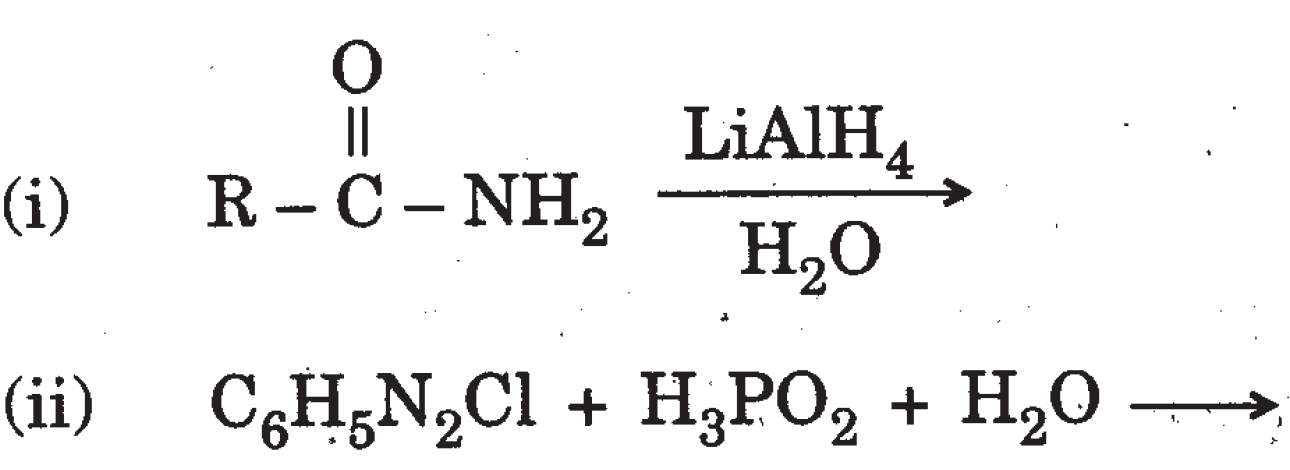
✓
Answer
Get the step-by-step solution for this question inside the Vidyadip app.
Get the answer in the appNeed a full question paper?
Generate a complete, print-ready paper with questions like this in minutes — across 16+ boards, with answer keys.
Explore more
Similar questions
Give reason:
(i) Transition elements exhibit higher enthalpies of atomisation.
(ii) In aqueous solution, $Cr ^{2+}$ is stronger reducting agent than $Fe ^{2+}$.
(iii) The second ionisation enthalpy of Cu is higher then $Z n$.
→(i) Transition elements exhibit higher enthalpies of atomisation.
(ii) In aqueous solution, $Cr ^{2+}$ is stronger reducting agent than $Fe ^{2+}$.
(iii) The second ionisation enthalpy of Cu is higher then $Z n$.
Why vitamin D, E and K compounds are essential for us? Describe their important sources.
Write the formulae of the following coordination compounds:
- Tetraamminediaquacobalt(III)chloride .
- Tris (ethane-1,2-diamine)chromium(III)chloride.
Answer thefollowing:
- Haloalkanes easily dissolve in organic solvents,why?
- What is known as a racemic mixture? Give an example.
- Of the two bromoderivatives, C6H5CH(CH3)Br and C6H5CH(C6H5) Br, which one ismore reactive in SN1 substitution reaction and why?
- What type of isomerism is shown by the complex [Co(en)3]Cl3?
- Write the hybridisation and magnetic character of [Co(C2O4)3]3–.
(At. no. of Co = 27)
- Write IUPAC name of the following Complex [Cr(NH3)3Cl3]
A solution contains 1g mol. each of p-toluene diazonium chloride and pnitrophenyl diazonium chloride. To this 1g mol. of alkaline solution of phenol is added. Predict the major product. Explain your answer.
- What is the basis of formation of the spectro-chemical series?
- Draw the structures of geometrical isomers of the following coordination complexes:
[Co(NH3)3Cl3] and [CoCl2(en)2]+.
(en = ethylenediamine and atomic number of Co is 27).
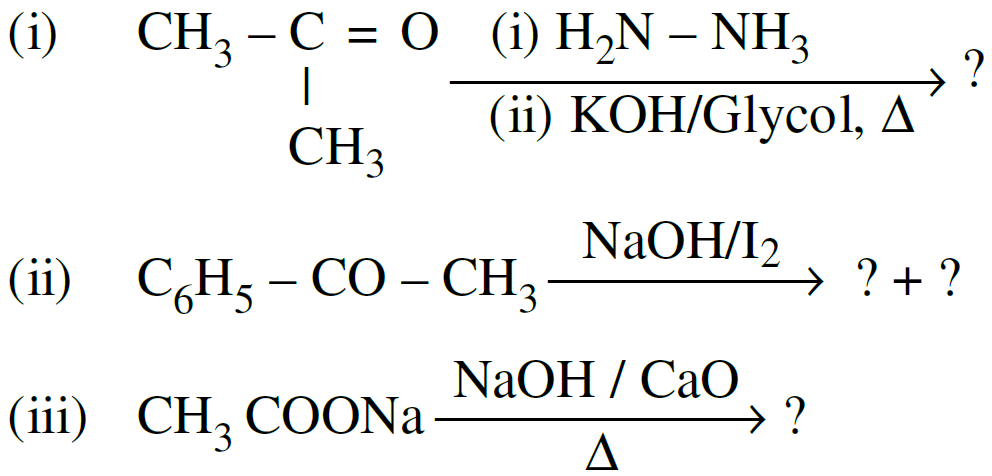
What is organo metallic compound? Explain grignard reagent.
Define the following terms:
- Nucleotide.
- Anomers.
- Essential amino acids.