Question

Complete the following reaction equations:
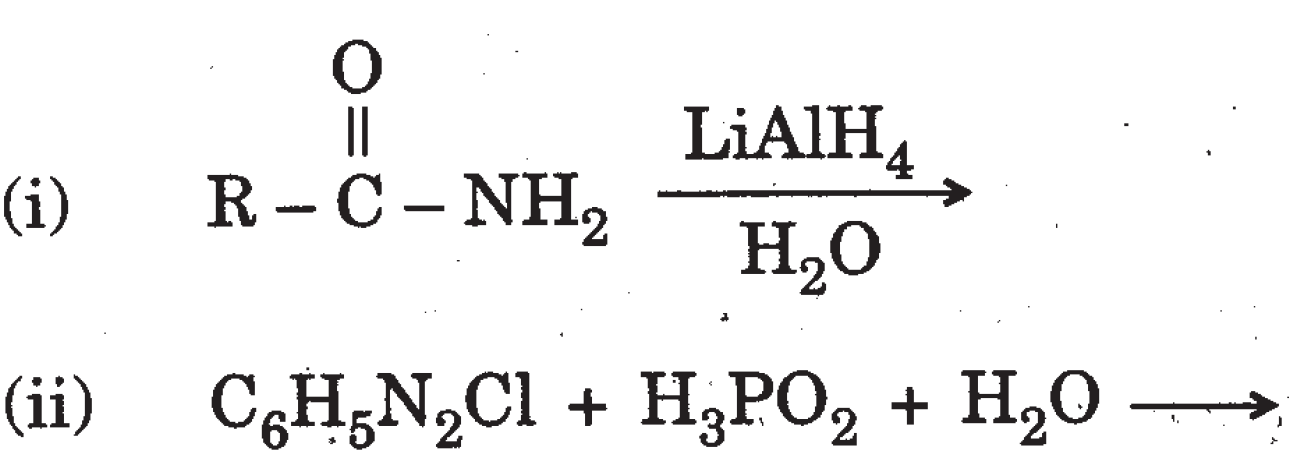
  1. $C_6H_5NH_2 + Br_2 (aq) \rightarrow$.

Answer

Get the step-by-step solution for this question inside the Vidyadip app.

Get the answer in the app

Need a full question paper?

Generate a complete, print-ready paper with questions like this in minutes — across 16+ boards, with answer keys.

Start Generating Free

Similar questions

A compound $‘X’ (C_2H_4O)$ on oxidation gives $‘Y’ (C_2H_4O_2)$. ‘X’ undergoes haloform reaction. On treatment with HCN ‘X’ forms a product ‘Z’ which on hydrolysis gives 2-hydroxy propanoic acid.
  1. Write down structures of ‘X’ and ‘Y’.
  2. Name the product when ‘X’ reacts with dil. NaOH.
  3. Write down the equations for the reactions involved.
Explain the following:
  1. Solution of chloroform and acetone is an example of maximum boiling azeotrope.
  2. A doctor advised a person suffering from high blood pressure to take less quantity of common salt.
Give reasons:
  1. $C–Cl$ bond length in chlorobenzene is shorter than $C–Cl$ bond length in $CH_3–Cl.$
  2. The dipole moment of chlorobenzene is lower than that of cyclohexyl chloride.
  3. $S_N1$ reactions are accompanied by racemization in optically active alkyl halides.
Vapour pressures of pure acetone and chloroform at $328$ K are $741.8$ mm Hg and $632.8$ mm Hg respectively. Assuming that they form ideal solution over the entire range of composition, plot $p_{total}, p_{chloroform},$ and $p_{acetone}$ as a function of $x_{acetone}$. The experimental data observed for different compositions of mixture is:
$100 \times x_{acetone}$ $0$ $11.8$ $23.4$ $36.0$ $50.8$ $58.2$ $64.5$ $72.1$
$p_{acetone}/ mm\ Hg$ $0$ $54.9$ $110.1$ $202.4$ $322.7$ $405.9$ $454.1$ $521.1$
$p_{chloroform}/ mm\ Hg$ $632.8$ $548.1$ $469.4$ $359.7$ $257.7$ $193.6$ $161.2$ $120.7$
Plot this data also on the same graph paper. Indicate whether it has positive deviation or negative deviation from the ideal solution.
What are the characteristics of the following colloids? Give one example of each.
  1. Multimolecular colloids.
  2. Lyophobic sols.
  3. Emulsions.
The conductivity of sodium chloride at $298 K$ has been determined at different concentrations and the results are given below:
Concentration/M 0.001 0.010 0.020 0.050 0.100
$10^2\times k/S m^{-1}$ 1.237 11.85 23.15 55.53 106.74
Calculate $\wedge_\text{m}$ for all concentrations and draw a plot between $\wedge_\text{m}$ and $\text{C}^\frac{1}{2}.$ Find the value of $\wedge^\circ_\text{m}.$
Match the types of defect given in Column I with the statement given in Column II.
  Column I   Column II
(i) Impurity defect (a) $NaCl$ with anionic sites called $F-$centres.
(ii) Metal excess defect (b) $FeO $with $Fe^{3+}.$
(iii) Metal deficiency defect (c) $NaCl$ with $Sr^{2+}$ and some cationic sites vacant.
Match the items of Column I and Column II.
 
Column I
 
Column II
(i)
Diamond.
(a)
Short interval of time.
(ii)
Instantaneous rate.
(b)
Ordinarily rate of conversion is imperceptible.
(iii)
Average rate.
(c)
Long duration of time.
Explain measurement and calculation of resistance and conductivity of electrolytic solution.
What type of colloidal sols are formed in the following:
  1. Sulphur vapours are passed through cold water.
  2. White of an egg is mixed with water.
  3. Soap solution.