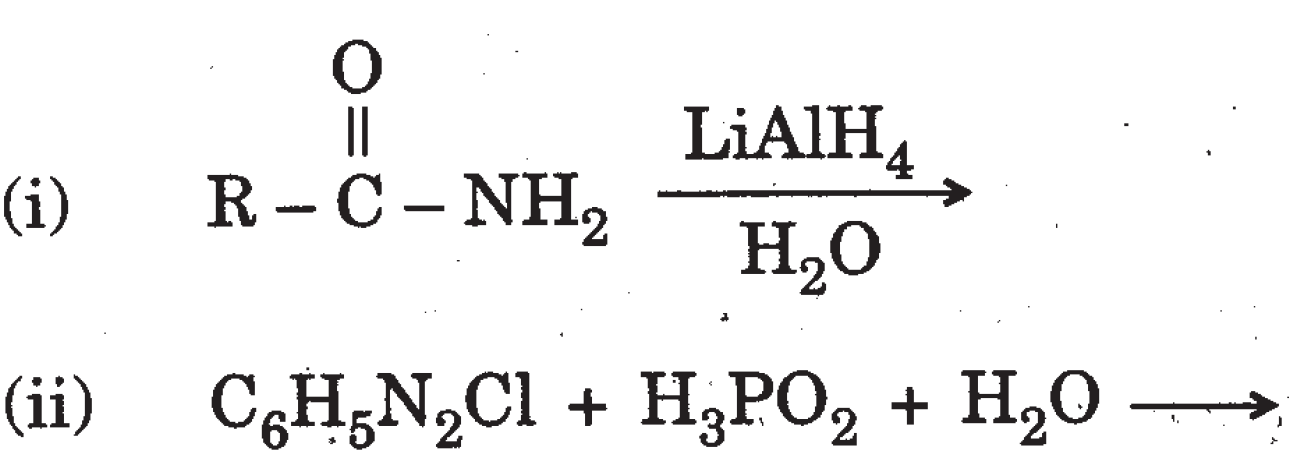
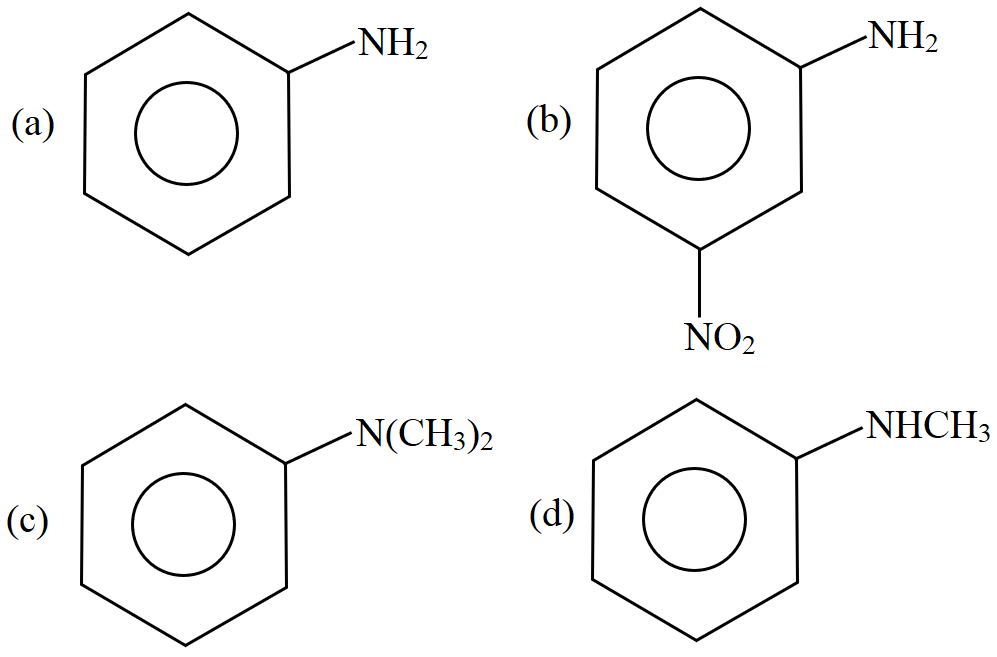
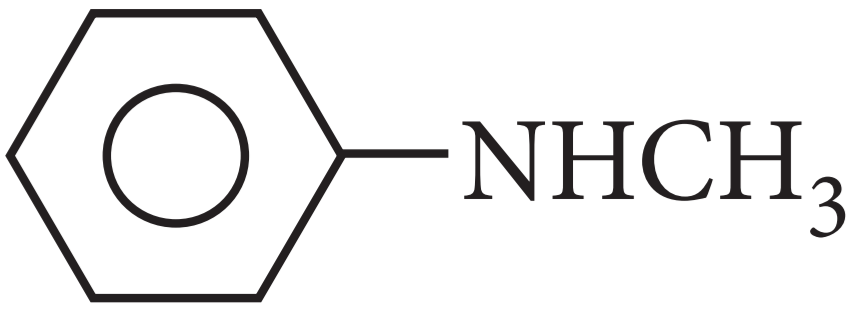
Question types

Amines question types

399 questions across 7 question groups — pick any mix to generate a Chemistry paper with step-by-step answer keys.

399
Questions
7
Question groups
5
Question types
Sample Questions

Amines questions

One sample from each question group in this chapter. Select any group above to see the full set with answer keys.

Decreasing order of basicity of the three isomers of nitro aniline is:
  • A
    $P −$ nitroaniline $> o −$ nitroaniline $> m −$ nitroaniline.
  • B
    $P −$ nitroaniline $> m −$ nitroaniline $> o −$ nitroaniline.
  • $M −$ nitroaniline $> p − $nitroaniline $> o −$ nitroaniline.
  • D
    $M −$ nitroaniline $> o −$ nitroaniline $> p −$ nitroaniline.

Answer: C.

View full solution
Reduction of alkyl nitriles in presence of $\mathrm{LiAlH}_4$​ Gives:
  • Alkyl Amines
  • B
    Alkyl Amides
  • C
    Alkyl Nitro compounds
  • D
    Alkyl Iso cyanides

Answer: A.

View full solution
In these questions, a statement of assertion followed by a statement of reason is given. Choose the correct answer out of the following choices.
Assertion: Boiling point of amines are lower than those of alcohols and carboxylic acids.
Reason: Amines are much more soluble in water than less polar solvents like alcohol, ether, etc.
  • A
    Assertion and reason both are correct statements and reason is correct explanation for assertion.
  • Assertion and reason both are correct statements but reason is not correct explanation for assertion.
  • C
    Assertion is correct statement but reason is wrong statement.
  • D
    Assertion is wrong statement but reason is correct statement.

Answer: B.

View full solution
Note: In the following question a statement of assertion followed by a statement of reason is given. Choose the correct answer out of the following choices.
Assertion: Acylation of amines gives a monosubstituted product whereas alkylation of amines gives polysubstituted product.
Reason: Acyl group sterically hinders the approach of further acyl groups.
  • A
    Both assertion and reason are wrong.
  • B
    Both assertion and reason are correct statements but reason is not correct explanation of assertion.
  • Assertion is correct statement but reason is wrong statement.
  • D
    Both assertion and reason are correct statements and reason is correct explanation of assertion.

Answer: C.

View full solution
In these questions, a statement of assertion followed by a statement of reason is given. Choose the correct answer out of the following choices.
Assertion: Aniline hydrogen sulphate, on heating, forms $p-$aminosulphonic acid.
Reason: The sulphonic acid group is electron$-$withdrawing.
  • A
    Assertion and reason both are correct statements and reason is correct explanation for assertion.
  • Assertion and reason both are correct statements but reason is not correct explanation for assertion.
  • C
    Assertion is correct statement but reason is wrong statement.
  • D
    Assertion is wrong statement but reason is correct statement.

Answer: B.

View full solution
In these questions, a statement of assertion followed by a statement of reason is given. Choose the correct answer out of the following choices.
Assertion: Nitration of aniline can be done conveniently by protecting the amino group by acetylation.
Reason: Acetylation increases the electron density in the benzene ring.
  • A
    Assertion and reason both are correct statements and reason is correct explanation for assertion.
  • B
    Assertion and reason both are correct statements but reason is not correct explanation for assertion.
  • Assertion is correct statement but reason is wrong statement.
  • D
    Assertion is wrong statement but reason is correct statement.

Answer: C.

View full solution
In these questions, a statement of assertion followed by a statement of reason is given. Choose the correct answer out of the following choices.
Assertion: Ammonolysis of alkyl halides involves the reaction between alkyl halides and alcoholic ammonia.
Reason: Reaction can be used to prepare $1^\circ , 2^\circ , 3^\circ $ amines and finally quaternary ammonium salts.
  • A
    Assertion and reason both are correct statements and reason is correct explanation for assertion.
  • Assertion and reason both are correct statements but reason is not correct explanation for assertion.
  • C
    Assertion is correct statement but reason is wrong statement.
  • D
    Assertion is wrong statement but reason is correct statement.

Answer: B.

View full solution
Write structures of different isomers corresponding to the molecular formula, $C_3H_9N$. Write IUPAC names of the isomers which will liberate nitrogen gas on treatment with nitrous acid.
View full solution
Give the structures of A, B and C in the following reaction:
$\text{C}_6\text{H}_5\text{NO}_2\xrightarrow[]{\text{Fe}/\text{HCl}}\text{A}\xrightarrow[273\text{K}]{\text{NaNO}_2+\text{HCl}}\text{B}\xrightarrow[\Delta]{\text{H}_2\text{O}/\text{H}^+}\text{C}$
View full solution
Q 213 Marks Question3 Marks
Give reasons for the following:
  1. Acetylation of aniline reduces its activation effect.
  2. $CH_3NH_2$ is more basic than $C_6H_5NH_2.$
  3. Although $-NH_2$ is o/p directing group, yet aniline on nitration gives a significant amount of m-nitroaniline.
View full solution
Q 223 Marks Question3 Marks
Give reasons for the following :
  1. Acetylation of aniline reduces its activation effect.
  2. $CH_3NH_2$ is more basic than $C_6H_5NH_2$.
  3. Although -NH2 is o/p directing group, yet aniline on nitration gives a significant amount of m-nitroaniline.
View full solution
Q 233 Marks Question3 Marks
Give reasons for the following:
  1. Aniline does not undergo Friedal-Crafts reaction.
  2. $(CH_3)_2\ NH$ is more basic than $(CH_3)_3\ N$ in an aqueous solution.
  3. Primary amines have higher boiling point than tertiary amines.
View full solution
Q 243 Marks Question3 Marks
Give reasons for the following:
  1. Acetylation of aniline reduces its activation effect.
  2. $CH_3NH_2$ is more basic than $C_6H_5NH_2$.
  3. Although $-NH_2$ is o/p directing group, yet aniline on nitration gives a significant amount of m-nitroaniline.
View full solution
Read the passage given below and answer the following questions:
Amines are basic in nature. The basic strength of amines can be expressed by their dissociation constant, $K_b$ or $pK_b$.
$\text{RNH}_2+\text{H}_2\text{O}\rightleftharpoons\text{RNH}^+_3+\text{OH}^-$
$\text{k}_\text{b}=\frac{[\text{RNH}^+_3][\text{OH}^-]}{[\text{RNH}_2]}\text{and}\text{ pk}_\text{b}=-\log\text{k}_\text{b}$
Greater the $K_b$ value or smaller the $pK_b$​​​​​​​ value, more is the basic strength of a mine. Aryl amines such as aniline are less basic than aliphatic amines due to the involvement of lone pair of electrons on N-atom with the resonance in benzene. In derivatives of aniline, the electron releasing groups increase the basic strength while electron withdrawing groups decrease the basic strength. The base weakening effect of electron withdrawing group and base strengthening effect of electron releasing group is more marked at p-position than at m-position. a-Substituted aniline is less basic than aniline due to ortho effect and is probable due to combination of electronic and steric effect.
The following questions are multiple choice questions. Choose the most appropriate answer:
  1. Which of the following has lowest $pK_b$ value?
  1. The strongest base among the following is:
  1. $C_6H_5NH_2$
  2. $p-NO_2 - C_6H_4NH_2$
  3. $m-NO_2 - C_6H_4NH_2$
  4. $C_6H_5CH_2NH_2$
  1. Maximum $pK_b​​​​​​​$​​​​​​​ value of:
  1.  
  1.  
  1. $(CH_3CH_2)_2NH$
  2. $(CH_3)_2NH$
  1. The order of basic strength among the following amines in benzene solution is:
  1. Methylamine is more basic than $NH_3$.
  2. Amines form hydrogen bonds.
  3. Ethylamine has higher boiling point than propane.
  4. Dimethylamine is less basic than methylamine.
  1. $CH_3CH_2NH_2$ contains a basic $-NH_2$ group, but $CH_3CONH_2$​​​​​​​ does not because:
  1. Acetamide is amphoteric in character.
  2. In ethylamine the electron pair on N-atom is delocalised by resonance.
  3. In ethylamine there is no resonance while in acetamide the lone pair of electrons on N-atom is delocalised and is less available for protonation.
  4. None of these.
View full solution
Read the passage given below and answer the following questions:
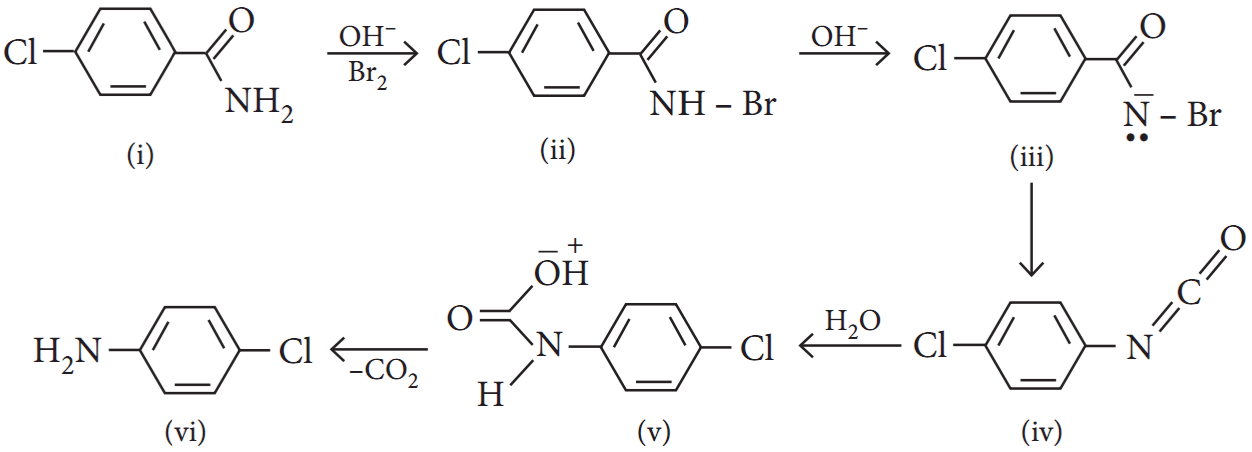
$RCONH_2$ is converted into $RNH_2$ by means of Hoffmann bromamide degradation. During the reaction amide is treated with $Br_2$ and alkali to get amine. This reaction is used to descend the series in which carbon atom is removed as carbonate ion $(\text{CO}^{2-}_3)$ Hoffmann bromide degradation reaction can be written as:

The following questions are multiple choice questions. Choose the most appropriate answer:
  1. Hoffmann bromamide degradation is used for the preparation of
  1. Primary amines.
  2. Secondary amines.
  3. Tertiary amines.
  4. Secondary aromatic amines.
  1. Which is the rate determining step in Hoffmann bromamide degradation?
  1. Formation of (i)
  2. Formation of (ii)
  3. Formation of (iii)
  4. Formation of (iv).
  1. Which of the following are used for the conversion of (i) to (ii)?
  1. $KBr$
  2. $KBr + CH_3ONa$
  3. $KBr + KOH$
  4. $Br_2 + KOH$
  1. Identify Bin the following reaction.
$\text{R}-\text{C}\equiv\text{N}\xrightarrow[\text{(Partially hydrolysis) }]{\text{Cone. HCI}}\text{A}\xrightarrow{\frac{\text{Br}_2}{\text{KOH}}}\text{B}$
  1. $RCONH_2$
  2. $RNH_2$
  3. $RNHBr$
  4. $R = N = C = O$
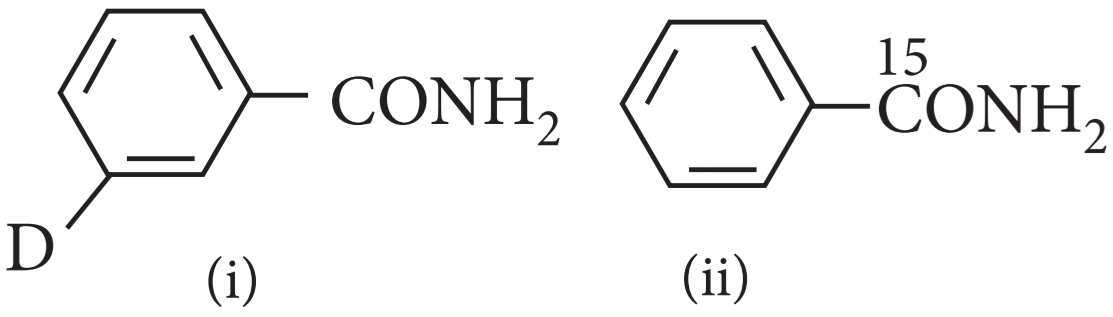
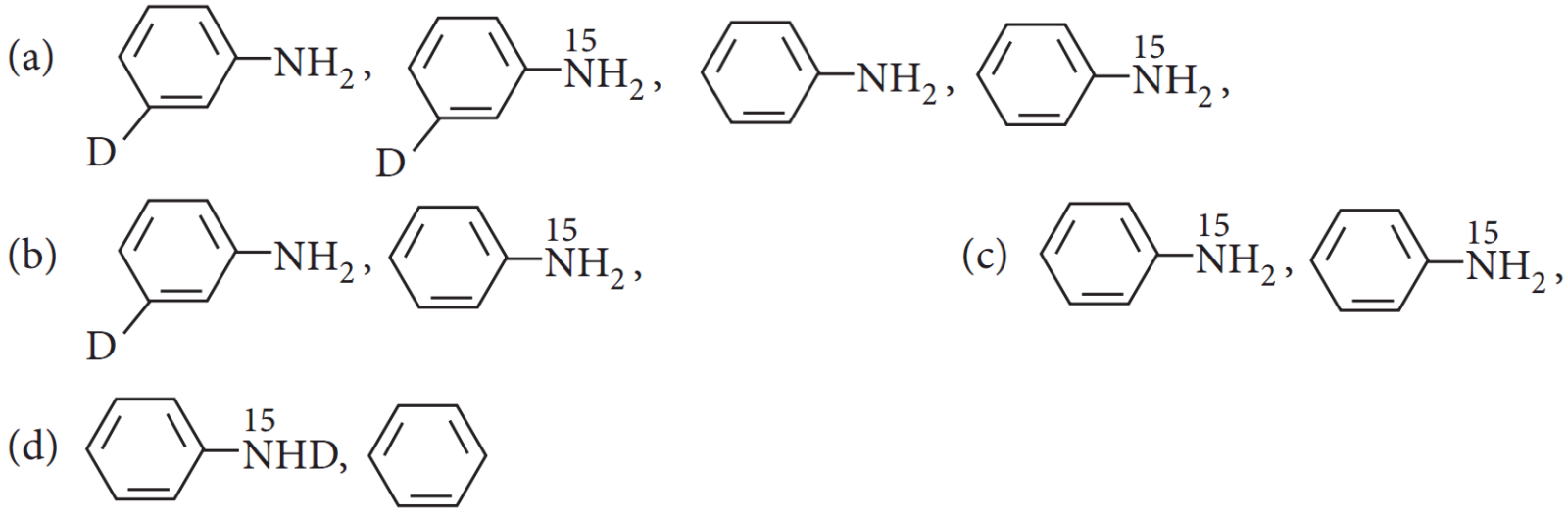
  1. What are the constituent amines formed when the mixture of (i) and (ii) undergoes Hoffmann bromamide degradation?

View full solution
Read the passage given below and answer the following questions: Aniline activates the benzene ring by increasing electron density at ortho- and para-positions. Hence, it is o-, p-directing. -NH2 group strongly activates the ring therefore it is difficult to stop the reaction at monosubstitution stage. Among electrophilic substitution reaction, direct nitration of aniline is not done to get o- and p-nitroaniline because lone pair of electrons present at nitrogen atom will accept proton from nitrating mixture to give anilinium ion which is meta-directing. Aniline with $NaNO_2$ and HCI forms benzene diazonium chloride at very low temperature. Aromatic amines react with nitrous acid to form a yellow oily liquid known as N-nitrosoamines. A statement of assertion followed by a statement of reason is given. Choose the correct answer out of the following choices.
  1. Assertion and reason both are correct statements and reason is correct explanation for assertion.
  2. Assertion and reason both are correct statements but reason is not correct explanation for assertion.
  3. Assertion is correct statement but reason is wrong statement.
  4. Assertion is wrong statement but reason is correct statement.
  1. Assertion: Nitrating mixture used for carrying out nitration of benzene consists of cone. $HNO_3$ + cone. $H_2SO_4$.
Reason: In presence of $H_2SO_4, HNO_3$ acts as a base and produces $\text{NO}^+_2$ ions.
  1. Assertion: Anilinium chloride is more acidic than ammonium chloride.
Reason: Anilinium ion is not resonance-stabilised.
  1. Assertion: Nitrobenzene can be prepared from benzene by using mixture of cone. $HNO_3$ and cone. $H_2SO_4$.
Reason: In the mixture, $H_2SO_4$ act as a acid.
  1. Assertion: In strongly acidic solution, aniline becomes less reactive towards electrophilic reagents.
Reason: The amino group being completely protonated in strongly acidic solution, the lone pair of electrons on the nitrogen is no longer available for resonance.
  1. Assertion: Nitration of aniline can be done conveniently by protecting $-NH_2$ group through acetylation.
Reason: Acetylation of aniline results in the increase of electron density in the benzene ring.
View full solution
Read the passage given below and answer the following questions:
A mixture of two aromatic compounds $(A)$ and $(B)$ was separated by dissolving in chloroform followed by extraction with aqueous $KOH$ solution. The organic layer containing compound $(A)$, when heated with alcoholic solution of KOH produce $C_7H_5N (C)$ associated with unpleasant odour.
The following questions are multiple choice questions. Choose the most appropriate answer:
  1. What is A?
  1. $C_6H_5NH_2$
  2. $C_6H_5CH_3$
  3. $C_6H_5CH_3$
  4. None of these.
  1. The reaction of $(A)$ with alcoholic solution of $KOH$ to produce $(C)$ of unpleasant odour is called:
  1. Sandmeyer reaction.
  2. Carbylamine reaction.
  3. Ullmann reaction.
  4. Reimer-Tiemann reaction..
  1. The alkaline aqueous layer $(B)$ when heated with chloroform and then acidified give a mixture of isomeric compounds of molecular formula $C_7H_6O_2. (B)$ is:
  1. $C_6H_5CHO$
  2. $C_6H_5COOH$
  3. $C_6H_5CH_3$
  4. $C_6H_5OH$
  1. In the chemical reaction, $CH_3CH_2NH_2 + CHCl_3 + 3KOH \rightarrow (A)+ (B) + 3H_2O,$
  1. $C_2H_5NC$ and $KCl$
  2. $C_2H_5CN$ and $KCl$
  3. $CH_3CH_2CONH_2$ and $KCl$
  4. $C_2H_5NC$ and $K_2CO_3$
  1. Direct nitration of an aromatic compound (A) is not feasible because:
  1. The reaction cannot be stopped at the mononitration stage.
  2. A mixture of o, m and p-nitroaniline is always obtained.
  3. Nitric acid oxidises most of the aromatic compound to give oxidation products along with only a small amount of nitrated products.
  4. All of the above.
View full solution

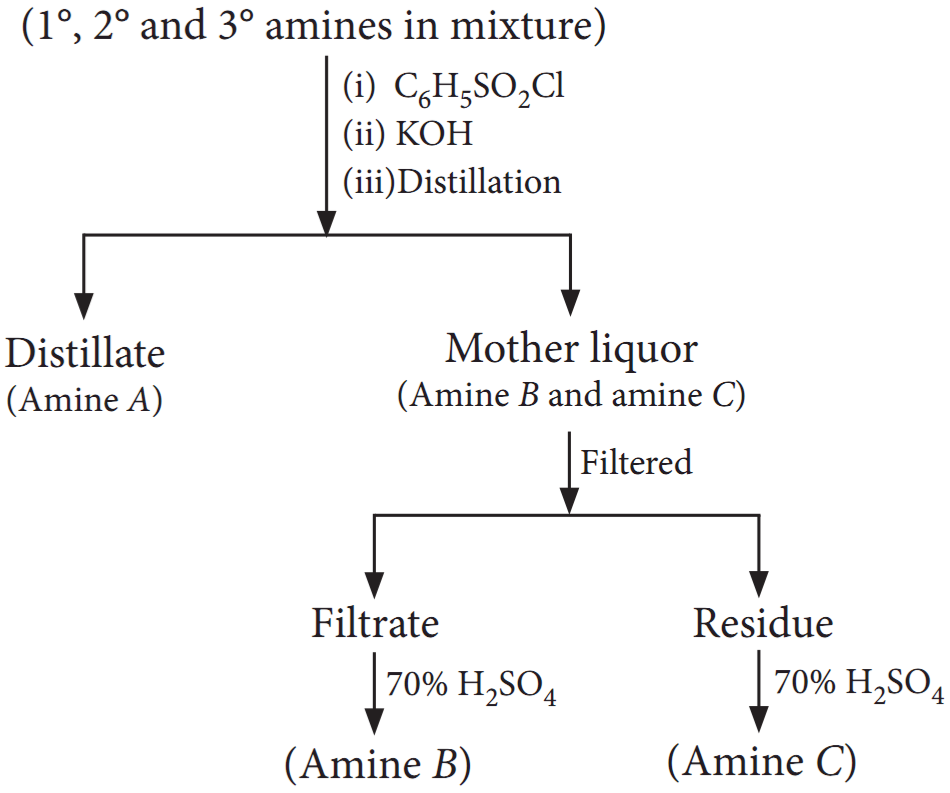
When the mixture contains the three amine salts (1º, 2º and 3º) along with quaternary salt, it is distilled with KOH solution. The three amines distill, leaving the quaternary salt unchanged in the solution. Then the mixture of amines is separated by fractional distillation, Hinsberg's method and Hoffmann's method.

The following questions are multiple choice questions. Choose the most appropriate answer:
  1. Hinsberg reagent is:
  1. Aliphatic sulphonyl chloride.
  2. Phthalamide.
  3. Aromatic sulphonyl chloride.
  4. Anhydrous ZnCl2 + cone. HCI.
  1. Primary amine with Hinsberg's reagent forms:
  1. N-alkyl benzene sulphonamide soluble in KOH solution.
  2. N-alkyl benzene sulphonamide insoluble in KOH solution.
  3. N, N-alkyl benzene sulphonamide soluble in KOH solution.
  4. N, N-alkyl benzene sulphonamide insoluble in KOH solution.
  1. Secondary amine with Hinsberg's reagent forms:
  1. N-alkyl benzene sulphonamide soluble in KOH solution.
  2. N-alkyl benzene sulphonamide insoluble in KOH solution.
  3. N,N-dialkyl benzene sulphonamide soluble in KOH solution.
  4. N,N-dialkyl benzene sulphonamide insoluble in KOH solution.
  1. To separate amines in a mixture Hoffmann's method is used. The Hoffman n's reagent is:
  1. Benzenesulphonyl chloride.
  2. Diethyl oxalate.
  3. Benzeneisocyanide.
  4. P-toulenesulphonic acid.
  1. 3º amines with Hinsberg's reagent give:
  1. No reaction.
  2. Product which is same as that of 1° amine.
  3. Product which is same as that of 2° amine.
  4. Products which is a quaternary salt.
View full solution
A hydrocarbon 'A', $\left(\mathrm{C}_4 \mathrm{H}_8\right)$ on reaction with HCl gives a compound ' B ', $\left(\mathrm{C}_4 \mathrm{H}_9 \mathrm{Cl}\right)$, which on reaction with 1 mol of $\mathrm{NH}_3$ gives compound ' C ', ( $\left.\mathrm{C}_4 \mathrm{H}_{11} \mathrm{~N}\right)$. On reacting with $\mathrm{NaNO}_2$ and HCl followed by treatment with water, compound ' C ' yields an optically active alcohol,'D'. Ozonolysis of 'A' gives 2 mols of acetaldehyde. Identify compounds 'A' to 'D'. Explain the reactions involved.
View full solution
A colourless substance 'A' $(C_6H_7N)$ is sparingly soluble in water and gives a water soluble compound 'B' on treating with mineral acid. On reacting with $CHCl_3$ and alcoholic potash 'A' produces an obnoxious smell due to the formation of compound 'C'. Reaction of 'A' with benzenesulphonyl chloride gives compound 'D' which is soluble in alkali. With $NaNO_2$ and HCl, 'A' forms compound 'E' which reacts with phenol in alkaline medium to give an orange dye 'F'. Identify compounds 'A' to 'F'.
View full solution
A hydrocarbon 'A', $\left(\mathrm{C}_4 \mathrm{H}_8\right)$ on reaction with HCl gives a compound ' B ', $\left(\mathrm{C}_4 \mathrm{H}_9 \mathrm{Cl}\right)$, which on reaction with 1 mol of $\mathrm{NH}_3$ gives compound ' C ', ( $\left.\mathrm{C}_4 \mathrm{H}_{11} \mathrm{~N}\right)$. On reacting with $\mathrm{NaNO}_2$ and HCl followed by treatment with water, compound ' C ' ields an optically active alcohol, 'D'. Ozonolysis of 'A' gives 2 moles of acetaldehyde. Identify the compounds 'A' to 'D'. Explain the reactions involved.
View full solution
$[A], [B], [C], [D], [E], [F]$ and $[G]$ are amines each of which forms a hydrochloride containing $32.42\%$ chlorine. $[A], [B], [C]$ and $[D]$ evolve $N_2$ on reaction with $HNO_2,$ but $[E], [F], [G]$ and $[H]$ do not. Give structures of $[A]$ to $[H]$ with reasons.
View full solution

Generate a Amines paper free

Pick question groups from the list above, set marks and difficulty, and export a branded PDF with step-by-step answer keys. First 3 chapters free — no signup.

Download App