Question
Complete the following table and write one equation for each to justify the statement :
Reactants Products Method
Soluble base + Acid (dil) Salt + water Neutralisation Titration
Metal + Non-metal Salt (soluble/insoluble) ……………
Insoluble base + .......... Salt (soluble) + water …………….
Active metal + Acid (dil) ………… + ………… …………….
Soluble salt solution (A) + Soluble salt solution (B) Precipitated salt + Soluble salt …………….
Carbonate/ bicarbonate + Acid (dil) Salt + ………. + ………… Decomposition of carbonate
Chlorides/nitrates + Acid (conc) …………. + ………… Decomposition of chlorides and nitrates

Answer

Reactants Products Method
Soluble base + Acid (dil) Salt + water Neutralisation Titration
Metal + Non-metal Salt (soluble/insoluble) Direct Combination
Insoluble base + Acid Salt (soluble) + water Neutralisation
Active metal + Acid (dil) Salt + Hydrogen Displacement
Soluble salt solution (A) + Soluble salt solution (B) Precipitated salt + Soluble salt Precipitation
Carbonate /bicarbonate + Acid (dil) Salt + Water+ Carbon dioxide Decomposition of carbonate
Chlorides/nitrates + Acid (conc) Acid salt + $HCl/HNO_3$ Decomposition of chlorides and nitrates

Need a full question paper?

Generate a complete, print-ready paper with questions like this in minutes — across 16+ boards, with answer keys.

Start Generating Free

Similar questions

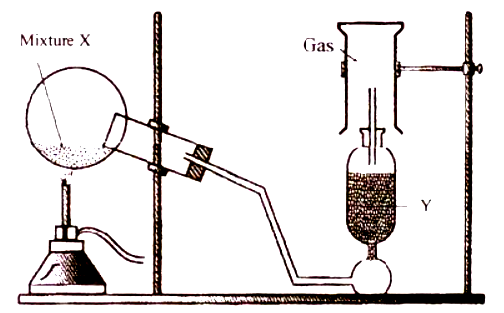
The diagram shows an experimental set-up for the laboratory prepration of a pungent smelling gas. The gas is alkaline in nature.

(i) Nature the gas collected in the jar.(ii) Write the balance equation for the above preparation.(iii) How is the gas being collected?(iv) Name the drying agent used.(v) How will you find that the jar is full of gas?
A gaseous compound of nitrogen and hydrogen contains $12.5\%$ hydrogen by mass. Find the molecular formula of the compound if its relative molecular mass is $37.$
Give the trivial (common) names and IUPAC names of the following:
(a) $C_3H_6$
(b) $C_2H_4$
(c) $C_2H_2$
(d) $CH_3OH$
(e) $C_2H_5OH$
A gas cylinder can hold $1\ \ kg$ of hydrogen at room temperature and pressure.
$(a)$ Find the number of moles of hydrogen present
$(b)$ What weight of $CO_2$ can the cylinder hold under similar conditions of temperature and pressure? $(H = 1 C = 12, O = 16)$
$(c)$ If the number of molecules of hydrogen in the cylinder is $X,$ calculate the number of $CO_2$​​​​​​​ molecules in the cylinder with the same conditions of temperature and pressure.
$(d)$ State the law that helped you to arrive at the above result.
Calculate the volume of air at $\text{STP},$ required to convert $300 \ mL$ of sulphur dioxide to sulphur trioxide. Air contains $21\%$ of oxygen by volume.
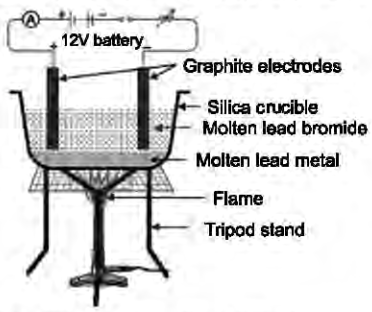
A diagram of the apparatus set up is given below for the electrolysis of fused lead bromide.
Image
(i) Write two properties of silica crucible used in the above apparatus.
(ii) Molten (fused) lead bromide is used as an electrolyte instead of solid lead bromide. Give reason.
(iii) Write the conditions required during the process.
(iv) Write the reactions taking place at the electrodes.
(v) Write the observations during the process.
$10.47\  g$ of a compound contained $6.25\ g$ of metal A and rest non-metal B. Calculate the empirical formula of the compound [At. wt of $A = 207, B = 35.5$]
Give two chemical tests to distinguish between dilute nitric acid and hydrochloric acid.
Describe the Ostwalds process for the manufacture of nitric acid with labeled diagram.
How does Avogadro's law explain Gay $-$ lussac's law of combining volumes?