Question types

Acids, Bases and Salts question types

231 questions across 7 question groups — pick any mix to generate a Chemistry paper with step-by-step answer keys.

231
Questions
7
Question groups
5
Question types
Sample Questions

Acids, Bases and Salts questions

One sample from each question group in this chapter. Select any group above to see the full set with answer keys.

Q 1MCQ1 Mark
Assertion : Tap water conducts electricity but distill water does not conducts electricity.
Reason : Tap water conducts electricity as it contains ions whereas distilled water does not contain ions.
  • Assertion and Reason both are correct statements and reason is the correct explanation of the assertion.
  • B
    Assertion and Reason both are correct statements, but reason is not the correct explanation of the assertion.
  • C
    Assertion is true, but reason is false.
  • D
    Assertion is false, but reason is true.

Answer: A.

View full solution
Q 2MCQ1 Mark
Assertion : Solutions of compounds like alcohol and glucose do not show acidic character.
Reason : They do not show acidic character because they do not dissociate into ions.
  • Assertion and Reason both are correct statements and reason is the correct explanation of the assertion.
  • B
    Assertion and Reason both are correct statements, but reason is not the correct explanation of the assertion.
  • C
    Assertion is true, but reason is false.
  • D
    Assertion is false, but reason is true.

Answer: A.

View full solution
Q 3MCQ1 Mark
What is formed when sodium hydroxide (NaOH) reacts with aluminum in a solution?
  • A
    Aluminum oxide and hydrogen gas
  • Sodium aluminate and hydrogen gas
  • C
    Aluminum chloride and sodium gas
  • D
    Sodium chloride and water

Answer: B.

View full solution
Q 4MCQ1 Mark
What is the result when blue litmus paper is dipped into a solution of potassium hydroxide (KOH)?
  • A
    The paper turns red.
  • B
    The paper turns purple.
  • The paper remains blue.
  • D
    The paper turns white.

Answer: C.

View full solution
Q 5MCQ1 Mark
Which ion is responsible for the acidity of aqueous solutions?
  • A
    Hydroxide ion $\left( OH ^{-}\right)$
  • B
    Sodium ion $\left( Na ^{+}\right)$
  • Hydronium ion $\left( H _3 O ^{+}\right)$
  • D
    Chloride ion $\left( Cl ^{-}\right)$

Answer: C.

View full solution
The preparation of Lead sulphate from Lead carbonate is a two-step process. (Lead sulphate cannot be prepared by adding dilute Sulphuric acid to Lead carbonate.)
Why is the direct addition of dilute sulphuric acid to Lead carbonate an impractical method of preparing Lead sulphate?
View full solution
(a) What are the terms defined by the following?
(i) A salt containing a metal ion surrounded by other ions or molecules.
(ii) A base which is soluble in water.
(b) Making use only of substances chosen from those given below:
Dilute sulphuric acidSodium Carbonate
Zinc Sodium sulphite
Lead Calcium carbonate
Give equations for the reactions by which you could obtain :
(i) Hydrogen
(ii) Sulphur dioxide
(iii) Carbon dioxide
(iv) Zinc carbonate (two steps required)
View full solution
The preparation of Lead sulphate from Lead carbonate is a two-step process. (Lead sulphate cannot be prepared by adding dilute Sulphuric acid to Lead carbonate.)
Write the equation for the reaction that will take place when this first step is carried out.
View full solution
The preparation of Lead sulphate from Lead carbonate is a two-step process. (Lead sulphate cannot be prepared by adding dilute Sulphuric acid to Lead carbonate.)
What is the first step that is required to prepare Lead sulphate from Lead carbonate?
View full solution
Write a balanced reaction for the following conversions $(A, B, C, D)$ $Fe \xrightarrow{\Delta} FeCl _2 \xrightarrow{ B } FeCO _3 \xrightarrow{ C } Fe \left( NO _3\right)_2 \xrightarrow{ D } Fe ( OH )_2$
View full solution
Fill in the blanks with suitable words : An acid is a compound which when dissolved in water forms hydronium ions as the only …………… ions.
A base is a compound which is soluble in water and contains …………….. ions.
A base reacts with an acid to form a …………….. and water only. This type of reaction is known as …………….
View full solution
Complete the following table and write one equation for each to justify the statement :
Reactants Products Method
Soluble base + Acid (dil) Salt + water Neutralisation Titration
Metal + Non-metal Salt (soluble/insoluble) ……………
Insoluble base + .......... Salt (soluble) + water …………….
Active metal + Acid (dil) ………… + ………… …………….
Soluble salt solution (A) + Soluble salt solution (B) Precipitated salt + Soluble salt …………….
Carbonate/ bicarbonate + Acid (dil) Salt + ………. + ………… Decomposition of carbonate
Chlorides/nitrates + Acid (conc) …………. + ………… Decomposition of chlorides and nitrates
View full solution
Which of the following methods, (a), (b), (c), (d) or (e) is generally used for preparing the chlorides listed below from (i) to (v). Answer by writing down the chloride and the letter pertaining to the corresponding method. Each letter is to be used only once.
(a) Action of an acid on a metal.
(b) Action of an acid on an oxide or carbonate.
(c) Direct combination.
(d) Neutralization of an alkali by an acid.
(e) Precipitation (double decomposition).
(i) copper(II) chloride.
(ii) iron(II) chloride.
(iii) iron(IIl) chloride.
(iv) lead (II) chloride.
(v) sodium chloride.
View full solution
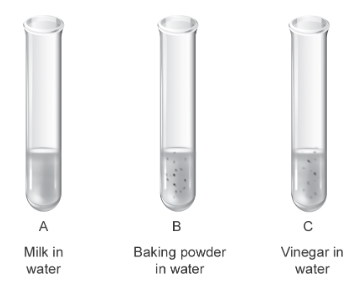
Given below in column A are different solutions in test tubes, which is checked using litmus paper. Identify the solutions labelled as A, B and C with the correct options from the column B.
Column AColumn B
Image(1) No change in colour of litmus paper
(2) Litmus paper turns to blue
(3) Litmus paper turns to red
(4) Litmus paper turns to green
View full solution
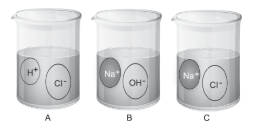
Given below in column A is combination of elements. Identify the elements labelled as A, B and C with the correct options from the column B.
Column AColumn B
Image(1) Base
(2) Salt
(3) Acid
(4) Water
View full solution
Column AColumn B
(1) Acid salt(a) Sodium potassium carbonate
(2) Mixed salt(b) Alum
(3) Complex salt(c) Sodium carbonate
(4) Double salt(d) Sodium zincate
 (e) Sodium hydrogen carbonate
View full solution
Column AColumn B
(1) Acid Salt(a) Ferrous ammonium sulphate
(2) Double Salt(b) Contains only ions
(3) Ammonium hydroxide solution(c) Sodium hydrogen sulphate
(4) Dilute hydrochloric(d) Contains only molecules
 (e) Contains ions and molecules
View full solution

Generate a Acids, Bases and Salts paper free

Pick question groups from the list above, set marks and difficulty, and export a branded PDF with step-by-step answer keys. First 3 chapters free — no signup.

Download App