Question

Complete the following table and write your observations.

Hydrogen sulphide Ammonia Sulphur dioxide Hydrogen chloride
Shake the gas with red litmus solution
Shake the gas with blue litmus solution
Apply a burning splint to a gas

Answer

Hydrogen sulphide Ammonia Sulphur dioxide Hydrogen chloride
Shake the gas with red litmus solution No change in the colour of litmus solution Red litmus solution becomes blue in colour. No change in the colour of litmus solution No change in the colour of litmus solution
Shake the gas with blue litmus solution Blue litmus solution becomes red in colour. No change in the colour of blue litmus solution. Blue litmus solution becomes red in colour. Blue litmus solution becomes red in colour
Apply a burning splint to a gas No reaction. No reaction. No reaction. No reaction.

Need a full question paper?

Generate a complete, print-ready paper with questions like this in minutes — across 16+ boards, with answer keys.
Start Generating Free

Similar questions

Explain the term $: Mole$
Taking $MgCI_2$ as an electrovalent compound, $CCI_4$ as a covalent compound, give four differences between electrovalent and covalent compounds.
Answer the following question :
Write the chemical formulae of main ore iron and aluminum.
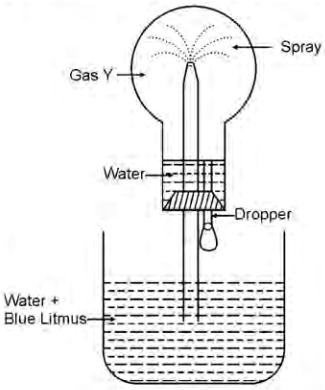
Study the figure given alongside and answer the questions that follow :
Image
(i) Name the experiment illustrated here.
(ii) Identify the gas Y.
(iii) What property of gas Y demonstrated by this experiment?
(iv) Explain the observations of the experiment.
The volume of gases $A, B, C$, and $D$ are in the ratio, $1: 2: 2: 4$ under the same conditions of temperature and pressure.
(i) Which sample of gas contains the maximum number of molecules?
(ii) If the temperature and pressure of gas A are kept constant, then what will happen to the volume of $A$ when the number of molecules is doubled?
(iii)If this ratio of gas volume refers to the reactants and products of a reaction, which gas law is being observed?
(iv)If the volume of A is actually $5.6 dm ^3$ at S.T.P., calculate the number of molecules in the actual Volume of D at S.T.P. (Avogadro's number is $6 \times 10^{23}$ ).
(v) Using your answer from (iv), state the mass of $D$ if the gas is dinitrogen oxide $\left( N _2 O \right)$

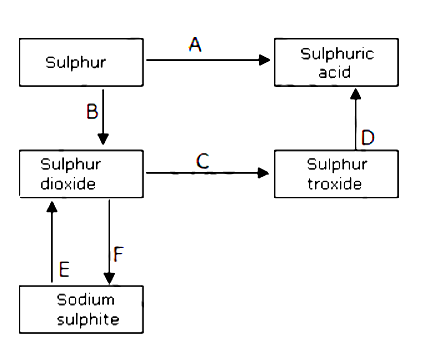
(i) Name the catalyst which helps in the conversion of sulphur dioxide to sulphur trioxide in step $C.$
(ii) In the contact process for the manufacture of sulphuric acid, sulphur trioxide is not converted to sulphuric acid by reacting it with water. Instead a two-step procedure is used. Write the equations for the two steps involved in $D.$
(iii) What type of substance will liberate sulphur dioxide from sodium sulphite in step $E?$​​​​​​​
(iv) Write the equation for the reaction by which sulphur dioxide is converted to sodium sulphite in step $F ?$
Why is ammonium hydroxide used in qualitative analysis? Give two equations to justify your answer.
$112 cm^3$ of $H_2S(g)$ is mixed with $120 cm^3$ of $Cl_2(g)$ at STP to produce $HCl(g)$ and sulphur(s). Write a balanced equation for this reaction and calculate (i) the volume of gaseous product formed (ii) composition of the resulting mixture.
A gaseous hydrocarbon contains $82.76\%$ of carbon. Given that its vapour density is $29$, find its molecular formula.
Propane burns in air according to the following equation :
$C_3H_{8 }+ 5O_{2 }\rightarrow 3CO_2 + 4H_2O$
What volume of propane is consumed on using $1000 \ cm^3$ of air, considering only $20\%$ of air contains oxygen?