Question
Taking $MgCI_2$ as an electrovalent compound, $CCI_4$ as a covalent compound, give four differences between electrovalent and covalent compounds.

Answer

Electrovalent Compounds Covalent compounds
They are made up of ions; $Mg^{2+}$ and $Cl^-$ They are made up of molecules; $1$carbon and $4$ chlorine atoms form a molecule of $CCl_4$.
They are made up of ions;$ Mg^{2+}$ and $Cl^-$​​​​​​​ They are generally gases or liquids under ordinary conditions; $CCl_4$​​​​​​​ is a liquid.
They have high m.p. and b.p. Their m.p. and b.p. are low.
They are easily soluble in water but insoluble in organic solvents, such as benzene, chloroform, etc. They are insoluble in water but are usually soluble in organic solvents, such as benzene, chloroform, etc.

Need a full question paper?

Generate a complete, print-ready paper with questions like this in minutes — across 16+ boards, with answer keys.
Start Generating Free

Similar questions

Give one use each of four different compounds of ammonia.
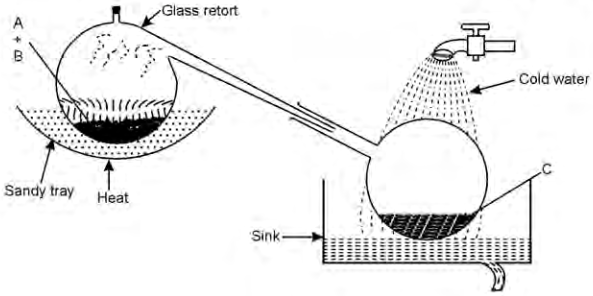
The figure given below illustrates the apparatus used in the laboratory preparation of nitric acid.
Image
(i) Name A (a liquid), B (a solid) and C (a liquid).
(ii) Write an equation to show how nitric acid undergoes decomposition.
(iii) Write the equation for the reaction in which copper is oxidised by concentrated nitric acid.
The empirical formula of a compound is $C_2H_5$. Its vapour density is $29$. Determine the relative molecular mass of the compound and hence its molecular formula.
Write the difference between with examples:
A strong electrolyte and a weak electrolyte
X is an element in the form of a powder. X burns in oxygen and the product is soluble in water. The solution is tested with litmus. Write down only the word which will correctly complete each of the following sentences:
(a) If X is a metal, then the litmus will turn ______.
(b) If X is a non-metal, then the litmus will turn ______.
(c) If X is a reactive metal, then ______ will be evolved, when X reacts with dilute sulphuric acid.
(d) If X is a non -metal, it will form _ oxide, which will form ______ solution with water.
(e) If X is a non -metal, it will not conduct electricity unless it is carbon in the form of ______.
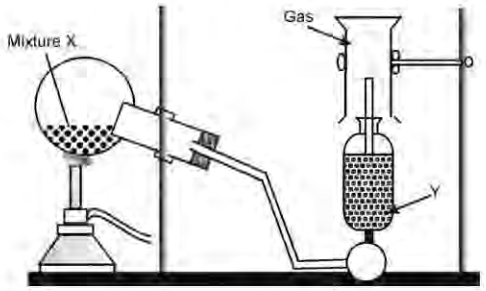
The diagram shows an experimental set-up for the laboratory preparation of a pungent smelling gas. The gas is alkaline in nature.
Image
(i) Name the gas collected in the jar.
(ii) Identify mixture X with ratio and compound Y.
(iii) Write the balanced equation for the above preparation.
(iv) How is the gas being collected?
(a) Give only one suitable chemical test to identify the following gases.
(i)Ammonia
(ii) Sulphur dioxide
(iii)Hydrogen Chloride
(iv)Chlorine
(v)Carbon Dioxide
(vi)Oxygen
(vii)Hydrogen
(b) Select a basic gas mentioned in Q. 1 (a). How is the basic nature suspected?
(c) Select acidic gases from the gases mentioned in Q .1 (a). How is the acidic nature suspected?
(d) The two gases $A$ and $B$ are bleaching agents. $A$ is greenish-yellow and bleaches due to its oxidizing property while $B$ is a colourless gas that bleaches due to reduction. Identify $A$ and $B$ ?
(e) Which gas turn blue cobalt chloride paper light pink?
Give one similarity in the test between (i) $Cl _2$ and HCl (ii) $SO _2$ and $CO _2$.
Water decomposes to $O _2$ and $H _2$ under suitable conditions as represented by the equation below:
$2 H _2 O \rightarrow 2 H _2+ O _2$
(a) If $2500 cm ^3$ of $H _2$ is produced, what volume of $O _2$ is liberated at the same time and under the same conditions of temperature and pressure?
(b) The $2500 cm ^3$ of $H _2$ is subjected to $2$ times an increase in pressure (temp. remaining constant). What volume of $H _2$ will now occupy?
(c) Taking the value of $H _2$ calculated in $5$(b), what changes must be made in Kelvin (absolute) temperature to return the volume to $2500 cm ^3$ pressure remaining constant.
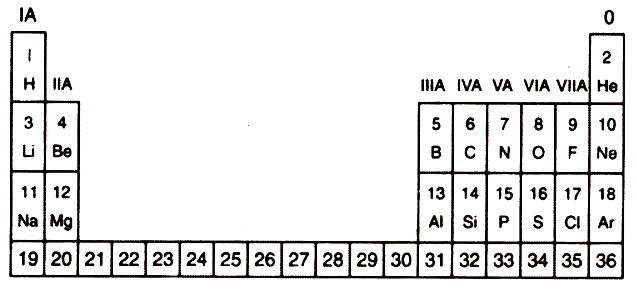
The following table represents the first period of the modern periodic table. Study the table and answer the questions that follow:

(i) Write the formula of the sulphate of the element with atomic number 13.
(ii) What type of bonding will be present in the oxide of the element with atomic number 1?
(iii) Which feature of the atomic structure accounts for the similarities in the chemical properties of the elements in group VIIA of the periodic table?
(iv) Name the element which has the highest ionization potential.
(v) How many electrons are present in the valence shell of the element with atomic number 18?
(vi) What is the name given to the energy released, when an atom in its isolated gaseous state accepts an electron to form an anion?
(vii) What is the electronic configuration of the element in the third period which gains one electron to become an anion?
(viii) Fill in the blanks:
The atomic size ______ as we move from left to right across the period, because the ______ increases, but the ______ remains the same.
An organic compound has the following percentage composition $: C = 12.76\%, H = 2.13\%, Br = 85.11\%$. The vapour density of the compound is $94.$ Find out its molecular formula.