Question
Complete the following table:
Car Model
Driver X
Reaction time 0.20s
Driver Y
Reaction time 0.30s
A (deceleration on hard braking = 6.0m/s2)
Speed = 54km/h
Braking distance
a = ...
Total stopping distance
b = ...
Speed = 72km/h
Braking distance
c = ...
Total stopping distance
d = ...
B (deceleration on hard braking = 7.5m/s2)
Speed = 54km/h
Breaking distance
e = ...
Total stopping distance
f = ...
Speed 72km/h
Braking distance
g = ...
Total stopping distance
h = ...

Answer

Car Model
Driver X
Reaction time 0.25s
Driver Y
Reaction time 0.35s
A (deceleration on hard braking = 6.0m/s2)
Speed = 54km/h
Braking distance
a = 19m
Total stopping distance
b = 22m
Speed = 72km/h
Braking distance
c = 33m
Total stopping distance
d = 39m
B (deceleration on hard braking = 7.5m/s2)
Speed = 54km/h
Breaking distance
e = 15m
Total stopping distance
f = 18m
Speed 72km/h
Braking distance
g = 27m
Total stopping distance
h = 33m

$\text{a}=\frac{0^2-15^2}{2(-6)}=19\text{m}$

So, b = 0.2 × 15 + 19 = 33m

Similarly other can be calculated.

Braking distance: Distance travelled when brakes are applied.

Total stopping distance = Braking distance + distance travelled in reaction time.

Need a full question paper?

Generate a complete, print-ready paper with questions like this in minutes — across 16+ boards, with answer keys.

Start Generating Free

Similar questions

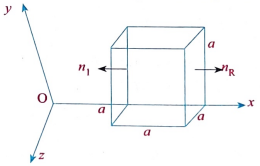
The electric field components in figure are
Image

$E _x=a x^{\frac{1}{2}}, E _y=0, E _z=0$ in which $a =800 NC ^{-1} m^{-\frac{1}{2}}$. Calculate
(a) The flux through the cube.
(b) The charge within the cube.
Assume $a=0.1 m$.
The radio and TV programmes, telecast at the studio, reach our antenna by wave motion. Is it a mechanical wave or nonmechanical?
Professor C.V Raman surprised his students by suspending freely a tiny light ball in a transparent vacuum chamber by shining a laser beam on it. Which property of EM waves was he exhibiting? Give one more example of this property.

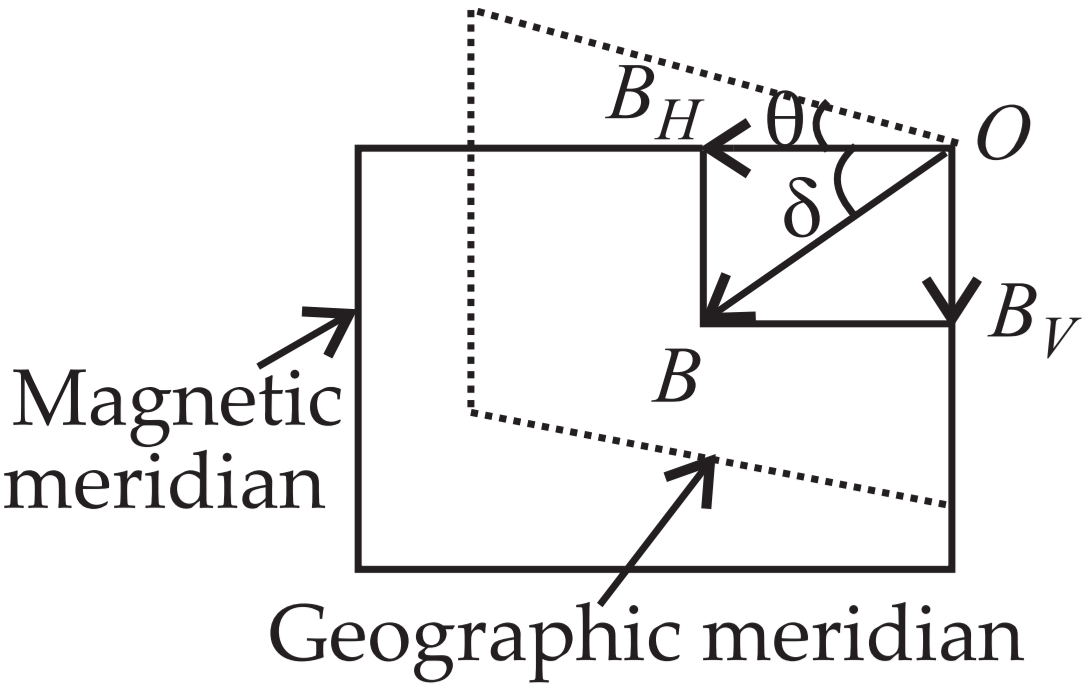
'Tile earth's magnetic field at a point on its surface is usually characterised by three quantities: (a) declination (bl inclination or dip and (cl horizontal component of the field. These are known as the elements of the earth's magnetic field. At a place, angle between geographic meridian and magnetic meridian is defined as magnetic declination, whereas angle made by the earth's magnetic field with the horizontal in magnetic meridian is known as magnetic dip.

  1. In a certain place, the horizontal component of magnetic field is $\frac{1}{\sqrt{3}}$ times the vertical component. 'Tile angle of dip at this place is:
  1. $\text{Zero}$

  2. $\frac{\pi}{3}$

  3. $\frac{\pi}{2}$

  4. $\frac{\pi}{6}$

  1. The angle between the true geographic north and the north shown by a compass needle is called as:
  1. Inclination.
  2. Magnetic declination.
  3. Angle of meridian.
  4. Magnetic pole.
  1. Tile angles of dip at the poles and the equator respectively are
  1. 30º, 30º
  2. 0º, 90º
  3. 45º, 90º
  4. 90º, 0º 
  1. A compass needle which is allowed to move in a horizontal plane is taken to a geomagnetic pole. It
  1. Will become rigid showing no movement.
  2. Will stay in any position.
  3. Will stay in north-south direction only.
  4. Will stay in east-west direction only. 
  1. Select the correct statement from the following.
  1. The magnetic dip is zero at the centre of the earth.
  2. Magnetic dip decreases as we move away from the equator towards the magnetic pole.
  3. Magnetic dip increases as we move away from the equator towards the magnetic pole.
  4. Magnetic dip does not vary from place to place. 
The electron mobility characterises how quickly an electron can move through a metal of semiconductor when pulled by an electric field. There is an analogous quality for holes, called hole mobility. A block of pure silicon at 300K has a length of 10cm and an area of 1.0cm2. A battery of emf 2V is connected across it. The mobility of electron is 0.14m2 V-1s-1 and their number density is 1.5 × 1016m-3. The mobility of holes is 0.05m2 V-1s-1.
  1. The electron current is:
  1. 6.72 × 10-4A
  2. 6.72 × 10-5A
  3. 6.72 × 10-6A
  4. 6.72 × 10⁻⁷A
  1. The hole current is:
  1. 2.0 × 10-7A
  2. 2.2 × 10-7A
  3. 2.4 × 10-7A
  4. 2.6 × 10-7A
  1. The number density of donor atoms which are to be added up to pure silicon semiconductor to produce an n-type semiconductor of conductivity $6.4\Omega^{-1}\text{cm}^{-1}$ is approximately (neglect the contribution of holes to conductivity).
  1. 3 × 1022m-3
  2. 3 × 1023m-3
  3. 3 × 1024m-3
  4. 3 × 1021m-3
  1. When the given silicon semiconductor is doped with indium, the hole concentration increases to 4.5 × 1023m-3. The electron concentration in doped silicon is:
  1. 3 × 109m-3
  2. 4 × 109m-3
  3. 5 × 109m-3
  4. 6 × 109m-3
  1. Pick out the statement which is not correct.
  1. At a low temperature, the resistance of a semiconductor is very high.
  2. Movement of holes is restricted to the valence band only.
  3. Width of the depletion region increases as the forward bias voltage increases in case of a p-n junction diode.
  4. ln a forward bias condition, the diode heavily conducts.
How long can an electric lamp of 100 W be kept glowing by fusion of 2.0 kg of deuterium? Take the fusion reaction as
\[{ }_1^2 H+{ }_1^2 H \longrightarrow{ }_2^3 He+n+3.27 MeV\]
A long bar magnet has a pole strength of 10A-m. Find the magnetic field at a point on the axis of the magnet at a distance of 5cm from the north pole of the magnet.
Explain the reverse blas characteristics of $p-n$ junction diode with proper graph.
Hydrogen spectrum consists of discrete bright lines in a dark background, and it is specifically known as hydrogen emission spectrum. There is one more type of hydrogen spectrum that exists where we get dark lines on the bright background, it is known as absorption spectrum. Balmer found an empirical formula by the observation of a small part of this spectrum, and it is represented by $\frac{1}{\lambda}=\text{R}\bigg(\frac{1}{2^2}-\frac{1}{\text{n}^2}\bigg)$ where n = 3, 4, 5 For Lyman series, the emission is from first state to nth state, for Paschen series, it is from third state to nth state, for Brackett series, it is from fourth state to nth state and for Pfund series, it is from fifth state to nth state.
  1. Number of spectral lines in hydrogen atom is:
  1. 8
  2. 6
  3. 15
  4. $\infty$
  1. Which series of hydrogen spectrum corresponds to ultraviolet region?
  1. Balmer series.
  2. Brackett series.
  3. Paschen series.
  4. Lyman series.
  1. Which of the following lines of the H-atom spectrum belongs to the Balmer series?
  1. 1025A
  2. 1218A
  3. 4861A
  4. 18751A
  1. Rydberg constant is.
  1. A universal constant.
  2. A universal constants.
  3. Different for different elements.
  4. None of these.
  1. Hydrogen atom is excited from ground state to another state with principal quantum number equal to 4. Then the number of spectral lines in the emission spectra will be.
  1. 3
  2. 5
  3. 6
  4. 2
A magnetic needle is free to rotate in a vertical plane which makes an angle of 60° with the magnetic meridian. If the needle stays in a direction making an angle of $\tan^{-1}\Big(\frac{2}{\sqrt{3}}\Big)$ with the horizontal, what would be the dip at that place?