Question
Complete the following table:
Car Model
Driver X
Reaction time 0.20s
Driver Y
Reaction time 0.30s
A (deceleration on hard braking = $6.0m/s^2$)
Speed = 54km/h
Braking distance
a = ...
Total stopping distance
b = ...
Speed = 72km/h
Braking distance
c = ...
Total stopping distance
d = ...
B (deceleration on hard braking = $7.5m/s^2$)
Speed = 54km/h
Breaking distance
e = ...
Total stopping distance
f = ...
Speed 72km/h
Braking distance
g = ...
Total stopping distance
h = ...

Answer

Car Model
Driver X
Reaction time 0.25s
Driver Y
Reaction time 0.35s
A (deceleration on hard braking = $6.0m/s^2$)
Speed = 54km/h
Braking distance
a = 19m
Total stopping distance
b = 22m
Speed = 72km/h
Braking distance
c = 33m
Total stopping distance
d = 39m
B (deceleration on hard braking = $7.5m/s^2$)
Speed = 54km/h
Breaking distance
e = 15m
Total stopping distance
f = 18m
Speed 72km/h
Braking distance
g = 27m
Total stopping distance
h = 33m
$\text{a}=\frac{0^2-15^2}{2(-6)}=19\text{m}$
So, b = 0.2 × 15 + 19 = 33m
Similarly other can be calculated.
Braking distance: Distance travelled when brakes are applied.
Total stopping distance = Braking distance + distance travelled in reaction time.

Need a full question paper?

Generate a complete, print-ready paper with questions like this in minutes — across 16+ boards, with answer keys.

Start Generating Free

Similar questions

A metal rod is placed along the axis of a solenoid carrying a high-freqμency alternating current. It is found that the rod gets heated. Explain why the rod gets heated.
A car starts from rest on a half kilometer long bridge. The coefficient of friction between the tyre and the road is $1.0$. Show that one cannot drive through the bridge in less than $10s$.
Read the passage given below and answer the following questions from 1 to 5. The product of force and time which is the change in momentum of the body remains a measurable quantity. This product is called impulse Impulse = Force × time duration = Change in momentum Large force acting for a short time to produce a finite change in momentum is called an impulsive force. The third law of motion states that when one object exerts a force on another object, the second object instantaneously exerts a force back on the first. These two forces are always equal in magnitude but opposite in direction. These forces act on different objects and never on the same object. The two opposing forces are also known as action and reaction forces. Answer the following questions. The second and third laws of motion lead to an important consequence: the law of conservation of momentum. Take a familiar example. A bullet is fired from a gun. If the force on the bullet by the gun is F, the force on the gun by the bullet is – F, according to the third law. The two forces act for a common interval of time $\triangle\text{t}$ According to the second law,$\text{F}\triangle\text{t}$ is the change in momentum of the bullet and $-\text{F}\triangle\text{t}$ is the change in momentum of the gun. Since initially, both are at rest, the change in momentum equals the final momentum for each. Thus if pb is the momentum of the bullet after firing and pg is the recoil momentum of the gun, pg = – pb i.e. pb + pg = 0 That is, the total momentum of the (bullet + gun) system is conserved. Thus in an isolated system (i.e. a system with no external force), mutual forces between pairs of particles in the system can cause momentum change in individual particles, but since the mutual forces for each pair are equal and opposite, the momentum changes cancel in pairs and the total momentum remains unchanged. This fact is known as the law of conservation of momentum. The total momentum of an isolated system of interacting particles is conserved.
  1. Action reaction forces acts on bodies in order that:
  1. Action acts first then reaction force comes.
  2. Reaction acts first then action force comes.
  3. Both action reaction act at same time.
  4. None of the above.
  1. Which of the following is correct about action reaction forces?
  1. They act on different objects.
  2. They are equal in magnitude and opposite in direction.
  3. Both forces acted on different object simultaneously
  4. All the above.
  1. State Newton’s third law of motion.
  1. Define impulse. Give its formula.
  1. State law of conservation of momentum.
Read the passage given below and answer the following questions from 1 to 5. The gravitational potential energy of an object at a point above the ground is defined as the work done in raising it from the ground by height h to that point against gravity. Let the work done on the object against gravity be W. That is, work done, W = force × displacement = mg × h Therefore potential energy (PE) = mg*h. The dimensions of potential energy are $[ML^2T^{-2}]$ and the unit is joule (J), the same as kinetic energy or work. To reiterate, the change in potential energy, for a conservative force, $\triangle\text{V}$ is equal to the negative of the work done by the force $\triangle\text{v}=−\text{F}(\text{x})\triangle\text{x}.$ Conservation of mechanical energy: Suppose that a body undergoes displacement $\triangle\text{x}$ under the action of a conservative force F. Then from the WE theorem we have, $ \triangle\text{K}=\text{F}(\text{x})\triangle\text{x}$ If the force is conservative, the potential energy function V(x) can be defined such that $-\triangle\text{V}=\text{F}(\text{x})\triangle\text{x}$ The above equations imply that $\triangle\text{K}+\triangle\text{V}=0$ or $\triangle(\text{K}+\text{V})=0.$ Which means that K + V, the sum of the kinetic and potential energies of the body is a constant? Over the whole path, $x_i$ to $x_f$, this means that $K_i + V(x_i ) = Kf + V(x_f )$. The quantity K +V(x), is called the total mechanical energy of the system. Individually the kinetic energy K and the potential energy V(x) may vary from point to point, but the sum is a constant. The aptness of the term ‘conservative force’ is now clear. Let us consider some of the definitions of a conservative force.
  • A force F(x) is conservative if it can be derived from a scalar quantity V(x).
  • The work done by the conservative force depends only on the end points. This can be seen from the relation, W = Kf – Ki = V (xi ) – V(xf ) which depends on the end points.
  • A third definition states that the work done by this force in a closed path is zero. This is once again apparent since xi = xf .
Thus, the principle of conservation of total mechanical energy can be stated as the total mechanical energy of a system is conserved if the forces, doing work on it, are conservative.
  1. Dimensions of potential energy is given by:
  1. $[ML^2T^{-2}]$
  2. $[M^2 L^2T^{-2}]$
  3. $[ML^3T^{-3}]$
  4. None of the above
  1. SI unit of potential energy is:
  1. Joule(J)
  2. Newton meter(N-m)
  3. Both a and b
  4. None of these
  1. Define the gravitational potential energy.
  1. Define conservative force.
  1. State conservation of mechanical energy.
Read the passage given below and answer the following questions from 1 to 5. Newton’s first law of motion states that If the net external force on a body is zero, its acceleration is zero. Acceleration can be non zero only if there is a net external force on the body. To summaries, if the net external force is zero, a body at rest continues to remain at rest and a body in motion continues to move with a uniform velocity. This property of the body is called inertia. Inertia means ‘resistance to change’. A body does not change its state of rest or uniform motion, unless an external force compels it to change that state. In other words, all objects resist a change in their state of motion. In a qualitative way, the tendency of undisturbed objects to stay at rest or to keep moving with the same velocity is called inertia. Consider a book at rest on a horizontal surface. It is subject to two external forces: the force due to gravity (i.e. its weight W) acting downward and the upward force on the book by the table, the normal force R. R is a self-adjusting force. This is an example of the kind of situation mentioned above. The forces are not quite known fully but the state of motion is known. We observe the book to be at rest. Therefore, we conclude from the first law that the magnitude of R equals that of W. A statement often encountered is : Since W = R, forces cancel and, therefore, the book is at rest”. This is incorrect reasoning. The correct statement is: “Since the book is observed to be at rest, the net external force on it must be zero, according to the first law. This implies that the normal force R must be equal and opposite to the weight W.
  1. The book on table is at rest. The force of gravity here is balanced by:
  1. Force of friction.
  2. Normal reaction by table on book.
  3. Weight of table.
  4. None of these.
  1. If no external force acts on object which is at rest. it will
  1. Remain at rest.
  2. Start to move.
  3. Both a and b can possible.
  4. None of these.
  1. Define inertia.
  1. State Newton’s first law of motion.
  1. Explain why book on table remains at rest.
Read the passage given below and answer the following questions from (i) to (v). Motion in a Straight Line If the position of an object is continuously changing w.r.t. its surrounding, then it is said to be in the state of motion. Thus, motion can be defined as a change in position of an object with time. It is common to everything in the universe. In the given figure, let P, Q and R represent the position of a car at different instants of time.
  1. With reference to the given figure, the position coordinates of points P and R are:
  1. $P = (+ 360,0,0); R = (-120,0,0)$
  2. $P = (-360,0,0); R = (+120,0,0)$
  3. $P = (0, + 360,0); R = (-120,0,0)$
  4. $P = (0,0, + 360); R = (0,0 -120)$
  1. Displacement of an object can be:
  1. Positive
  2. Negative
  3. Zero
  4. All of the above
  1. The displacement of a car in moving from O to P and its displacement in moving from P to Q are:
  1. $+ 360m and -120m$
  2. $-120m and + 360m$
  3. $+ 360m and + 120m$
  4. $+ 360m and - 600m$
  1. If the car goes from O to P and returns back to O, the displacement of the journey is:
  1. zero
  2. $720m$
  3. $420m$
  4. $340m$
  1. The path length of journey from O to P and back to O is:
  1. $0m$
  2. $720m$
  3. $360m$
  4. $480m$
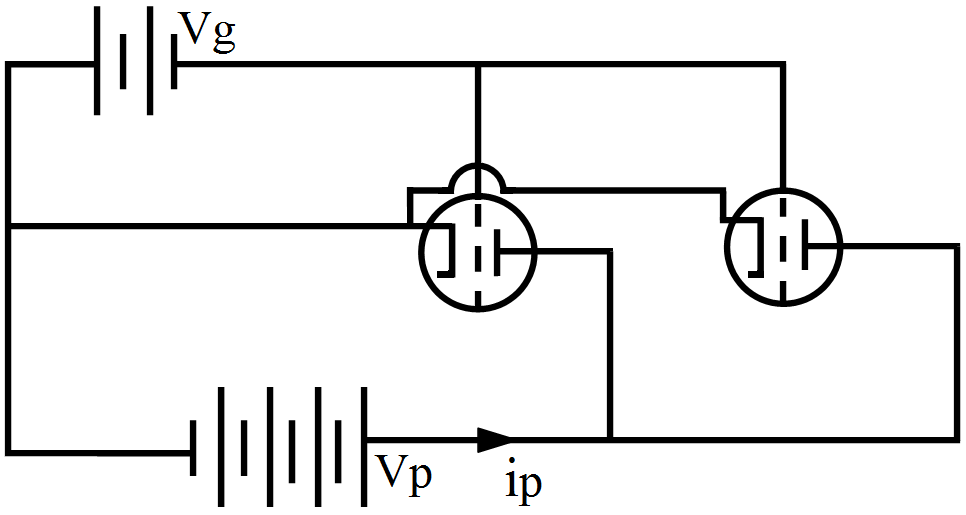
The figure shows two identical triode tubes connected in parallel. The anodes are connected together and the cathodes are connected together. Show that the equivalent plate resistance is half the individual plate resistance, the equivalent mutual conductance is double the

individual mutual conductance and the equivalent amplification factor is the same as the individual amplification factor.
The plate current in a triode can be written as $\text{i}_\text{p}=\text{k}\Big(\text{V}_\text{g}+\frac{\text{V}_\text{p}}{\mu}\Big)^{\frac{3}{2}}$ Show that the mutual conductance is proportional to the cube root of the plate current.
A simple pendulum fixed in a car has a time period of 4 seconds when the car is moving uniformly on a horizontal road. When the accelerator is pressed, the time period changes to 3.99 seconds. Making an approximate analysis, find the acceleration of the car.
Read the passage given below and answer the following questions from 1 to 5. If A is vector given by $A = Ax\ i + Ay\j$ where The quantities $A_x$ and $A_y$ are called x, and y- components of the vector A. Note that Ax is itself not a vector, but $A_x$ i is a vector, and so is $A_y\ j$. Using simple trigonometry, we can express $A_x$ and $A_y$ in terms of the magnitude of A and the angle \theta it makes with the x-axis. $\text{Ax} = \text{A} \cos(\theta)$
$\text{Ay} = \text{A} \text{ \sin}(\theta)$ If A and $\theta$ are given, Ax and Ay can be obtained using If Ax and Ay are given, A and $\theta$ can be obtained as follows – $\text{A}^2_\text{x}+\text{A}^2_\text{y}=(\text{A}\cos\theta)^2+(\text{A}\sin\theta)^2$ $\text{A}^2_\text{x}+\text{A}^2_\text{y}=\text{A}^2\cos^2\theta+\text{A}^2\sin^2\theta$ $\Rightarrow\text{A}^2_\text{x}+\text{A}^2_\text{y}=\text{A}^2(\cos^2\theta+\sin^2\theta)$ ${A}^2_\text{x}+\text{A}^2_\text{y}=\text{A}^2(\because\sin^2\theta+\cos^2\theta=1)$ $\text{A}^2=\text{A}^2_\text{y}+\text{A}^2_\text{y}$ $\Rightarrow\text{A}=\sqrt{\text{A}^2_\text{x}+\text{A}^2_\text{y }}...$ $\text{Dividing}\text{ A}_\text{y}\text{ by} \text{ A}_\text{y},\text{we get}$ $\frac{\text{A}_\text{y}}{\text{A}_\text{x}}=\frac{\text{A}\sin\theta}{\text{A}\cos\theta}$ $\Rightarrow\frac{\text{A}_\text{y}}{\text{A}_\text{x}}=\tan\theta$ $\tan\theta=\frac{\text{A}_\text{y}}{\text{A}_\text{x}}$ $\theta=\tan^{-1}\Big[\frac{\text{A}_\text{y}}{\text{A}_\text{x}}\Big]$
Position vector-The position vector r of a particle P located in a plane with reference to the origin of an x-y reference frame is given by $r = x i + y j$ where x and y are components of r along x-, and y- axes or simply they are the coordinates of the object. Suppose a particle moves along the Then, the displacement is: $\triangle r = r_2-r_1.$ We can write this in a component form: $\triangle r = (x’ i + y’ j) – ( x i + y j) = i\triangle x – j\triangle y$ Where $\triangle x = x’ – x, \triangle y = y – y.$
The average velocity (v) of an object is the ratio of the displacement and the corresponding time Interval. $\text{V}=\frac{\triangle\text{r}}{\triangle\text{t}}$
$=\frac{\text{i}\triangle\text{x}-\text{j}\triangle\text{y}}{\triangle\text{t}}$
$=\text{i}\times\frac{\triangle\text{x}}{\triangle\text{t}}+\text{j}\times\frac{\triangle\text{y}}{\triangle\text{t}}$
$=\text{V}_\text{x}\text{i}+\text{V}_\text{y}\text{j}$ So, if the expressions for the coordinates x and y are known as functions of time, we can use these equations to find vx and vy. The magnitude of v is then $V = ( v_x^2+ v_y^2)$ and the direction of v is given by the angle q and given by $\tan(\theta)=\frac{\text{vx}}{\text{vy}}$
  1. If A is vector given by A = Ax i + Ay j .if the magnitude of vector is A and the angle $\theta$ it makes with the x-axis Ax can be given by:
  1. Ax = A cos(q)
  2. Ax = A sin(q)
  3. Ax = A tan(q)
  4. None of the above
  1. If A is vector given by A = Ax i + Ay j .if the magnitude of vector is A and the angle $\theta$ it makes with the x-axis Ay can be given by:
  1. Ax = A cos(q)
  2. Ax = A sin(q)
  3. Ax = A tan(q)
  4. None of the above
  1. Write a note on position vector and displacement of object:
  1. Write a note on average velocity:
  1. If A is vector given by A = Ax i + Ay j where obtain expression for resultant amplitude of vector and its angle with x axis: