Question
The figure shows two identical triode tubes connected in parallel. The anodes are connected together and the cathodes are connected together. Show that the equivalent plate resistance is half the individual plate resistance, the equivalent mutual conductance is double the
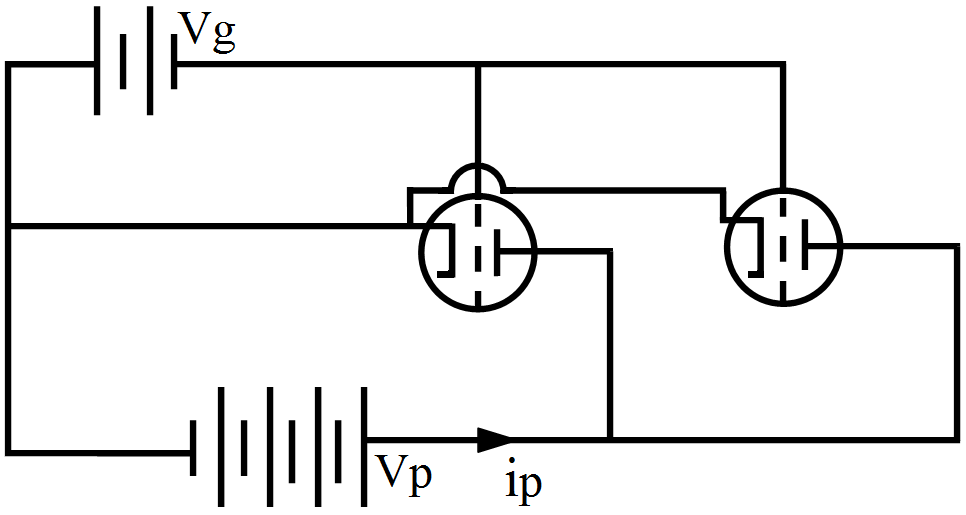
individual mutual conductance and the equivalent amplification factor is the same as the individual amplification factor.
Answer

From the circuit, Cathode of both the triodes are connected to a common point and their anodes are also connected together. Thus, the 2 triodes are connected in parallel. As plate resistance is obtained by observing the variation of plate voltage with plate current, keeping grid voltage as constant. Hence equivalent plate resistance,$\text{R}_\text{p}=\frac{\text{rp}_1\times\text{rp}_2}{\text{rp}_1+\text{rp}_2}$
if both the triodes have equal plate resistance i.e., $\text{R}_\text{p}=\frac{\text{r}_\text{p}}{2}$ To find the equivalent transconductance. We need to look at the variation of current with respect to grid voltage, keeping plate voltage as constant. From the circuit Now the 2 triodes are in series w.r.t grid voltage. Hence equivalent transconductance will be equal to$\text{G}_\text{m}=2\text{g}_\text{m}$
if the 2 triodes have equal trens conductance i.e., $\text{g}_{\text{m}_1}=2\text{g}_{\text{m}_2}=\text{g}_{\text{m}}$ Now the equivalent amplification factor is,$\mu_{\text{equivalent}}=\text{G}_{\text{m}}\times\text{R}_{\text{p}}$
$\mu_{\text{equivalent}}=2\text{g}_{\text{m}}\times\frac{\text{r}_{\text{p}}}{2}$
$\mu_{\text{equivalent}}=\mu$

Need a full question paper?

Generate a complete, print-ready paper with questions like this in minutes — across 16+ boards, with answer keys.

Start Generating Free

Similar questions

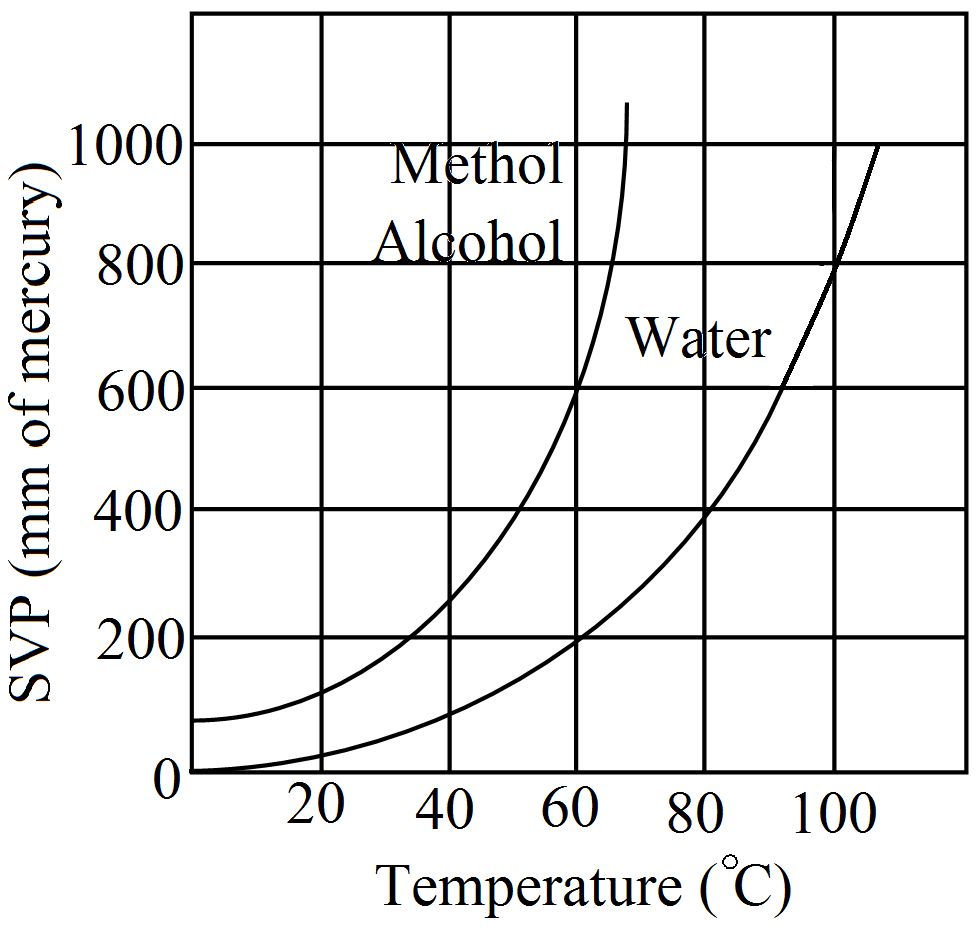
The human body has an average temperature of 98°F. Assume that the vapour pressure of the blood in the veins behaves like that of pure water. Find the minimum atmospheric pressure which is necessary to prevent the blood from boiling. Use figure. of the text for the vapour pressures.
A unitless quantity:
  1. Never has a non-zero dimension.
  2. Always has a non-zero dimension.
  3. May have a non-zero dimension.
  4. Does not exist.
A metal rod is placed along the axis of a solenoid carrying a high-freqμency alternating current. It is found that the rod gets heated. Explain why the rod gets heated.
A steel blade placed gently on the surface of water floats on it. If the same blade is kept well inside the water, it sinks. Explain.
The power delivered in the plate circular of a diode is 1.0W when the plate voltage is 36V. Find the power delivered if the plate voltage is increased to 49V. Assume Langmuir-Child equation to hold.
Read the passage given below and answer the following questions from 1 to 5. Simple Harmonic Motion Simple harmonic motion is the simplest form of oscillation. A particular type of periodic motion in which a particle moves to and fro repeatedly about a mean position under the influence of a restoring force is termed as simple harmonic motion (S.H.M). A body is undergoing simple harmonic motion if it has an acceleration which is directed towards a fixed point, and proportional to the displacement of the body from that point. Acceleration $\text{a}\propto-\text{x}$$\Rightarrow\text{a}=-\text{kx}$ or $\frac{\text{d}^2\text{x}}{\text{dt}^2}=-\text{kx},$
where x = displacement at any instant t.
  1. Which of the following is not a characteristics of simple harmonic motion?
  1. The motion is periodic.
  2. The motion is along a straight line about the mean position.
  3. The oscillations are responsible for the energy conversion.
  4. The acceleration of the particle is directed towards the extreme position.
  1. The equation of motion of a simple harmonic motion is:
  1. $\frac{\text{d}^2\text{x}}{\text{dt}^2}=-\omega^2\text{x}$
  2. $\frac{\text{d}^2\text{x}}{\text{dt}^2}=-\omega^2\text{t}$
  3. $\frac{\text{d}^2\text{x}}{\text{dt}^2}=-\omega\text{x}$
  4. $\frac{\text{d}^2\text{x}}{\text{dt}^2}=-\omega\text{t}$
  1. Which of the following expressions does not represent simple harmonic motion?
  1. $\text{x}=\text{A}\cos\omega\text{t}+\text{B}\sin\omega\text{t}$
  2. $\text{x}=\text{A}\cos(\omega\text{t}+\alpha)$
  3. $\text{x}=\text{B}\sin(\omega\text{t}+\beta)$
  4. $\text{x}=\text{A}\sin\omega\text{t}\cos^2\omega\text{t}$
  1. The time period of simple harmonic motion depends upon:
  1. Amplitude
  2. Energy
  3. Phase constant
  4. Mass
  1. Which of the following motions is not simple harmonic?
  1. Vertical oscillations of a spring
  2. Motion of a simple pendulum
  3. Motion of planet around the Sun
  4. Oscillation of liquid in a U-tube
A short magnet oscillates in an oscillation magnetometern with a time period of 0.10s where the earth's horizontal magnetic field is $24\mu\text{T}.$ A downward current of 18 A is established in a vertical wire placed 20cm east of the magnet. Find the new time period.
The plate current in a diode is 20mA when the plate voltage is 50V or 60V. What will be the current if the plate voltage is 70V?