Question
Complete the following table:
Car Model
Driver X
Reaction time 0.20s
Driver Y
Reaction time 0.30s
$A ($deceleration on hard braking $= 6.0m/s^2)$
Speed = 54km/h
Braking distance
a = ...
Total stopping distance
b = ...
Speed = 72km/h
Braking distance
c = ...
Total stopping distance
d = ...
$B ($deceleration on hard braking $= 7.5m/s^2)$
Speed = 54km/h
Breaking distance
e = ...
Total stopping distance
f = ...
Speed 72km/h
Braking distance
g = ...
Total stopping distance
h = ...

Answer

Car Model
Driver X
Reaction time 0.25s
Driver Y
Reaction time 0.35s
$A ($deceleration on hard braking $= 6.0m/s^2)$
Speed = 54km/h
Braking distance
a = 19m
Total stopping distance
b = 22m
Speed = 72km/h
Braking distance
c = 33m
Total stopping distance
d = 39m
$B ($deceleration on hard braking $= 7.5m/s^2)$
Speed = 54km/h
Breaking distance
e = 15m
Total stopping distance
f = 18m
Speed 72km/h
Braking distance
g = 27m
Total stopping distance
h = 33m
$\text{a}=\frac{0^2-15^2}{2(-6)}=19\text{m}$
So, $b = 0.2 × 15 + 19 = 33m$
Similarly other can be calculated.
Braking distance: Distance travelled when brakes are applied.
Total stopping distance = Braking distance + distance travelled in reaction time.

Need a full question paper?

Generate a complete, print-ready paper with questions like this in minutes — across 16+ boards, with answer keys.

Start Generating Free

Similar questions

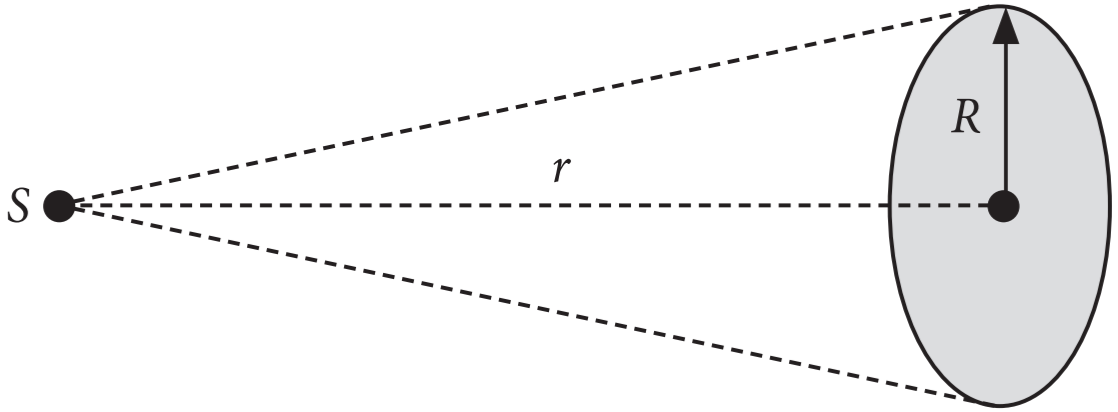
A point sources of power $6.4 \times 10^{-3}W$ emits mono energetic photons each of energy 6.0eV. The source is located at a distance of 0.8m from the centre of a stationary metallic sphere of work function 3.0eV and of radius $1.6 \times 10^{-3}m$ mas shown in figure. The sphere is isolated and initially neutral and photoelectrons are instantly taken away from sphere after emission. The efficiency of photoelectric emission is one for very $10^5$ incident photons.
  1. The power received by the sphere through radiations is:
  1. $\frac{\text{R}^2}{\text{Pr}}$
  2. $\frac{\text{PR}^2}{4\text{r}^2}$
  3. $\frac{\text{P}^2\text{R}}{2\pi\text{r}}$
  4. $\frac{\text{PR}}{4\text{r}}$
  1. Number of photons striking the metal sphere per second is:
  1. $6.7 \times 10^9$
  2. $3.3 \times 10^9$
  3. $6.7 \times 10^{10}$
  4. $3.3 \times 10^{10}$
  1. The number of photoelectrons emitted per second is about.
  1. $3.3 \times 10^4$
  2. $6.7 \times 10^4$
  3. $6.7 \times 10^{15}$
  4. $3.3 \times 10^{15}$
  1. The photoelectric emission stops when the sphere acquires a potential about.
  1. 2V
  2. 3V
  3. 4V
  4. 6V
  1. If the distance of source becomes double from the centre of the metal sphere then the power received by the sphere.
  1. $\frac{\text{PR}^2}{4\text{r}^2}$
  2. $\frac{\text{PR}^2}{16\text{r}^2}$
  3. $\frac{\text{PR}^2}{4\text{r}}$
  4. $\frac{\text{P}^2\text{R}^2}{16\text{r}^2}$
A tangent galvanometer shows a deflection of 45° when 10mA of current is passed through it. If the horizontal component of the earth's magnetic field is $B_H = 3.6\times 10^{-5} T$ and radius of the coil is 10cm, find the number of turns in the coil.
To keep valuable instruments away from the earth's magnetic field, they are enclosed in iron boxes. Explain.
For a circular coil of radius R and N turns carrying current I, the magnitude of the magnetic field at a point on its axis at a distance x from its centre is given by,
$\text{B}=\frac{\mu_{0}\text{IR}^{2}\text{N}}{2(\text{x}^{2}+\text{R}^{2})^{\frac{3}{2}}}$
  1. Show that this reduces to the familiar result for field at the centre of the coil.
  2. Consider two parallel co-axial circular coils of equal radius R, and number of turns N, carrying equal currents in the same direction, and separated by a distance R. Show that the field on the axis around the mid-point between the coils is uniform over a distance that is small as compared to R, and is given by,$\text{B}=0.72\frac{\mu_{0}\text{NI}}{\text{R}}$, approximately.
[Such an arrangement to produce a nearly uniform magnetic field over a small region is known as Helmholtz coils.]
50cc of oxygen is collected in an inverted gas jar over water. The atmospheric pressure is 99.4kPa and the room temperature is 27°C. The water level in the jar is same as the level outside. The saturation vapour pressure at 27°C is 3.4kPa. Calculate the number of moles of oxygen collected in the jar.
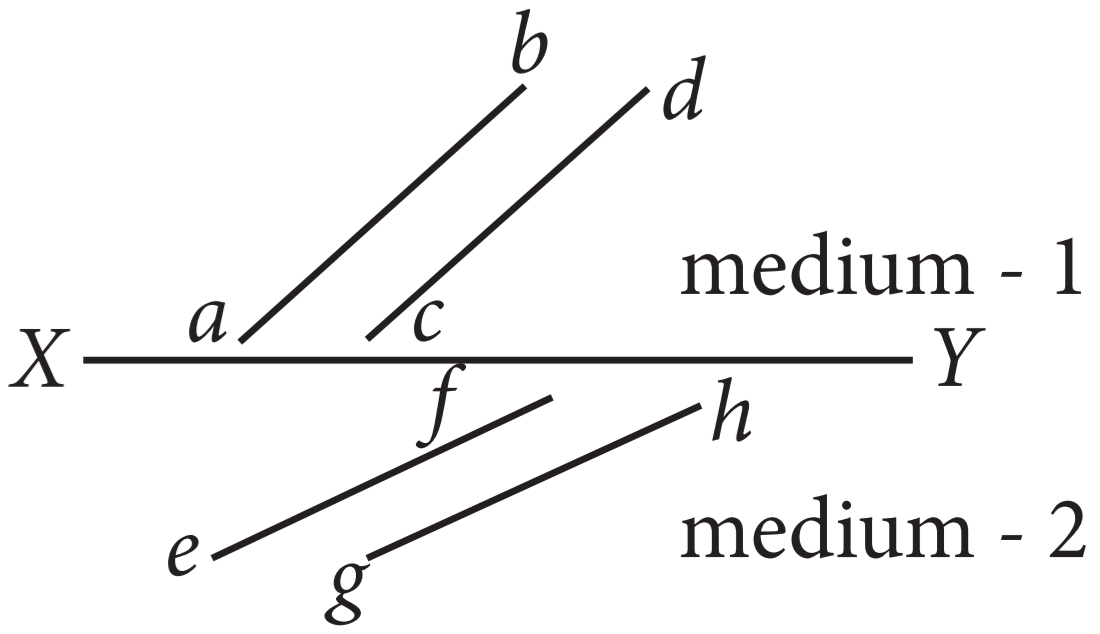
Wavefront is a locus of points which vibratic in same phase. A ray of light is perpendicular to the wavefront. According to Huygens principle, each point of the wavefront is the source of a secondary disturbance and the wavelets connecting from these points spread out in all directions with the speed of wave.
The figure shows a surface XY separating two transparent media, medium-I and medium-2. The lines ab and cd represent wavefronts of a light wave travelling in medium- 1 and incident on XY. The lines ef and gh represent wavefronts of the light wave in medium-2 after refraction.
  1. Light travels as a:
  1. Parallel beam in each medium.
  2. Convergent beam in each medium.
  3. Divergent beam in each medium.
  4. Divergent beam in one medium and convergent beam in the other medium.
  1. The phases of the light wave at c, d, e and f are $\phi_\text{c},\phi_\text{d},\phi_\text{e}$ and $\phi_\text{f}$ respectively. It is given that $\phi_\text{c}\not=\phi_\text{f}$
  1. $\phi_\text{c}$ cannot be equal $\phi_\text{d}$
  2. $\phi_\text{d}$ cannot be equal $\phi_\text{e}$
  3. $(\phi_\text{d}-\phi_\text{f})$ is equal to $(\phi_\text{c}-\phi_\text{e})$
  4. $(\phi_\text{d}-\phi_\text{c})$ is not equal to $(\phi_\text{f}-\phi_\text{e})$
  1. Wavefront is the locus of all points, where the particles of the medium vibrate with the same.
  1. Phase
  2. Amplitude
  3. Frequency
  4. Period
  1. A point source that emits waves uniformly in all directions, produces wavefronts that are:
  1. Spherical
  2. Elliptical
  3. Cylindrical
  4. Planar
  1. What are the types of wavefronts?
  1. Spherical
  2. Cylindrical
  3. Plane
  4. All of these.
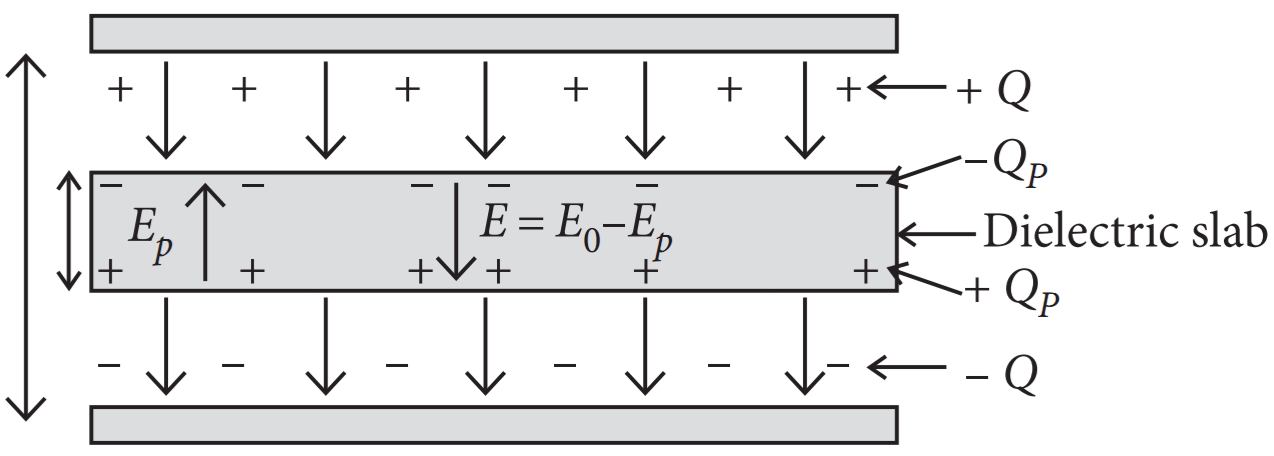
A dielectric slab is a substance which does not allow the flow of charges through it but permits them to exert electrostatic forces on one another. When a dielectric slab is placed between the plates, the field $E_0$ polarises the dielectric. This induces charge $-Q_P$ on the upper surface and $+ Q_P$ on the lower surface of the dielectric. These induced charges set up a field $E_P$ inside the dielectric in the opposite direction of $\vec{\text{E}_0}$ as shown.
  1. ln a parallel plate capacitor, the capacitance increases from $4\mu\text{F}$ to $80\mu\text{F},$ on introducing a dielectric medium between the plates. What is the dielectric constant of the medium?
  1. 10
  2. 20
  3. 50
  4. 100
  1. A parallel plate capacitor with air between the plates has a capacitance of 8pE The separation between the plates is now reduced half and the space between them is filled with a medium of dielectric constant 5. Calculate the value of capacitance of the capacitor in second case.
  1. 8pF
  2. 10pF
  3. 80pF
  4. 100pF
  1. A dielectric introduced between the plates of a parallel plate condenser:
  1. Decreases the electric field between the plates.
  2. Increases the capacity of the condenser.
  3. Increases the charge stored in the condenser.
  4. Increases the capacity of the condenser.
  1. A parallel plate capacitor of capacitance 1 pF has separation between the plates is d. When the distance of separation becomes 2d and wax of dielectric constant x is inserted in it the capacitance becomes 2pE What is the value of x?
  1. 2
  2. 4
  3. 6
  4. 8
  1. A parallel plate capacitor having area A and separated by distanced is filled by copper plate of thickness b. The new capacity is:
  1. $\frac{\in_0\text{A}}{\text{d}+\frac{\text{b}}{2}}$
  2. $\frac{\in_0\text{A}}{\text{2d}}$
  3. $\frac{\in_0\text{A}}{\text{d-b}}$
  4. $\frac{2\in_0\text{A}}{\text{d}+\frac{\text{b}}{2}}$
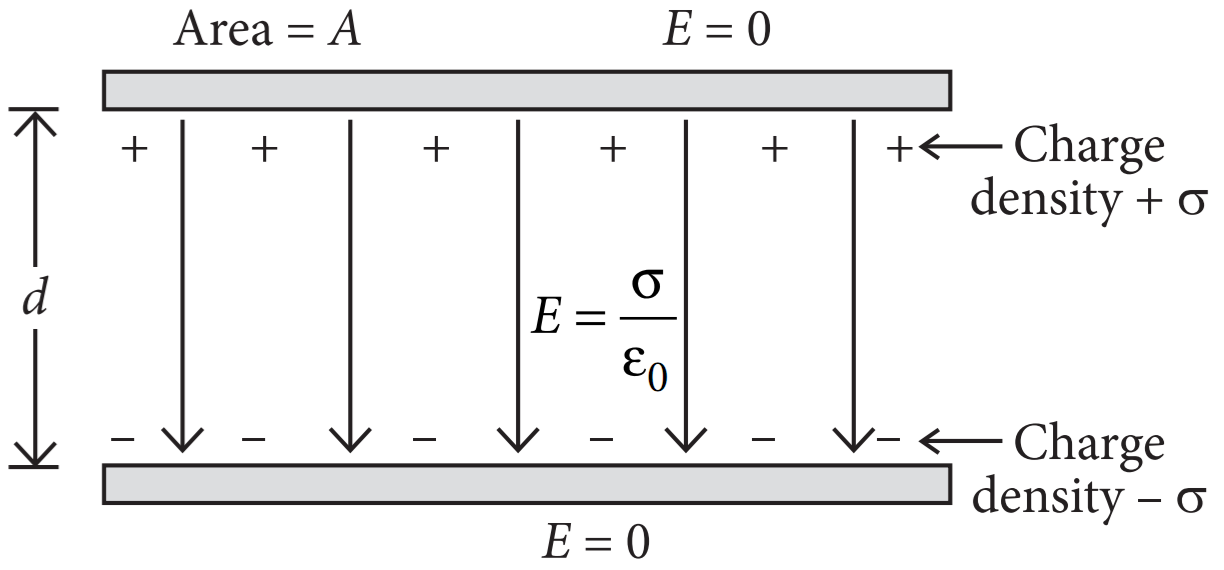
The simplest and the most widely used capacitor is the parallel plate capacitor. It consists of two large plane parallel conducting plates, separated by a small distance. In the outer regions above the upper plate and below the lower plate, the electric fields due to the two charged plates cancel out. The net field is zero. In the inner region between the two capacitor plates, the electric fields due to the two charged plates add up. The net field is $\frac{\sigma}{\in_0}.$

For a uniform electric field, potential difference between the plates = Electric field x distance between the plates. Capacitance of the parallel plate capacitor is the charge required to supplied to either of the conductors of the capacitor so as to increase the potential difference between then by unit amount.
  1. A parallel plate capacitor is charged and then isolated. The effect of increasing the plate separation on charge, potential and capacitance respectively are:
  1. Increases, decreases, decreases.
  2. Constant, increases, decreases.
  3. Constant, decreases, decreases.
  4. Constant, decreases, increases.
  1. In a parallel plate capacitor, the capacity increases if:
  1. Area of the plate is decreases.
  2. Distance between the plates increases.
  3. Area of the plate is increases.
  4. Dielectric constant decreases.
  1. A parallel plate capacitor has two square plates with equal and opposite charges. The surface charge densities on the plates are $+\sigma$ and $-\sigma$ respectively. In the region between the plates the magnitude of the electric field is:
  1. $\frac{\sigma}{2\in_0}$
  2. $\frac{\sigma}{\in_0}$
  3. 0
  4. None of these.
  1. If a parallel plate air capacitor consists of two circular plates of diameter 8cm. At what distance should the plates be held so as to have the same capacitance as that of sphere of diameter 20cm?
  1. 9mm
  2. 4mm
  3. 8mm
  4. 2mm
  1. If a charge of $+ 2.0 \times 10^{-8}C$ is placed on the positive plate and a charge of $- 1.0 \times 10^{-8}C$ on the negative plate of a parallel plate capacitor of capacitance $1.2\times10^{-3}\mu\text{F},$ then the potential difference developed between the plates is:
  1. 6.25V
  2. 3.0V
  3. 12.5V
  4. 25V
  1. A mobile phone lies along the principal axis of a concave mirror. Show, with the help of a suitable diagram, the formation of its image. Explain why magnification is not uniform.
  2. Suppose the lower half of the concave mirror's reflecting surface is covered with an opaque material. What effect this will have on the image of the object? Explain.
Explais the arrangements for conducting an experimental study of the photoelectric effect.