Question
Wavefront is a locus of points which vibratic in same phase. A ray of light is perpendicular to the wavefront. According to Huygens principle, each point of the wavefront is the source of a secondary disturbance and the wavelets connecting from these points spread out in all directions with the speed of wave.
The figure shows a surface XY separating two transparent media, medium-I and medium-2. The lines ab and cd represent wavefronts of a light wave travelling in medium- 1 and incident on XY. The lines ef and gh represent wavefronts of the light wave in medium-2 after refraction.
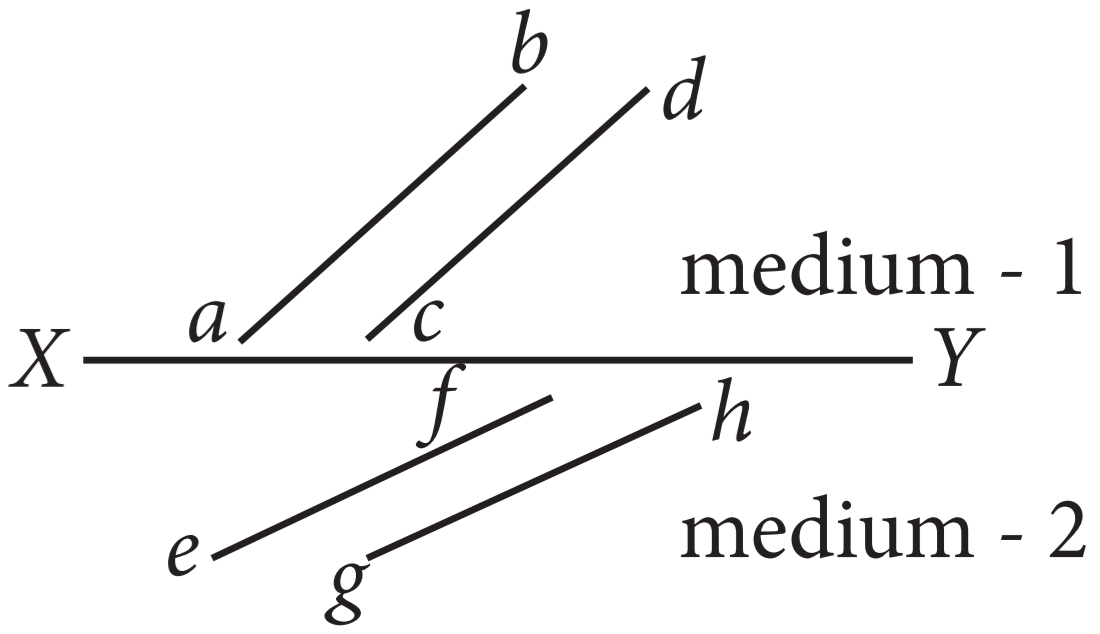
  1. Light travels as a:
  1. Parallel beam in each medium.
  2. Convergent beam in each medium.
  3. Divergent beam in each medium.
  4. Divergent beam in one medium and convergent beam in the other medium.
  1. The phases of the light wave at c, d, e and f are $\phi_\text{c},\phi_\text{d},\phi_\text{e}$ and $\phi_\text{f}$ respectively. It is given that $\phi_\text{c}\not=\phi_\text{f}$
  1. $\phi_\text{c}$ cannot be equal $\phi_\text{d}$
  2. $\phi_\text{d}$ cannot be equal $\phi_\text{e}$
  3. $(\phi_\text{d}-\phi_\text{f})$ is equal to $(\phi_\text{c}-\phi_\text{e})$
  4. $(\phi_\text{d}-\phi_\text{c})$ is not equal to $(\phi_\text{f}-\phi_\text{e})$
  1. Wavefront is the locus of all points, where the particles of the medium vibrate with the same.
  1. Phase
  2. Amplitude
  3. Frequency
  4. Period
  1. A point source that emits waves uniformly in all directions, produces wavefronts that are:
  1. Spherical
  2. Elliptical
  3. Cylindrical
  4. Planar
  1. What are the types of wavefronts?
  1. Spherical
  2. Cylindrical
  3. Plane
  4. All of these.

Answer

  1. (a) Parallel beam in each medium.
Explanation:
Since the path difference between two waveform is equal, light traves as parallel beam in each medium.
  1. (c) $(\phi_\text{d}-\phi_\text{f})$ is equal to $(\phi_\text{c}-\phi_\text{e})$
Explanation:
Since all points on the wavefront are in the same phase,
$\phi_\text{d}=\phi_\text{c}$ and $\phi_\text{f}=\phi_\text{e}$
$\therefore\phi_\text{d}-\phi_\text{f}=\phi_\text{c}-\phi_\text{e}$
  1. (a) Phase
Explanation:
Wavefront is the locus of all points, where the particles of the medium vibrate with the same phase.
  1. (a) Spherical
  1. (d) All of these.

Need a full question paper?

Generate a complete, print-ready paper with questions like this in minutes — across 16+ boards, with answer keys.

Start Generating Free

Similar questions

The mean free path of electrons in a gas in a discharge tube is inversely proportional to the pressure inside it. The Crookes dark space occupies half the length of the discharge tube when the pressure is 0.02mm of mercury. Estimate the pressure at which the dark space will fill the whole tube.
A magnetic dipole of magnetic moment $0.72\sqrt{2}\text{ A-m}^2$ -is placed horizontally with the north pole pointing towards east. Find the position of the neutral point if the horizontal component of the earth's magnetic field is $18\mu\text{T.}$

The field of a hollow wire with constant current is homageneous.
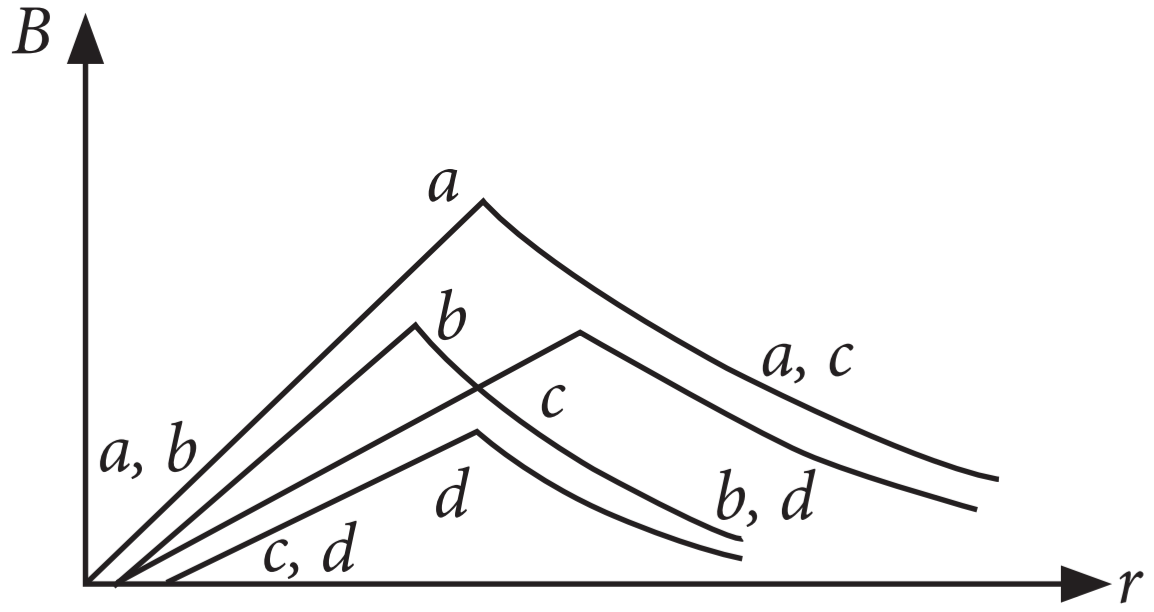
Curves in the graph shown give, as functions of radius distance r, the magnitude B of the magnetic field inside and outside four long wires a, b, c and d, carrying currents that are uniformly distributed across the cross sections of the wires. Overlapping portions of the plots are indicated by double labels.
  1. Which wire has the greatest magnitude of the magnetic field on the surface?
  1. a
  2. b
  3. c
  4. d
  1. The current density in a wire a is:
  1. Greater than in wire c.
  2. Less than in wire c.
  3. Equal to that in wire c.
  4. Not comparable to that of in wire c due to lack of information.
  1. Which wire has the greatest radius?
  1. a
  2. b
  3. c
  4. d
  1. A direct current I flows along the length of an infinitely long straight thin walled pipe, then the magnetic field is:
  1. Uniform throughout the pipe but not zero.
  2. Zero only along the axis of the pipe.
  3. Zero at any point inside the pipe.
  4. Maximum at the centre and minimum at the edges.
  1. In a coaxial, straight cable, the central conductor and the outer conductor carry equal currents in opposite direction. The magnetic field is zero.
  1. Outside the cable.
  2. Inside the inner conductor.
  3. Inside the outer conductor.
  4. In between the two conductor.
Refer to the previous problem. Suppose, the goldsmith argues that he has not mixed copper or any other material with gold, rather some cavities might have been left inside the ornament. Calculate the volume of the cavities left that will allow the weights given in that problem.
When white radiation is passed through a sample of hydrogen gas at room temperature, absorption lines are observed in Lyman series only. Explain.
A person is standing on a weighing machine placed on the floor of an elevator. The elevator starts going up with some acceleration, moves with uniform velocity for a while and finally decelerates to stop. The maximum and the minimum weights recorded are 72kg and 60kg. Assuming that the magnitudes of the acceleration and the deceleration are the same, find:
  1. The true weight of the person.
  2. The magnitude of the acceleration. Take $g = 9.9m/s^2.$
The reduction factor K of a tangent galvanometer is written on the instrument. The manual says that the current is obtained by multiplying this factor to tane. The procedure works well at Bhuwaneshwar. Will the procedure work if the instrument is taken to Nepal? If there is some error, can it be corrected by correcting the manual or the instrument will have to be taken back to the factory?
The needle of a dip circle shows an apparent dip of 45° in a particular position and 53° when the circle is rotated through 90°. Find the true dip.
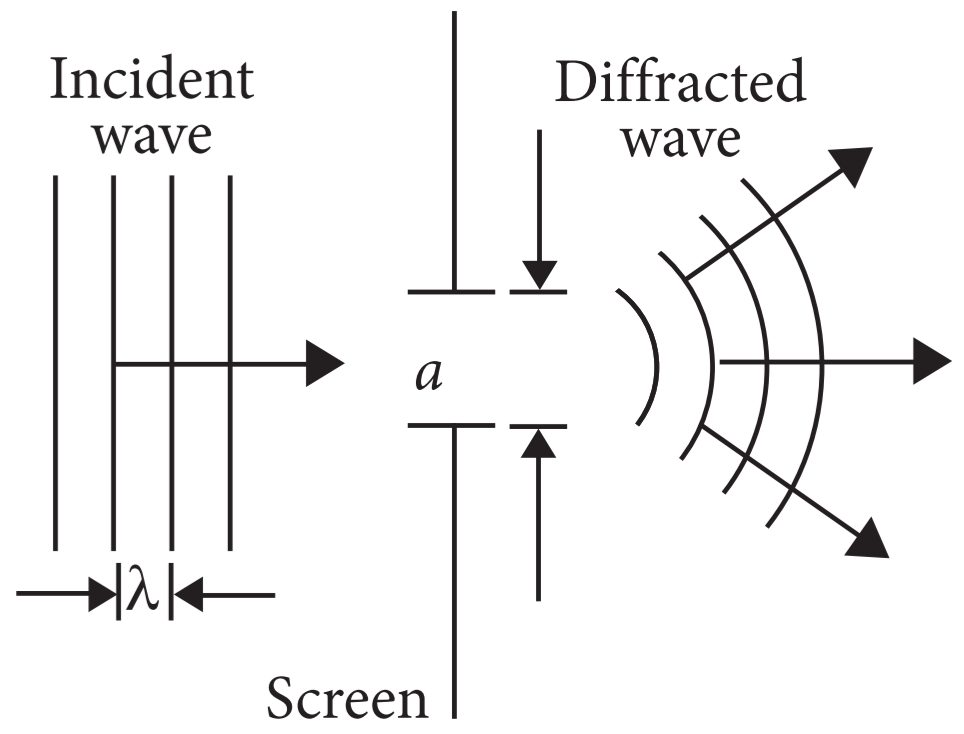
The phenomenon of bending ofli ght around the sharp corners and the spreading of light within the geometrical shadow of the opaque obstacles is called diffraction of light. The light thus deviates from its linear path. The deviation becomes much more pronounced, when the dimensions of the aperture or the obstacle are comparable to the wavelength of light.
  1. Light seems to propagate in rectilinear path because.
  1. Its spread is very large.
  2. Its wavelength is very small.
  3. Reflected from the upper surface of atmosphere.
  4. It is not absorbed by atmosphere.
  1. ln diffraction from a single slit the angular width of the central maxima does not depends on:
  1. $\lambda$ of light used.
  2. Width of slit.
  3. Distance of slits from the screen.
  4. Ratio of $\lambda$ and slit width.
  1. For a diffraction from a single slit, the intensity of the central point is:
  1. Infinite.
  2. Finite and same magnitude as the surrounding maxima.
  3. Finite but much larger than the surrounding maxima.
  4. Finite and substantially smaller than the surrounding maxima.
  1. Resolving power of telescope increases when:
  1. Wavelength of light decreases.
  2. Wavelength of light increases.
  3. Focal length of eye-piece increases.
  4. Focal length of eye-piece decreases.
  1. ln a single diffraction pattern observed on a screen placed at D metre di stance from the slit of width d metre, the ratio of the width of the central maxima to the width of other secondary maxima is:
  1. 2 : 1
  2. 1 : 2
  3. 1 : 1
  4. 3 : 1
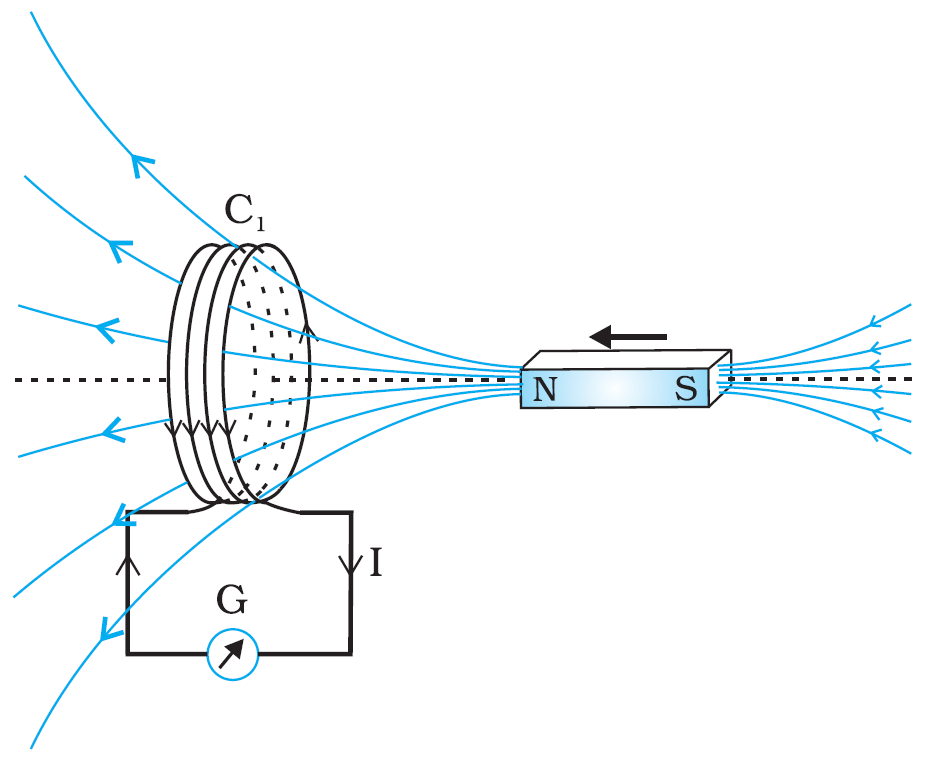
In year 1820 Oersted discovered the magnetic effect of current. Faraday gave the thought that reverse of this phenomenon is also possible i.e., current can also be produced by magnetic field. Faraday showed that when we move a magnet towards the coil which is connected by a sensitive galvanometer. The galvanometer gives instantaneous deflection showing that there is an electric current in the loop. Whenever relative motion between coil and magnet takes place an emf induced in coil. If coil is in closed circuit then current is also induced in the circuit. This phenomenon is called electromagnetic induction.
  1. The north pole of a long bar magnet was pushed slowly into a short solenoid connected to a galvanometer. The magnet was held stationary for a few seconds with the north pole in the middle of the solenoid and then withdrawn rapidly. The maximum deflection of the galvanometer was observed when the magnet was:
  1. Moving towards the solenoid.
  2. Moving into the solenoid.
  3. At rest inside the solenoid.
  4. Moving out of the solenoid.
  1. Two similar circular loops carry equal currents in the same direction. On moving the coils further apart, the electric current will.
  1. Remain unaltered.
  2. Increases in one and decreases in the second.
  3. Increase in both.
  4. Decrease in both.
  1. A closed iron ring is held horizontally and a bar magnet is dropped through the ring with its length along the axis of the ring. The acceleration of the falling magnet is.
  1. Equal to g.
  2. Less than g.
  3. More than g.
  4. Depends on the diameter of the ring and length of magnet.
  1. Whenever there is a relative motion between a coil and a magnet, the magnitude of induced emf set up in the coil does not depend upon the:
  1. Relative speed between the coil and magnet.
  2. Magnetic moment of the coil.
  3. Resistance of the coil.
  4. Number of turns in the coil.
  1. A coil of metal wire is kept stationary in a non-uniform magnetic field:
  1. A n emf and current both are induced in the coil.
  2. A current but no emf is induced in the coil.
  3. An emf but no current is induced in the coil.
  4. Neither emf nor current is induced in the coil.