Question
Complete the following table:
 
Components Origin Function Approx. No. $(mm^3)$ Life span
RBCs        
WBCs        
Platelets        

Answer

Components Origin Function Approx. No. $(mm^3)$ Life span
RBCs Bone marrow Carry $O_2$ to the different parts of the body 4.8 million-5.5 million 120 days
WBCs Bone marrow Develop immu­nity 7,000 Two weeks
Platelets Large bone marrow cells Initiate blood clotting 250,000 2-3 days

Need a full question paper?

Generate a complete, print-ready paper with questions like this in minutes — across 16+ boards, with answer keys.

Start Generating Free

Similar questions

Give Reasons for the following:
Transplanting of seedlings to a flowerbed in the evening is better than doing so in the morning.
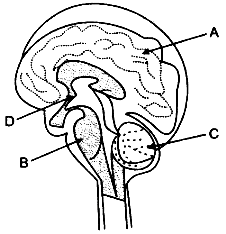
The below-simplified diagram shows a section through the brain.

(i) Name the parts labeled A, B, and C.
(ii) Give one function of each of the parts A, B, and C.
(iii) What is found in region D?
What is wilting? Some plants show wilting of their leaves at noon even when the soil is well watered, Why is it so?
Differentiate between:
Arteries and Veins.
Differentiate Between Transpiration and Perspiration.
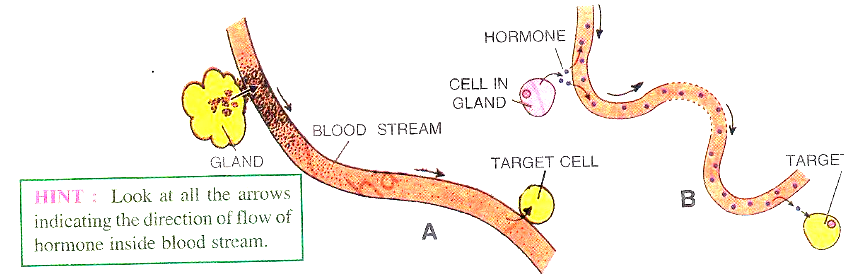
Given below are two diagrams (one is correct, the other one is somewhat incorrect) showing the transport of a hormone from its source gland/cell to the target organ/cell.

What is the error?
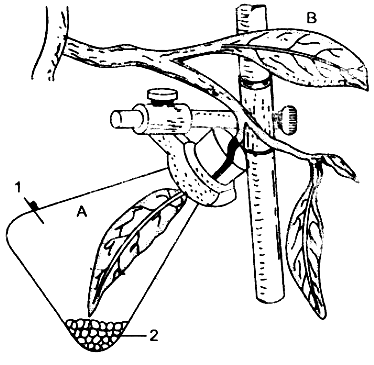
The figure below represents an experiment performed to demonstrate a particular aspect of photosynthesis. The apparatus was kept in sunlight for almost the whole day. The numeral $‘1’$ represents a certain condition inside the flask and the numeral $‘2’$ represents a chemical responsible for this condition.
(i) What is the object of the experiment?
(ii) What is the special condition inside the flask?
(iii) What is the chemical substance numbered ‘2’?
(iv) In what way will the three leaves ($A, B$, and $C$) differ at the end of the experiment, when tested with iodine solution?
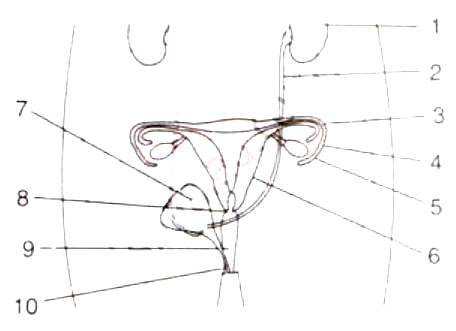
Given below is a diagram of two systems together in the human body.
Describe the functions of the parts 3, 4, 5 and 6.
A 50-year-old man, Mr. Johnson, is experiencing frequent urination, especially at night, along with fatigue and swelling in his ankles. Upon examination, his doctor suspects a possible issue with his excretory system. Mr. Johnson is concerned about his condition and seeks clarification on how the excretory system fiunctions and its role in maintaining overall health.
(i) What are the organs involved in excretion in human body and the substances excreted by the excretory system?
(ii) How does the excretory system regulate the balance of water and electrolytes in the body?
(iii) Discuss the role of the kidneys in excretion.
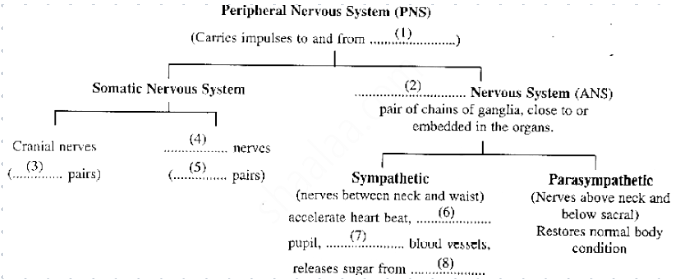
Given below is the partially incomplete scheme of the components of peripheral nervous system. Fill up the blanks numbered (1) – (8): Image