Question types

The Circulatory System question types

167 questions across 7 question groups — pick any mix to generate a Biology paper with step-by-step answer keys.

167
Questions
7
Question groups
5
Question types
Sample Questions

The Circulatory System questions

One sample from each question group in this chapter. Select any group above to see the full set with answer keys.

Q 1MCQ1 Mark
Erythroblastosis foetalis can occur when:
  • A
    $\text { Man } \mathrm{Rh}^{+v e} \text { and woman } \mathrm{Rh}^{+v e}$
  • B
    $\text { Man } \mathrm{Rh}^{-\mathrm{ve}} \text { and woman } \mathrm{Rh}^{+\mathrm{ve}}$
  • $\text { Man } \mathrm{Rh}^{+\mathrm{ve}} \text { and woman } \mathrm{Rh}^{-\mathrm{ve}}$
  • D
    $\text { Man } \mathrm{Rh}^{-\mathrm{ve}} \text { and woman } \mathrm{Rh}^{-\mathrm{ve}}$

Answer: C.

View full solution
Q 2MCQ1 Mark
What is blood pressure?
  • A
    The pressure of blood on the heart muscles
  • The pressure of blood exerted on the walls of arteries and veins
  • C
    The pressure of blood on the walls of veins only
  • D
    The pressure of blood on the walls of arteries only

Answer: B.

View full solution
Q 3MCQ1 Mark
Arteries are:
  • A
    Thin walled and blood flows under diminished pressure
  • Thick walled and blood flows under high pressure
  • C
    Thin walled and blood flows under low pressure
  • D
    Thick walled and blood flows under diminished pressure

Answer: B.

View full solution
Q 4MCQ1 Mark
The beating of the heart of man is heart on the left side, because:
  • A
    The left ventride is towards the left side
  • B
    Both the ventricles are towards the left side
  • Contraction of heart is powerful on left side
  • D
    The dorsal aorta is on the left side

Answer: C.

View full solution
Q 5MCQ1 Mark
Which protein is used in preventing clotting of blood?
  • A
    Albumin
  • Heparin
  • C
    Fibrinogeri
  • D
    Globulin

Answer: B.

View full solution
The table below is designed to indicate the transport of certain substances in our body. Fill in the blanks with suitable answers:
Substance From To
(i) Lungs Whole Body
(ii) Carbon Dioxide
(iii) Urea
(iv) Digested Carbohydrates Intestines
(v) Target Organs
(vi) Heat Whole Body
View full solution
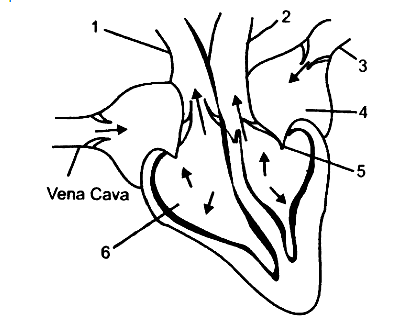
The figure below represents the internal structure of a mammalian heart and the associated blood vessels.

(i) (a) Name each of the structures labeled 1, 2, 3, 4, 5, 6, 7 and 8.
(b) State the function of each of the structures 5, 6, 7, and 8.
(ii) (a) State the function of the heart as an entire organ.
(b) Why are the walls of the left ventricle more muscular than the right?
View full solution
The diagram given below represents the human heart in one phase of its activity. Study the same and then answer the questions that follow:

(i) Name the phase.
(ii) Which parts of the heart are contracting in this phase ? Give a reason to support your answer.
(iii) Name the part numbered 1 to 6.
(iv) What type of blood flows through the parts marked ‘1’ and ‘2’?
(v) How many valves are closed in this phase?
View full solution
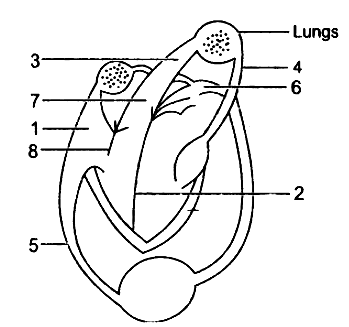
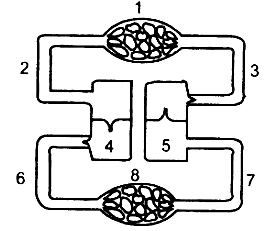
Given below is a simple diagram of the circulation of blood in a mammal showing the main blood vessels, the heart, lungs, and body tissues. The blood vessel labeled 6 contains deoxygenated blood and 2 the valve leading to it has three semi-lunar pockets.

(i) Name the blood vessels of organs marked by numbers 1 to 8.
(ii) What do you mean by the term ‘double circulation’ of blood in mammals?
(iii) What is diastole?
View full solution
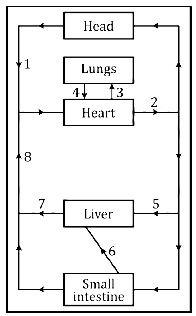
The diagram below represents the simplified pathway of the circulation of blood. Study the same and answer the questions which follow:

(i) Name the blood vessels labelled 1 and 2.
(ii) State the function of blood vessels labelled 5 and 8.
(iii) What is the importance of the blood vessel labelled 6?
(iv) Which blood vessel will contain a high amount of glucose and amino acids after a meal?
(v) Draw a diagram of the different blood cells as seen in a smear of human blood.
View full solution
Q 33TRUE / FALSE1 Mark
Serum is an immunological preparation of blood (without cells and fibrinogen) containing antibodies and antitoxins against specific diseases
View full solution

Generate a The Circulatory System paper free

Pick question groups from the list above, set marks and difficulty, and export a branded PDF with step-by-step answer keys. First 3 chapters free — no signup.

Download App