Question
Complete the following table. The first answer has been given as an example

Quantity Unit

(a) Electrical potential Volt

( b) Resistance

( c) Power

( d) Energy

( e) Resistivity

Volt

........

..........

............

..............

Answer

Quantity Unit
1. Electrical potential volt
2. Resistance ohm
3. Power watt
4. Enerqy Joule
5. Resistivity Ohm-meter

Need a full question paper?

Generate a complete, print-ready paper with questions like this in minutes — across 16+ boards, with answer keys.

Start Generating Free

Similar questions

State two factors on which the magnitude of induced e.m.f. depend.
An electric bulb is rated as 100W – 250V. What information does it convey? Calculate the current through the filament of the bulb.
(i) State the relationship between mechanical advantage, velocity ratio and efficiency.
(ii) Name the term that will not change for a machine of a given design.
State two properties of ultra-violet radiations which differ from visible light.
What are non-ohmic reistors? Give one example and draw a graph to show its current-voltage relationship.
An isotope of uranium is ${ }_{92} Y ^{238}$, i.e., it has mass number $235 $and atomic number $92 .$
Find the number of electrons in the neutral atom of this isotope.
(a) What do you understand by the term moment of force?
(b) State two factors which determines the moment of force.
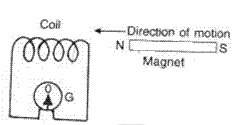
The following diagram shows a fixed coil of several turns connected to a
center zero galvanometer G and a magnet NS which can move.
(a) Describe the observation in the galvanometer if (i) The magnet is moved rapidly in the direction of arrow, (ii ) The magnet is kept still after it has moved into the coil, (iii ) The magnet~ then rapidly pulled out the coil. Image (b) How would the observation alter if a more powerful magnet is used?
A ball of mass $200$ g falls from a height of $5 m$. What will be its kinetic energy when it just reaches the ground? $(g = 9.8 m s^{−2})$
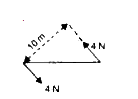
(i) What do you understand by the term couple of forces?
(ii) Calculate the moment of a couple shown in fig.