Questions · Page 1 of 2

[2 Mark Question Answer]

🎯

Test yourself on this topic

50 questions · timed · auto-graded

Question 12 Marks
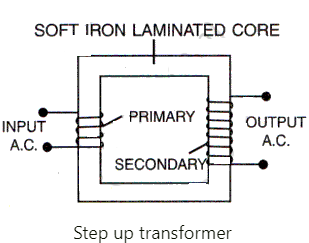
Why do you mean by turns ratio of a transformer? Can it work with D.C.?
Answer
The ratio of number of turns NS in secondary coil to the number of turns NP in the primary coil (NS / NP) is called the turns ratio.
A transformer cannot be used with direct current (d.c.) since its working is based on the principle that when there is a change of magnetic field lines due to varying current of same in one coil, an induced varying current of same frequency flows in the other coil. If the current in one coil is constant (i.e. d.c.), no induced current will flow in the other coil since there will be no change in the magnetic field lines linked with the coil.
View full question & answer
Question 22 Marks
Transformers are usually designed so that their efficiency is as close to 100% as possible. Describe two features in transformer design which help to achieve high efficiency?
Answer
Features which provide greater efficiency to a transformer are:
(i) The core of the transformer is laminated which prevents the formation of eddy currents.
(ii) A closed soft-iron core is used which reduces the magnetic field link loss and hysteresis loss.
View full question & answer
Question 32 Marks
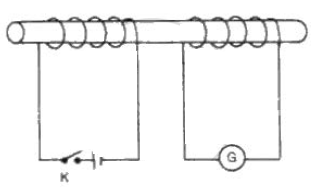
The circuit diagram in fig shows two coils of an insulated copper wire wound on a cardboard tube. G is a center zero galvanometer.

Image

(a) Describe what will happen when th e swi tch K is cl osed for severa l
seconds and then opened again .
(b) What will be the effect of repeating the experiment with an iron placed in the tube?

Answer
(a) We will observe that the needle of the galvanometer instantly jumps to one side and just as quickly returns to zero, indicating a momentary current in coil connected to galvanometer.
(b) Introducing an iron bar in the tube, will increase the amount of induced current and the galvanometer will show a greater deflection.
View full question & answer
Question 42 Marks
Why is an ammeter always connected in series while the voltmeter always in parallel to a circuit across which voltage is to be measured?
Answer
An ammeter is a low resistance device; hence it is connected in series.
A voltmeter is a high resistance device; hence it is connected in parallel.
View full question & answer
Question 52 Marks
How can you convert a moving coil galvanometer into ammeter and voltmeter?
Answer
A moving coil galvanometer can be converted into an ammeter by connecting a low resistance (called a shunt) in parallel to the galvanometer.
A moving coil galvanometer can be converted into a voltmeter by connecting a high resistance in series with the galvanometer.
View full question & answer
Question 62 Marks
A primary of 800 turns is connected to a 220 V A.C. supply and the secondary has 8 turns. What will be the output voltage?
Answer
Given, $N_p=800, N_s=8, E p=220 \mathrm{~V}, E_s=?$
We know that for a step-down transformer
$ \begin{aligned} & \frac{N_s}{N_p}=\frac{E_s}{E_p} \\ & E_s=\frac{N_s}{N_p} \times E_p=\frac{8}{800} \times 220=2.2 \mathrm{~V} \end{aligned} $
View full question & answer
Question 72 Marks
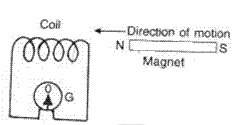
The following diagram shows a fixed coil of several turns connected to a
center zero galvanometer G and a magnet NS which can move.
(a) Describe the observation in the galvanometer if (i) The magnet is moved rapidly in the direction of arrow, (ii ) The magnet is kept still after it has moved into the coil, (iii ) The magnet~ then rapidly pulled out the coil. Image (b) How would the observation alter if a more powerful magnet is used?
Answer
(a) (i) When the magnet is moved rapidly in the direction of arrow, the magnetic flux linked with the coil changes and there is a deflection in the galvanometer, indicating a flow of current through the coil.
(ii) On keeping the magnet still, the magnetic flux linked with the coil does not change and there is no deflection in the galvanometer, indicating that no current is flowing through the coil.
(iii) When the magnet is rapidly pulled out, there is again change in the magnetic flux linked with the coil and the galvanometer shows a deflection but this time in opposite direction, indicating that a current is flowing in opposite direction in the coil.
(b) If a more powerful magnet is used, deflection in the galvanometer will be large, indicating a greater amount of current.
View full question & answer
Question 82 Marks
Out of the wires- live, neutral and earthing, on which line will you connect the fuse and the switch. Give reason for your answer.
Answer
Fuse and switches are always connected to the live wire so that when the switch is in off position no current flows through the app lia nee and its live and neutra I wires are at same potential. In case, excess current flows through the I ive wire, the fuse wire me Its and breaks the circuit; so no excess current flows through the appliance and it is protected against any dam age.
View full question & answer
Question 102 Marks
What are the advantages of a parallel connection?
Answer
Advantages of a parallel connection are:
(i) In parallel arrangement, each appliance works at the same voltage. For example, if several bulbs are connected in parallel, each bulb glows at the same voltage. Therefore, the glow of a bulb is unaffected if another bulb is switched on or off.
(ii) In parallel arrangement, if one bulb (or appliance
View full question & answer
Question 112 Marks
What is meant by a ring circuit in house wiring?
Answer
The ring system consists of a ring of three wires namely live wire, earth wire and neutral wire, which originate from the main fuse box and after running around the rooms in the house comes back to the main fuse box, thus, completing a ring. In ring system, a separate connection is taken from the live wire of the ring for each appliance. In the ring circuit, all appliances are connected in parallel.
View full question & answer
Question 122 Marks
An electric oven is rated as 1.5 kW, 250 V. If it is connected to a 250 V mains, calculate the
(a) Current drawn,
(b) Energy consumed in 20 hours,
(c) Cost of energy consumed in 20 hours at the rate of Re. 1 per unit.
Answer
Given, Power P = 1.5 kW, voltage V= 250 V
(a) Current, $I=\frac{P}{V}=\frac{1.5 \times 1000}{250}=6 \mathrm{~A}$
(b) Energy consumed in 20 hrs= P x t = 1.5 x 20 = 30 kWh
( c) Cost of consumed energy @Re. 1 per unit= 1 x 30 =Rs. 30
View full question & answer
Question 132 Marks
Two bulbs are marked 60 W, 220 V and 60 W, 110 V respectively. Calculate the ratio of their resistance.
Answer
We know that $R=\frac{V^2}{P}$
$\frac{\text { Resistance of } 60 \mathrm{~W}-220 \mathrm{~V} \text { bulb }}{\text { Resistance of } 60 \mathrm{~W}-220 \mathrm{~V} \text { bulb }}=\frac{(220)^2}{60} x \frac{60}{(110)^2}=\frac{4}{1}$
Thus, the required ratio is 4: 1.
View full question & answer
Question 162 Marks
A 3 pin mains plug is fitted to the lead for a 1 kW electric kettle to be used on a 250 V A.C. supply. Which of the following statements is NOT correct?
(a) A 13 A fuse is the most appropriate value to use.
(b) The brown wire should be connected to the live side of the mains.
Answer
Incorrect statement:
(a) A 13A fuse is the most appropriate value to use
View full question & answer
Question 172 Marks
If the potential differences between two parts of a thundercloud is $10s V,$
what is the amount of energy given up during the passage of $20$ coulombs?(a)$2x10⁻⁷J$
$(b)200J$
$(c)Sx106 j$
$(d)2x 10⁹J$
$(e)2x 10¹⁰ J$
Answer
Given, p.d. , $V = 10^8$​​​​​​​ volt, charge $Q = 20$ coulombsEnergy given $= QV = 20 x10^8 =2x10^9 J$
$(d) 2x10^9 J$
View full question & answer
Question 182 Marks
Three fuses available are rated at 2 A, 10 A and 13 A. Which fuse would you chose for an electric wire rated at 3 kW, 250 V? Show how you arrived at your answer.
Answer
Given power P = 3k W = 3000 W, Voltage = 250 V
We know that, P =VI
$I=\frac{P}{V}=\frac{3000}{250}=12 \mathrm{~A}$
Thus am aximum of 12 A current can pass through the electric wire
and a fuse of rating 13 A should be used with it
View full question & answer
Question 192 Marks
What would be the danger involved in replacing a blown fuse with the one which would carry a large current?
Answer
Replacing a fuse with another fuse of higher rating wou Id al low a large current to flow through the circuit or applia nee to which the fuse is connected and thus, there is a chance of short-circuiting and the appliance may get damaged.
View full question & answer
Question 202 Marks
What is the purpose of fuse in an electrical circuit?
Answer
An electric fuse is a device which is used to Ii m it the current in an electric circuit. The use of a fuse thus safeguards the circuit and appliances connected in that circuit from being damaged. It is a short piece of wire made of an alloy of lead and tin. If the current passing through the fuse exceeds the safeguard Ii m it the heat produced melts the fuse and this breaks the circuit.
View full question & answer
Question 212 Marks
Complete the following table. The first answer has been given as an example

Quantity Unit

(a) Electrical potential Volt

( b) Resistance

( c) Power

( d) Energy

( e) Resistivity

Volt

........

..........

............

..............

Answer
Quantity Unit
1. Electrical potential volt
2. Resistance ohm
3. Power watt
4. Enerqy Joule
5. Resistivity Ohm-meter
View full question & answer
Question 222 Marks
State Fleming's right hand rule.
Answer
Fleming's right hand rule can be stated as: Stretch the forefinger, the middle finger and the thumb of the right hand, such that they are mutually perpendicular to each other. If the forefinger indicates the direction of the magnetic field, thumb indicates the direction of motion of conductor, then the middle finger indicates the direction of induced current in the conductor.
View full question & answer
Question 232 Marks
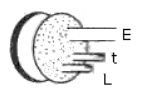
Fig shows a three pin plug top. Label the three pins. Why is the top pin thicker and longer than the other two? Why are the pins splitted at the ends?

Image

Answer
E is for earth pin, N is for neutral pin and L is for live pin.
The earth pin is long so that the earth connection is made first. This ensures the safety of the user because if the appliance is defective, the fuse will blow off. The earth pin is made thicker so that even by mistake it cannot be inserted into the hole for the live or neutral connection of the socket.
The pins are splitted at the ends to provide spring action so that they fit in the socket holes tightly.
View full question & answer
Question 242 Marks
What do you mean by earthing?
Answer
Earthing is a safety device which is used to prevent shocks due to short-circuiting and leakages. Earthing, means that the metal body of an appliance, or the kWh meter of the house, is connected to a thick copper wire which is buried deep in the earth and at its end ia a copper plate surrounded by a mixture of charcoal and common salt. This prevents the users from getting shocks.
View full question & answer
Question 252 Marks
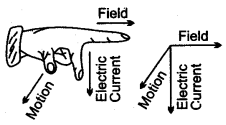
State Fleming's left hand rule.
Answer
Image

According to this rule, stretch the thumb, forefinger and middle finger of your left hand such that they are mutually perpendicular. If the first finger points in the direction of magnetic field and the second finger in the direction of the current, then the thumb will point in the direction of motion of the conductor or the force acting on the conductor.

View full question & answer
Question 262 Marks
State Fleming's right hand rule.
Answer
Fleming's right hand rule can be stated as: Stretch the forefinger, the middle finger and the thumb of the right hand, such that they are mutually perpendicular to each other. If the forefinger indicates the direction of the magnetic field, thumb indicates the direction of motion of conductor, then the middle finger indicates the direction of induced current in the conductor.
View full question & answer
Question 272 Marks
Many electrical appliances and circuits are earthed grounded. What is the reason for this?
Answer
This is done to protect the appliances and circuits from any damage due to short-circuit and thus accidents like fire and fatal shocks. Earthing provides an easy and safe path to the excess current in the circuit and sends it to the ground.
View full question & answer
Question 282 Marks
What do you mean by an electric fuse?
Answer
An electric fuse is a device which is used to limit the current in an electric circuit. The use of a fuse thus safeguards the circuit and appliances connected in that circuit from being damaged. It is a short piece of wire made of an alloy of lead and tin. If the current passing through the fuse exceeds the safeguard limit the heat produced melts the fuse and this breaks the circuit.
View full question & answer
Question 292 Marks
What do you mean by earthing?
Answer
Earthing is a safety device which is used to prevent shocks due to short-circuiting and leakages. Earthing, means that the metal body of an appliance, or the kWh meter of the house, is connected to a thick copper wire which is buried deep in the earth and at its end ia a copper plate surrounded by a mixture of charcoal and common salt. This prevents the users from getting shocks.
View full question & answer
Question 302 Marks
State two important precautions you should observe while using electricity?
Answer
Precautions while using electricity:
(i) One must use wires or cables of current carrying capacity higher than the current which can flow through the circuit while using all appliances.
(ii) An electrical appliance must never be operated (or touched) with wet hands.
View full question & answer
Question 312 Marks
What do you mean by short-circuiting?
Answer
Short circuiting occurs when the live wire comes in direct contact with the neutral wire so a zero resistance path is provided to the current. The heavy current then passes through the appliance and wires of the circuit.
View full question & answer
Question 322 Marks
What is fuse? Name the material of fuse.
Answer
An electric fuse is a safety device which is used to limit the current in an electric circuit. The use of a fuse thus safeguards the circuit and appliances connected in that circuit from being damaged.
A fuse is generally made of an alloy of lead and tin.
View full question & answer
Question 332 Marks
A 720 W heater operates from a 220 V line voltage. Calculate:
(a) The electrical energy consumed by the heater in 3 h.
(b) The cost of electrical energy consumption at the rate of 60 paise per kWh.
Answer
Given, power P =720 w= 0.72 kW
Voltage, V = 220 volt
(a) Electrical energy consumed in 3 h = 0.72 x 3 = 2.16 kWh
(b) Cost of energy consumption @60 paise per kWh= 2.16 x Rs 0.6 =Rs 1.3
View full question & answer
Question 342 Marks
Calculate the electric current supplied by a 12 V battery of an automobile to a starter that develops a power of 2.4 kW.
Answer
We know that,
$\mathrm{P}=\mathrm{VI}$
$I=\frac{P}{V}=\frac{2.4 \times 1000}{12}=200 \mathrm{~A}$
The current supplied by the battery is 200A
View full question & answer
Question 352 Marks
An electric kettle is rated 3 kW, 250 V. Give reason whether this kettle can be used in a circuit which contains a 13 A fuse.
Answer
We know that,
$\mathrm{P}=\mathrm{VI}$
$I=\frac{P}{V}=\frac{3 \times 1000}{250}=12 \mathrm{~A}$
Thus, it can be used in a circuit which contains a 13A fuse.
View full question & answer
Question 362 Marks
A fuse is rated 8 A'. Can it be used with an electrical appliance of rating 5 kW, 200 V?
Answer
We know that,
$\mathrm{P}=\mathrm{VI}$
$I=\frac{P}{V}=\frac{5 \times 1000}{200}=25 A$
Thus, safe limit of current through t he appliance is 25A and a fuse of rating BA cannot be used with an appliance of rating SkW, 200 v.
View full question & answer
Question 372 Marks
Define electric power. What do you mean by 'power rating' of an electric appliance?
Answer
Electrical power is defined as the rate at which energy is changed or work is done i.e., the work done per second or energy converted per second.
Electrical appliances come with certain number of watts and volts written on them. Power rating of an electrical appliance gives the knowledge of the safe current limit of an appliance and also indicates the voltage above which the appliance should not be used.
View full question & answer
Question 382 Marks
State two characteristics of a fuse wire.
Answer
Characteristics of fuse wire:
(i) It should have low melting point.
(ii) It should have high resistance.
View full question & answer
Question 392 Marks
The metal case of an electric appliance is earthed. Explain the reason.
Answer
The metal case of an electrical appliance is earthed so that in any case of accidental contact of live wire with the metallic body of the appliance, the earthing would provide a safe and easy path for the electric charges to flow down to the earth which acts as very large sink. Thus, user is thereby protected from any fatal electric shock.
View full question & answer
Question 402 Marks
A switch is not touched with wet hands while putting it on or off. Give a reason for your answer.
Answer
A switch should not be touched with wet hands. If water reaches the live wire, it forms a conducting layer between the hand and the live wire of the switch through which the current passes to the hand and the person may get a fatal shock.
View full question & answer
Question 412 Marks
What is the purpose of a switch in a circuit? Why is the switch put in the live wire?
Answer
A switch is an on-off device for current in a circuit (or in an appliance). Its main function is either to connect or to disconnect an electrical appliance in an electric circuit.
Switches are always connected in the live wire of circuits so that when a switch is in 'off' position, no current flows through the appliance and its live and neutral wires are at same potential and it is safe to touch the live wire leading to the appliance, even when the fuse is blown.
View full question & answer
Question 422 Marks
A heater is rated at 1200 W when the electric current is 5 A. Calculate the resistance and the potential difference.
Answer
We know that,
P=VI= I1R
Given, P = 1200 watt , I= 5A
$\mathrm{R}=\frac{\mathrm{P}}{\mathrm{I}^2}=\frac{1200}{5 \times 5}=48 \Omega$
and,
$V=\frac{P}{I}=\frac{1200}{5}=240 \mathrm{~V}$
View full question & answer
Question 432 Marks
A 200 v electric transfer draws an electric current of 11 A. What is its electrical resistance?
Answer
AIC to Ohm's law;
V=IR
Here, V = 200 volt and I= 11 A
$\mathrm{R}=\frac{\mathrm{V}}{\mathrm{I}}=\frac{200}{11}=18.2 \Omega$
View full question & answer
Question 442 Marks
The resistance of 100 W (220 V) bulb is greater than that of 60 W (220 V) bulb. Is it true or false?
Answer
We know that,$R=\frac{V^2}{P}$
Thus, voltage remaining constant, resistance is inversely proportional to the power of the appliance; which means resistance of 60 W (220V) bulb is greater.
Hence, the given statement is false.
View full question & answer
Question 452 Marks
What do you mean by 'power-voltage' rating of electrical appliances?
Answer
Power-voltage rating of an electrical appliance indicates the value of voltage above which the appliance should not be used. It serves as a precaution to the customer and also helps to calculate the maximum value of current that can be safely passed through the appliance.
View full question & answer
Question 462 Marks
Calculate the amount of energy transferred by a 10 A electric current flowing through a resistor of 5 o for 15 minutes.
Answer
As per Joule's law,
$\mathrm{H}=1^2 \mathrm{Rt}$
Here, I= 10 A, R = $5 \Omega$ and t=15 mins = 900s
$H=(10)^2 \times 5 \times(900)=4.5 \times 10^5 \mathrm{~J}$
View full question & answer
Question 472 Marks
State the S.I. units of electrical power and electrical energy.
(i) Define the household unit of electricity.
(ii) What is the voltage of the electricity that is generally supplied to a house?
Answer
The SI unit of electrical energy is joule.
The SI unit of electrical power is watt.
(i) Kilowatt-hour is the household unit of electrical energy. It is defined as the quantity of electrical energy consumed in 1 hour when the rate of consumption is 1000 watts, i.e. 1000 J/s.
(ii) A voltage of 220 volt is generally supplied to a house.
View full question & answer
Question 482 Marks
Under what circumstances does one get an electric shock from an electrical gadget?
Answer
One may get an electric shock from an electrical appliance if accidentally the live wire comes in contact with the metallic case of the body of the appliance due to break of insulation after constant use (or otherwise).
View full question & answer
Question 502 Marks
Why is earthing done?
Answer
Earthing is done to save an electrical circuit or an appliance from damage. If due to some reason such as short circuiting, an excessive current flows through the line wires, it will pass to the earth if there is local earthing, otherwise it may cause a fire due to overheating of line wires.
View full question & answer
[2 Mark Question Answer] - Physics STD 10 Questions - Vidyadip