Question

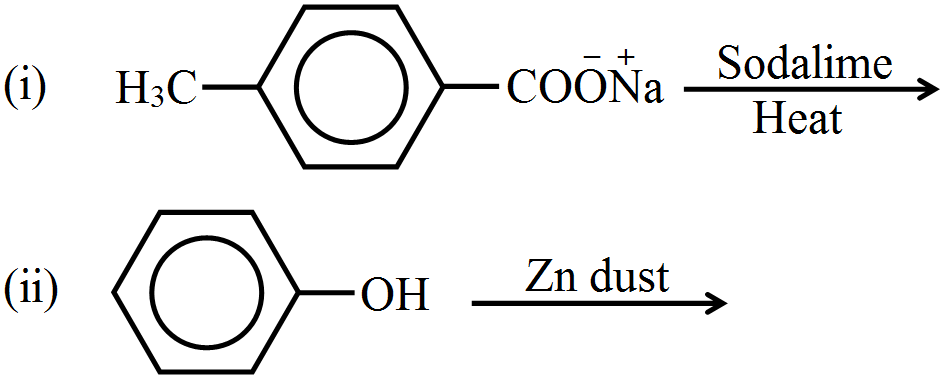
Complete the following:

Answer

Get the step-by-step solution for this question inside the Vidyadip app.

Get the answer in the app

Need a full question paper?

Generate a complete, print-ready paper with questions like this in minutes — across 16+ boards, with answer keys.
Start Generating Free

Similar questions

Derive relationship between free energy change and equilibrium state.
Explain the shape of $I^{-3}$ ion.
Why is $\mathrm{SO}_2$ considered air pollutant?
Which of the following are isoelectronic species i.e., those having the same number of electrons?
$
Na^{+}, K^{+}, Mg^{2+}, Ca^{2+}, S^{2-}, Ar
$
Knowing the properties of $\mathrm{H}_2 \mathrm{O}$ and $\mathrm{D}_2 \mathrm{O}$, do you think that $\mathrm{D}_2 \mathrm{O}$ can be used for drinking purposes?
$\mathrm{BF}_3$ does not have proton but still acts as an acid and reacts with $\mathrm{NH}_3$. Why is it so? What type of bond is formed between the two?
Element 'Al' belongs to group 13 forms ionic compounds. Write,
  1. Formula of its oxide.
  2. Arrange the following in decreasing order of electropositive character Li, Na, K, Cs Give reason.
The relation between pressure exerted by an ideal gas ( $\left.P _{\text {ideal }}\right)$ and observed pressure ( $\left.P _{\text {real }}\right)$ is given by the equation, $p _{\text {ideal }}= p _{\text {real }}+\frac{ an ^2}{V^2}$
i. If pressure is taken in $Nm ^{-2}$, number of moles in mol and volume in $m ^3$, calculate the unit of ' a '.
ii. What will be the unit of 'a' when pressure is in atmosphere and volume in $dm ^3$ ?
In a reaction $A+B_2 \rightarrow A B_2$, identify the limiting reagent when $2$ mole of $A$ are mixed with $3$ moles $B_2$.
In 250 ml solution, 12.6 gm crystalline oxalic acid is dissolved and density of solution is $1 . 1$ $gm / ml$ then calculate (a) molarity (b) normality (c) molality.