MCQ
Complete the reaction: ${ }_{86} \mathrm{Rn}^{220} \rightarrow{ }_{84} \mathrm{Po}^{216}+ ......$
  • A
    $\beta$
  • B
    $\gamma$
  • $\alpha$
  • D
    $\text{H}^1_1$

Answer

Correct option: C.
$\alpha$

${ }_{86} \mathrm{Rn}^{220} \rightarrow{ }_{84} \mathrm{Po}^{216}+z \mathrm{X}^A$
$Z + 84 = 86$ and $220 = 216 + A$
So, $Z = 2$ and $A = 4$
$2​​\alpha^4$
So, it is $\alpha$ particle.

Need a full question paper?

Generate a complete, print-ready paper with questions like this in minutes — across 16+ boards, with answer keys.
Start Generating Free

Similar questions

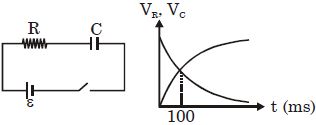
In the $RC$ circuit shown, switch is closed at $t = 0$ . Graphs showing variation of potential $(V_R)$ across resistor and potential $(V_C)$ across capacitor are given. Time constant of circuit is approximately equal to.....$ms$
Which of the following is not the unit of self inductance
Two charges each of 1 coulomb are at a distance 1 km apart, the force between them is
The plates of a parallel plate capacitor of capacity $50\,\mu C$ are charged to a potential of $100\;volts$ and then separated from each other so that the distance between them is doubled. How much is the energy spent in doing so
An electron $($mass $m)$ with an initial velocity $\text{v}=\text{v}_0\hat{\text{i}}(\text{v}_0>0)$ is in an electric field $\text{E}=-\text{E}_0\hat{\text{i}}(\text{E}_0=\text{constant}>0)$. It’s de Broglie wavelength at time $t$ is given by:
An electric field $\vec E\, = (25 \hat i + 30 \hat j)\,NC^{-1}$ exists in a region of space. If the potential at the origin is taken to be zero then the potential at $x\, = 2\, m, y\, = 2\, m$ is......$volt$
Two parallel, long wires are kept $0.20\,m$ apart in vacuum, each carrying current of $x$ in the same direction. If the force of attraction per meter of each wire is $2 \times 10^{-6}\,N$, then the value of $x$ is approximately
From the given data, the amount of energy required to break the nucleus of aluminium ${ }_{13}^{27} {Al}$ is $....\,x \times 10^{-3} {J}$

Mass of neutron $=1.00866 \,{u}$

Mass of proton $=1.00726 \,{u}$

Mass of aluminium nucleus $=27.18846\, {u}$

(Assume $1\,u$ corresponds to $x\,J$ of energy)

(Round off to the nearest integer)

If collector current is $120\, mA$ and base current is $2\, mA$ and resistance gain is $3$, what is power gain?
A horizontal straight conductor kept in north-south direction falls under gravity, then