MCQ
Complexes $[Co(NH_3)_5SO_4]Br$ and $[Co(NH_3)_5Br]SO_4$ can be distinguished by
- Aconductance measurement
- Busing $BaCl_2$
- Cusing $AgNO_3$
- ✓all
Generate a complete, print-ready paper with questions like this in minutes — across 16+ boards, with answer keys.
| Column $I$ | Column $II$ |
| $(A)$ $\mathrm{Cu}+$ dil $\mathrm{HNO}_3$ | $(p)$ NO |
| $(B)$ $\mathrm{Cu}+$ conc $\mathrm{HNO}_3$ | $(q)$ $\mathrm{NO}_2$ |
| $(C)$ $\mathrm{Zn}+$ dil $\mathrm{HNO}_3$ | $(r)$ $\mathrm{N}_2 \mathrm{O}$ |
| $(D)$ $\mathrm{Zn}+$ conc $\mathrm{HNO}_3$ | $(s)$ $\mathrm{Cu}\left(\mathrm{NO}_3\right)_2$ |
| $(t)$ $ \mathrm{Zn}\left(\mathrm{NO}_3\right)_2$ |
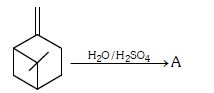

$HC \equiv CH\mathop {\xrightarrow{{30\%\, {H_2}S{O_4}}}}\limits_{HgS{O_4}} A\xrightarrow{{NaOH}}B$