Question
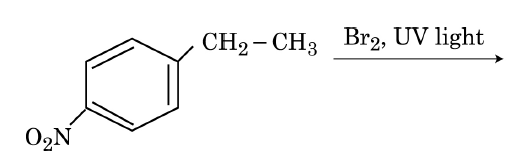
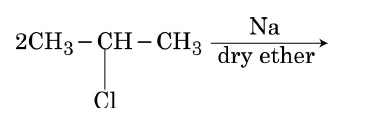
Complte the following reaction :

Image

Answer

$(iii) CH_3 CH_2 CONH_2$​​​​​​​

Need a full question paper?

Generate a complete, print-ready paper with questions like this in minutes — across 16+ boards, with answer keys.
Start Generating Free

Similar questions

What is the difference between multimolecular and macromolecular colloids? Give one example of each. How are associated colloids different from these two types of colloids?
A decimolar solution of potassium ferrocyanide is $50\%$ dissociated at $300K.$ Calculate the osmotic pressure of the solution. $(R = 8.314J\ K^{-1}\ mol^{-1}).$
The electrical resistance of a column of $0.05M$ NaOH solution of diameter $1 cm$ and length $50 cm$ is $5.55 x 10^3$ ohm. Calculate its resistivity, conductivity and molar conductivity.
Following reaction takes place in one step:
$\text{2NO(g)+O}_2\text{(g)}\rightarrow\text{2NO}_2\text{(g)}$
How will the rate of the above reaction change if the volume of the reaction vessel is reduced to one-third of its original volume? Will there be any change in the order of the reaction with reduced volume?
How would you achieve the following conversions:
  1. Nitrobenzene to aniline.
  2. An alkyl halide to a quaternary ammonium salt.
  3. Aniline to benzonitrile.
Write the chemical equation with reaction conditions in each case.
  1.  
  1.  
  1. $\text{CH}_{3}-\text{CH}_{2}-\text{ Br}\xrightarrow{\text{AgCN } } ?$
Vapour pressures of pure acetone and chloroform at $328$ K are $741.8$ mm Hg and $632.8$ mm Hg respectively. Assuming that they form ideal solution over the entire range of composition, plot $p_{total}, p_{chloroform},$ and $p_{acetone}$ as a function of $x_{acetone}$. The experimental data observed for different compositions of mixture is:
$100 \times x_{acetone}$ $0$ $11.8$ $23.4$ $36.0$ $50.8$ $58.2$ $64.5$ $72.1$
$p_{acetone}/ mm\ Hg$ $0$ $54.9$ $110.1$ $202.4$ $322.7$ $405.9$ $454.1$ $521.1$
$p_{chloroform}/ mm\ Hg$ $632.8$ $548.1$ $469.4$ $359.7$ $257.7$ $193.6$ $161.2$ $120.7$
Plot this data also on the same graph paper. Indicate whether it has positive deviation or negative deviation from the ideal solution.
Write a note on molecularity of a reaction and its different types.
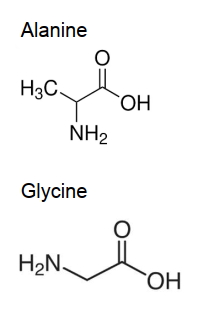
a. Give the structure of all the possible dipeptides formed when the following two amino acids form a peptide bond.
Image
b. Keratin, insulin, and myosin are a few examples of proteins present in the human body. Identify which type of protein is keratin and insulin and differentiate between them based on their physical properties.
What is essentially the difference between $\alpha$-glucose and $\beta$-glucose? What is meant by pyranose structure of glucose?