Question
What is essentially the difference between $\alpha$-glucose and $\beta$-glucose? What is meant by pyranose structure of glucose?

Answer

$\alpha$-glucose $\& \beta$ glucose differ only in the orientation of the hydroxyl group at $\mathrm{C}_1$ position. In $\alpha$-glucose the OH group is on right-hand side at $\mathrm{C}_1$ position whereas in $\beta$-glucose the OH group is on left-hand side at $\mathrm{C}_1$ position. The six-membered hetero cyclic structure of glucose is called pyranose structure.

Need a full question paper?

Generate a complete, print-ready paper with questions like this in minutes — across 16+ boards, with answer keys.
Start Generating Free

Similar questions

An aromatic compound $‘A’$ on heating with $Br_2$ and $KOH$ forms a compound $‘B’$ of molecular formula $C_6H_7N$ which on reacting with $CHCl_3$ and alcoholic $KOH$ produces a foul smelling compound $‘C’.$ Write the structures and IUPAC names of compounds $A, B$ and $C.$
Give reasons for the following:
  1. Ethyl iodide undergoes $S_N2$ reaction faster than ethyl bromide.
  2. $(\pm)$ 2-Butanol is optically inactive.
  3. C-X bond length in halobenzene is smaller than C-X bond length in $CH_3-X$.
Write the reactions involved when D-glucose is treated with the following reagents:
i. $\mathrm{Br}_2$ water
ii. $\mathrm{H}_2 \mathrm{N}-\mathrm{OH}$
iii. $\left(\mathrm{CH}_3 \mathrm{CO}\right)_2 \mathrm{O}$
Explain nitration of phenol in detail.
An organic compound ' $A$ ' $\left(\mathrm{C}_3 \mathrm{H}_4\right)$ on hydration in presence of $\mathrm{H}_2 \mathrm{SO}_4 / \mathrm{HgSO}_4$ gives compound '$B$' $\left(\mathrm{C}_3 \mathrm{H}_6 \mathrm{O}\right)$. Compound 'B' gives white crystalline product ( D ) with sodium hydrogensulphite. It gives negative Tollens' test and positive iodoform's test. On drastic oxidation 'B' gives compound ' $\mathrm{C}^{\prime}\left(\mathrm{C}_2 \mathrm{H}_4 \mathrm{O}_2\right)$ along with formic acid. Identify compounds ' A ', ' B ' and ' C ' and explain all the reactions.
How would you account for the following:
  1. $NCl_3$ is an endothermic compound while $NF_3$ is an exothermic one.
  2. $XeF_2$ is a linear molecule without a bend.
  3. The electron gain enthalpy with negative sign for fluorine is less than that for chlorine, still fluorine is a stronger oxidising agent than chlorine.
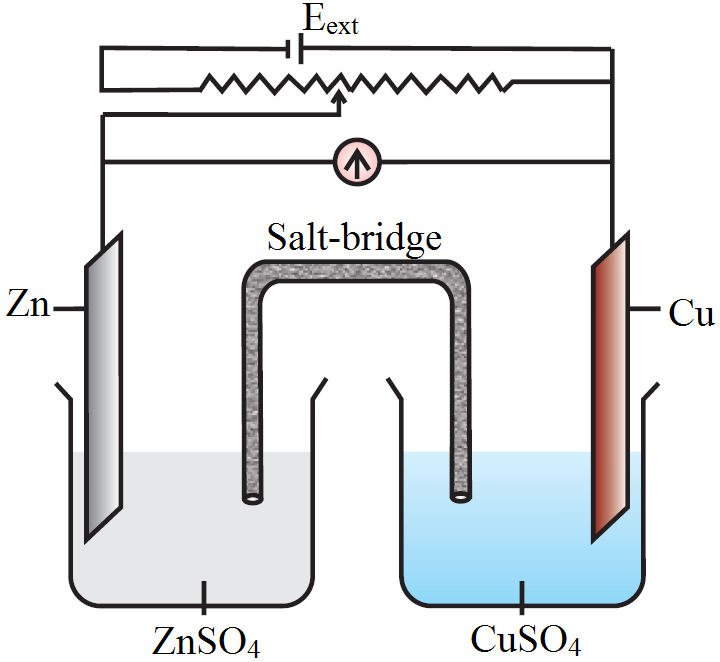
The electrochemical cell given alongside converts the chemical energy released during the redox reaction
$\text{Zn(s) + Cu}^{2+}\text{(aq)}\xrightarrow{ \ \ \ \ \ \ \ }\text{Zn}^{2+}(\text{aq) + Cu(s)}$
to electrical energy. It gives an electrical potential of $1.1V$ when concentration $Zn^{2+}$ and $Cu^{2+}$ ions is unity. State the direction of flow of current and also specify whether zinc and copper are deposited or dissolved at their respective electrodes when:
  1. An external opposite potential of less than $1.1V$ is applied.
  2. An external potential of $1.1V$ is applied.
  3. An external potential of greater than $1.1V$ is applied.
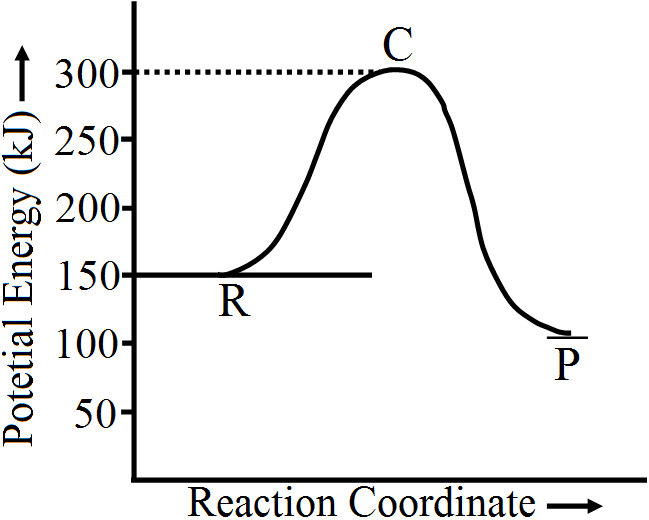
Answer the following questions on the basis of the given plot of potential energy vs reaction coordinate:
  1. What is the threshold energy for the reaction?
  2. What is the activation energy for forward reaction?
  3. What is the activation energy for backward reaction?
  4. What is enthalpy change for the forward reaction?
A compound formed by elements $A$ and $B$ has a cubic structure in which $A$ atoms are at the corners of the cube and $B$ atoms are at the face centres. Derive the formula of the compound.
Identify the metal and justify your answer.
  1. Carbonyl M $(CO)_5$
  2. $MO_3F$