MCQ
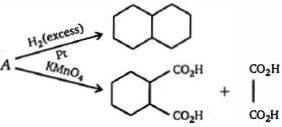
Compound $(A)$ is
  • A


  • C

  • D

Answer

Correct option: B.

b
$(b)$ Conjugated Dienes on $KMnO_4 / \Delta$ give oxalic acid

Need a full question paper?

Generate a complete, print-ready paper with questions like this in minutes — across 16+ boards, with answer keys.

Start Generating Free

Similar questions

A solution of sodium sulphate in water is electrolysed using platinum electrodes. The products at cathode and anode are respectively
The $pH $ of pure water or neutral solution at $50\,^oC$ is …. $(p{K_w} = 13.26$$ = 13.26$ at $50\,^oC)$
In $PO_4^{3 - }$ ion, the formal charge on each oxygen atom and $P - O$ bond order respectively are
The equilibrium constant $K_{c}$ at $298\, \mathrm{~K}$ for the reaction  $\mathrm{A}+\mathrm{B} \rightleftharpoons \mathrm{C}+\mathrm{D}$  is $100 .$ Starting with an equimolar solution with concentrations of $\mathrm{A}, \mathrm{B}, \mathrm{C}$ and $\mathrm{D}$ all equal to $1\, \mathrm{M}$, the equilibrium concentration of $D$ is $.......\times 10^{-2}$ M. (Nearest integer)
Identify the reaction order from the following rate constants.
$k=3 \times 10^{-4} s^{-1}$
Given below are two statements, one is labeled as Assertion $(A)$ and other is labeled as Reason $(R).$

Assertion $(A):$ Gabriel phthalimide synthesis cannot be used to prepare aromatic primary amines.

Reason $(R) :$ Aryl halides do not undergo nucleophilic substitution reaction.

In the light of the above statements, choose the correct answer form the options given below.

Which of the following is correct on the basis of hund's rule but not follow Pauli's principle
In which structure central carbon ($C-3$) not chiral centre ?
Ligands, in complex compounds
The enthalpy and entropy change for the reaction :

$Br_{2(l)} + Cl_{2(g)} \rightarrow 2BrCl_{(g)}$

are $30\ kJ\ mol^{-1}$ and $105\ J\ K^{-1} mol^{-1}$ respectively. The temperature at which the reaction will be in equilibrium is ............... $\mathrm{K}$