Compressibility per unit atm. pressure of water is $'\sigma '$ and if due to pressure $P$ there is decrement in volume $V$, find change is volume
Medium


Download our appand get started for free
Experience the future of education. Simply download our apps or reach out to us for more information. Let's shape the future of learning together!No signup needed.*
Similar Questions
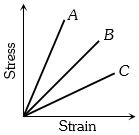
- 1The stress-strain curves for brass, steel and rubber are shown in the figure. The lines $A, B$ and $C$ are forView Solution
- 2If one end of a wire is fixed with a rigid support and the other end is stretched by a force of $10 \,N,$ then the increase in length is $0.5\, mm$. The ratio of the energy of the wire and the work done in displacing it through $1.5\, mm$ by the weight isView Solution
- 3Steel ruptures when a shear of $3 .5 \times 10^8\,\,N\,m^{-2}$ is applied. The force needed to punch a $1\,cm$ diameter hole in a steel sheet $0.3\,cm$ thick is nearlyView Solution
- 4A brass rod of cross-sectional area $1\,c{m^2}$ and length $0.2\, m$ is compressed lengthwise by a weight of $5\, kg$. If Young's modulus of elasticity of brass is $1 \times {10^{11}}\,N/{m^2}$ and $g = 10\,m/{\sec ^2}$, then increase in the energy of the rod will beView Solution
- 5If the compressibility of water is $\sigma $ per unit atmospheric pressure, then the decrease in volume $V$ due to $P$ atmospheric pressure will beView Solution
- 6View SolutionWhich of the following is the graph showing stress-strain variation for elastomers?
- 7The Poisson's ratio of a material is $0.5$. If a force is applied to a wire of this material, there is a decrease in the cross-sectional area by $4 \%$. The percentage increase in the length is ........ $\%$View Solution
- 8A metal block of mass $m$ is suspended from a rigid support through a metal wire of diameter $14\,mm$. The tensile stress developed in the wire under equilibrium state is $7 \times 10^5\,Nm ^{-2}$. The value of mass $m$ is $......kg$.View Solution
(Take, $g =9.8\,ms ^{-2}$ and $\left.\pi=\frac{22}{7}\right)$
- 9If the potential energy of a spring is $V$ on stretching it by $2\, cm$, then its potential energy when it is stretched by $10 \,cm$ will beView Solution
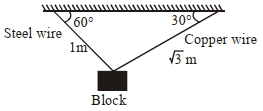
- 10A block of weight $100 N$ is suspended by copper and steel wires of same cross sectional area $0.5 cm ^2$ and, length $\sqrt{3} m$ and $1 m$, respectively. Their other ends are fixed on a ceiling as shown in figure. The angles subtended by copper and steel wires with ceiling are $30^{\circ}$ and $60^{\circ}$, respectively. If elongation in copper wire is $\left(\Delta \ell_{ C }\right)$ and elongation in steel wire is $\left(\Delta \ell_{ s }\right)$, then the ratio $\frac{\Delta \ell_{ C }}{\Delta \ell_{ S }}$ is. . . . . .View Solution
[Young's modulus for copper and steel are $1 \times 10^{11} N / m ^2$ and $2 \times 10^{11} N / m ^2$ respectively]