A metal block of mass $m$ is suspended from a rigid support through a metal wire of diameter $14\,mm$. The tensile stress developed in the wire under equilibrium state is $7 \times 10^5\,Nm ^{-2}$. The value of mass $m$ is $......kg$.
(Take, $g =9.8\,ms ^{-2}$ and $\left.\pi=\frac{22}{7}\right)$
JEE MAIN 2023, Medium
Download our app for free and get started
Tensile stress, $\sigma=\frac{F}{A}=\frac{4 m g}{\pi D^2}$
$\therefore m=\frac{\pi D^2 \sigma}{4 g}$
$=\frac{22}{7} \times \frac{\left(14 \times 10^{-3}\right)^2 \times 7 \times 10^5}{4 \times 9.8}$
$=11\,kg$

Download our appand get started for free
Experience the future of education. Simply download our apps or reach out to us for more information. Let's shape the future of learning together!No signup needed.*
Similar Questions
- 1When a certain weight is suspended from a long uniform wire, its length increases by one cm. If the same weight is suspended from another wire of the same material and length but having a diameter half of the first one then the increase in length will be ........ $cm$View Solution
- 2A metal wire of length $'L'$ is suspended vertically from a rigid support. When a body of mass $M$ is attached to the lower end of wire, the elongation in wire is $'l'$, consider the following statementsView Solution
$(I)$ the loss of gravitational potential energy of mass $M$ is $Mgl$
$(II)$ the elastic potential energy stored in the wire is $Mgl$
$(III)$ the elastic potential energy stored in wire is $\frac{1}{2}\, Mg l$
$(IV)$ heat produced is $\frac{1}{2}\, Mg l$
Correct statement are :-
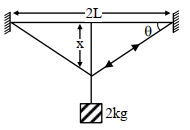
- 3A wire of cross sectional area $A$, modulus of elasticity $2 \times 10^{11} \mathrm{Nm}^{-2}$ and length $2 \mathrm{~m}$ is stretched between two vertical rigid supports. When a mass of $2 \mathrm{~kg}$ is suspended at the middle it sags lower from its original position making angle $\theta=\frac{1}{100}$ radian on the points of support. The value of $A$ is. . . . . . $\times 10^{-4} \mathrm{~m}^2$ (consider $\mathrm{x}<\mathrm{L}$ ).View Solution
(given: $\mathrm{g}=10 \mathrm{~m} / \mathrm{s}^2$ )
- 4View SolutionAccording to Hook’s law force is proportional to
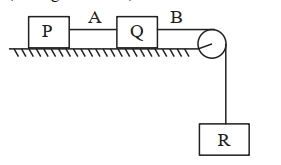
- 5Each of three blocks $P$, $Q$ and $R$ shown in figure has a mass of $3 \mathrm{~kg}$. Each of the wire $A$ and $B$ has cross-sectional area $0.005 \mathrm{~cm}^2$ and Young's modulus $2 \times 10^{11} \mathrm{~N} \mathrm{~m}^{-2}$. Neglecting friction, the longitudinal strain on wire $B$ is____________ $\times 10^{-4}$. $\left(\right.$ Take $\mathrm{g}=10 \mathrm{~m} / \mathrm{s}^2$ )View Solution
- 6$A$ current of $(2.5 \pm 0.05)$ $A$ flows through a wire and develops a potential difference of $(10 \pm 0.1)$ $\mathrm{volt}.$ Resistance of the wire in $\mathrm{ohm},$ isView Solution
- 7A rod of length $L$ at room temperature and uniform area of cross section $A$, is made of a metal having coefficient of linear expansion $\alpha {/^o}C$. It is observed that an external compressive force $F$, is applied on each of its ends, prevents any change in the length of the rod, when it temperature rises by $\Delta \,TK$. Young’s modulus, $Y$, for this metal isView Solution
- 8A sample of a liquid has an initial volume of $1.5\,L$ . The volume is reduced by $0.2\,mL$ , when the pressure increases by $140\,kP$ . What is the bulk modulus of the liquidView Solution
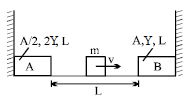
- 9In the given figure, two elastic rods $A$ & $B$ are rigidly joined to end supports. $A$ small mass $‘m’$ is moving with velocity $v$ between the rods. All collisions are assumed to be elastic & the surface is given to be frictionless. The time period of small mass $‘m’$ will be : [$A=$ area of cross section, $Y =$ Young’s modulus, $L=$ length of each rod ; here, an elastic rod may be treated as a spring of spring constant $\frac{{YA}}{L}$ ]View Solution
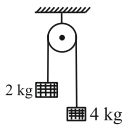
- 10Two blocks of mass $2 \mathrm{~kg}$ and $4 \mathrm{~kg}$ are connected by a metal wire going over a smooth pulley as shown in figure. The radius of wire is $4.0 \times 10^{-5}$ $\mathrm{m}$ and Young's modulus of the metal is $2.0 \times 10^{11} \mathrm{~N} / \mathrm{m}^2$. The longitudinal strain developed in the wire is $\frac{1}{\alpha \pi}$. The value of $\alpha$ is [Use $\mathrm{g}=10 \mathrm{~m} / \mathrm{s}^2$ )View Solution