Question

Answer

(i) Total number of schools = 1000
Number of schools having more than 100 computers = 80
∴ Probability that the school chosen at random has more than 100 computers $=\frac{80}{1000}=0.08$
(i) Number of schools having 50 or fewer computers = 250 + 200 + 290 = 740
∴ Required probability $=\frac{740}{1000}=0.74$
(ii) Number of schools having not more than 20 computers = 250 + 200 = 450
∴ Required probability $=\frac{450}{1000}=0.45$
(iv) Number of schools having 10 or less than 10 computers = 250
∴ Required probability $=\frac{250}{1000}=0.25$

Need a full question paper?

Generate a complete, print-ready paper with questions like this in minutes — across 16+ boards, with answer keys.

Start Generating Free

Similar questions

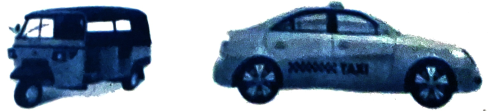
It is common that governments revise travel fares from time to time based on various factors such as inflation (a general increase in prices and fall in the purchasing value of money) on different types of vehicles like auto rickshaws, taxis, radio cabs etc. The auto charges in a city comprise of a fixed charge together with the charge for the distance covered. Study the following situations:
Image

Name of the CityDistance travelled (km)( Amount paid (₹))
City A1075
15110
City B891
14145
(i) If the fixed charges of autorickshaw be ₹ $x$ and the running charges be ₹ $y$ per km, the pair of linoar equations representing the travel in city $A$ is
(a) $x+10 y=75, x+5 y=145$
(b) $x+10 y=75, x+15 y=110$
(c) $x+8 y=91, x+14 y=145$
(d) $x+8 y=145, x+14 y=91$
(ii) If the fixed charges of autorikshaw be ₹$ x$ and the running charges be ₹$ y$ per km, the pair of linoar equations representing the travel in City $B$ is
(a) $x+10 y=75, x+5 y=145$
(b) $x+10 y=75, x+15 y=110$
(c) $x+8 y=91, x+14 y=145$
(d) $x+8 y=145, x+14 y=91$
(iii) The amount paid by a person travelling 100 km in city $A$ is
(a) ₹ 310 $\qquad$ (b) ₹ 510 $\qquad$ (c) ₹ 705 $\qquad$ (d) ₹ 710
(iv) The amount paid by a person travelling 60 km in city $B$ is
(a) ₹ 370 $\qquad$ (b) ₹ 578 $\qquad$ (c) ₹ 559 $\qquad$ (d) ₹ 610
Read the following text carefully and answer the questions that follow:
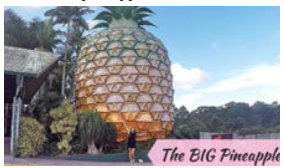
Statue of a Pineapple: The Big Pineapple is a heritage $-$ listed tourist attraction at Nambour Connection Road, Woombye, Sunshine Coast Region, Queensland, Australia. It was designed by Peddle Thorp and Harvey, Paul Luff, and Gary Smallcombe and Associates. It is also known as Sunshine Plantation. It was added to the Queensland Heritage Register on $6$ March $2009$.
Kavita last year visited Nambour and wanted to find the height of a statue of a pineapple. She measured the pineapple's shadow and her own shadow. Her height is $156 \ cm$ and casts a shadow of $39 \ cm$. The length of shadow of pineapple is $4 \ m$.
Image
$i$. What is the height of the pineapple?
$ii$. What is the height Kavita in metres?
$iii.$ Write the type of triangles used to solve this problem.
OR
Which similarity criterion of triangle is used?
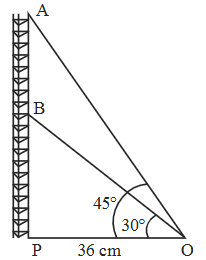
Radio towers are used for transmitting a range of communication services including radio and television. The tower will either act as an antenna itself or support one or more antennas on its structure. On a similar concept, a radio station tower was built in two Sections A and B. Tower is supported by wires from a point $O$.
Distance between the base of the tower and point O is 36 cm . From point O , the angle of elevation of the top of the Section B is $30^{\circ}$ and the angle of elevation of the top of Section $A$ is $45^{\circ}$.
Image
Based on the above information, answer the following questions:
(i) Find the length of the wire from the point O to the top of Section B.
(ii) Find the distance $A B$.
OR
Find the area of $\triangle OPB$.
(iii) Find the height of the Section A from the base of the tower.

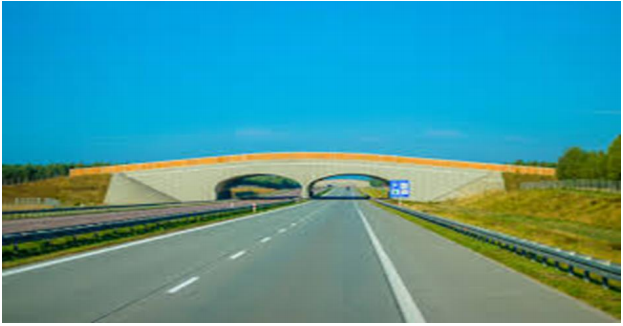
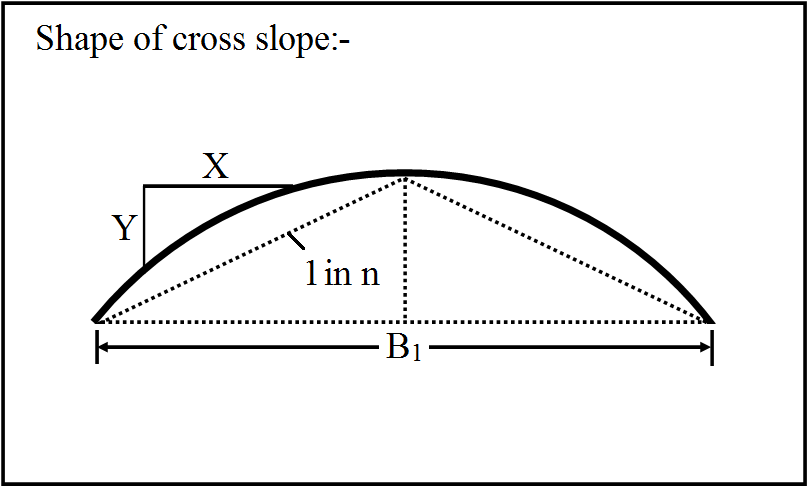
Applications of Parabolas-Highway Overpasses/ Underpasses A highway underpass is parabolic in shape.


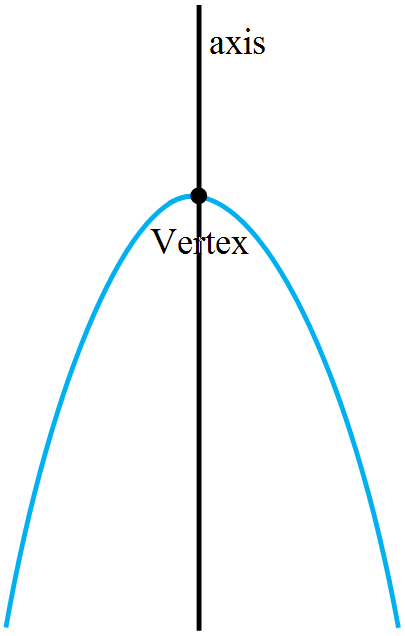
Parabola: A parabola is the graph that results from $p(x) = ax^2 + bx + c$ Parabolas are symmetric about a vertical line known as the Axis of Symmetry. The Axis of Symmetry runs through the maximum or minimum point of the parabola which is called the vertex.
  1. The highway overpass is represented graphically. Zeroes of a polynomial can be expressed graphically. Number of zeroes of polynomial is equal to number of points where the graph of polynomial:
  2. Graph of a quadratic polynomial is a:
  3. The representation of Highway Underpass whose one zero is 10 and sum of the zeroes is 16, is:
    Or
    The number of zeroes that polynomial $f(x) = (x - 3)^2 + 1$ can have is:
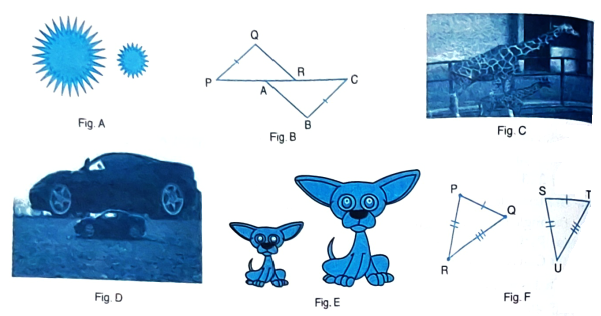
Observe the below given figures carefully and answer the questions:
Image
(i) Which among the above shown figures are congruent figures?
(a) A and C $\qquad$ (b) $E$ and $F$ $\qquad$ (c) $D$ and $F$ $\qquad$ (d) $B$ and $F$
(ii) Which of the following statements is correct?
(a) All similar figures are congruent.
(b) All congruent figures are similar.
(c) The criterion for similarity and congruency is same.
(d) Similar figures have same size and shape.
(iii) If a line divides any two sides of the triangle in the same ratio, then the line is parallel to the third side. Which theorem is depicted by this statement?
(a) Pythagoras
(b) Thales Theorem
(c) Converse of Thales theorem
(d) Converse of Pythagoras theorem
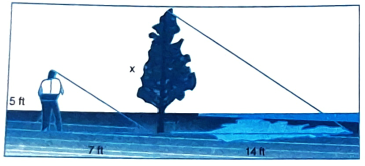
(iv) Using the concept of similarity, the height of the tree is
Image
(a) 12 ft $\qquad$ (b) 10 ft $\qquad$ (c) 15 ft $\qquad$ (d) 7 ft
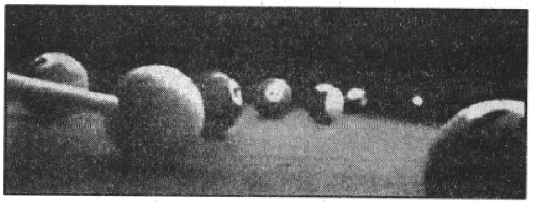
"Eight Ball" is a game played on a pool table with $15$ balls numbered $1$ to $15$ and $a$ "cue ball" that is solid and white. Of the $15$ numbered balls, eight are solid $($non$-$white$)$ coloured and numbered $1$ to $8$ and seven are striped balls numbered $9$ to $15.$

Image
The $15$ numbered pool balls $($no cue ball$)$ are placed in a large bowl and mixed, then one ball is drawn out at random.
Based on the above information, answer the following questions:
$(i)$ What is the probability that the drawn ball bears number $8$?
$(ii)$ What is the probability that the drawn ball bears an even number?
OR
What is the probability that the drawn ball bears a number, which is a multiple of $3$ ?
$(iii)$ What is the probability that the drawn ball is a solid coloured and bears an even number?
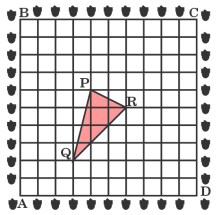
A garden is in the shape of a square. The gardener grew saplings of Ashoka tree on the boundary of the garden at the distance of $1 m$ from each other. He wants to decorate the garden with rose plants. He chose a triangular region inside the garden to grow rose plants. In the above situation, the gardener took help from the students of class $10$. They made a chart for it which looks like the given figure.
Image
Based on the above, answer the following questions :
$(i)$ If $A$ is taken as origin, what are the coordinates of the vertices of $\triangle PQR$ ?
$(ii) \ (a)$ Find distances $PQ$ and $QR$ .
OR
$(b)$ Find the coordinates of the point which divides the line segment joining points $P$ and $R$ in the ratio $2: 1$ internally.
$(iii)$ Find out if $\triangle PQR$ is an isosceles triangle.
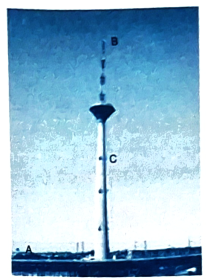
The following TV Tower was built in 1988 and is located in Pitampura, Delhi. It has an observation deck. Observe the picture given below:
Image
The TV Tower stands vertically on the ground. From a point ' $A$ ' on the ground, the angle of elevation of top of the tower (point ' $B$ ') is $60^{\circ}$. There is a point ' $C ^{\prime}$ ' on the tower which is 78 m (approx.) above the ground. The angle of elevation of the point $C$ from point $A$ is found to be $30^{\circ}$.
(i) Draw a well-labelled figure, based on the information given above.
(ii) Find the height of the tower and the distance of the tower from point $A$.