Question types

Probability question types

326 questions across 8 question groups — pick any mix to generate a Maths paper with step-by-step answer keys.

326
Questions
8
Question groups
5
Question types
Sample Questions

Probability questions

One sample from each question group in this chapter. Select any group above to see the full set with answer keys.

A bag contains cards numbered from 1 to 25. A card is drawn at random from the bag. The probability that the number on this card is divisible by both 2 and 3 is:
  • A
    $\frac{1}{5}$
  • B
    $\frac{3}{25}$
  • $\frac{4}{25}$
  • D
    $\frac{2}{25}$

Answer: C.

View full solution
Two dice are rolled simultaneously. The probability that they show different faces is:
  • A
    $\frac{2}{3}$
  • B
    $\frac{1}{6}$
  • C
    $\frac{1}{3}$
  • $\frac{5}{6}$

Answer: D.

View full solution
A bag contains three green marbles, four blue marbles and two orange marbles. If a marble is picked at random, then the probability that it is not an orange marble is:
  • A
    $\frac{1}{4}$
  • B
    $\frac{1}{3}$
  • C
    $\frac{4}{9}$
  • $\frac{7}{9}$

Answer: D.

View full solution
In a single throw of a die, the probability of getting a multiple of 3 is:
  • A
    $\frac{1}{2}$
  • $\frac{1}{3}$
  • C
    $\frac{1}{6}$
  • D
    $\frac{2}{3}$

Answer: B.

View full solution
Statement-1 (A): In a cricket match, a batsman hits a boundary 9 times out of 45 balls he plays. The probability that in a given ball, he does hit the boundary is $\frac{4}{5}$.
Statement-2 (R): P(E) + P(notE) = 1
  • Statement-1 is true, Statement-2 is true; Statement-2 is a correct explanation for Statement-1.
  • B
    Statement-1 is true, Statement-2 is true; Statement-2 is not a correct explanation for Statement-7
  • C
    Statement-1 is true, Statement-2 is false.
  • D
    Statement-1 is false, Statement-2 is true.

Answer: A.

View full solution
Statement-1 (A): Avni and Manvi were born in the year 2000. The probability that they have the same birthday is $\frac{1}{366}$.
Statement-2 (R): Leap year has 366 days.
  • Statement-1 is true, Statement-2 is true; Statement-2 is a correct explanation for Statement-1.
  • B
    Statement-1 is true, Statement-2 is true; Statement-2 is not a correct explanation for Statement-6
  • C
    Statement-1 is true, Statement-2 is false.
  • D
    Statement-1 is false, Statement-2 is true.

Answer: A.

View full solution
Statement-1 (A): A four digit number is formed using the digits 1, 2, 5, 6 and 8 without repetition. The probability that it is an even number is $\frac{3}{5}$.
Statement-2 (R): The units digit of even number is also an even number.
  • A
    Statement-1 is true, Statement-2 is true; Statement-2 is a correct explanation for Statement-1.
  • Statement-1 is true, Statement-2 is true; Statement-2 is not a correct explanation for Statement-5
  • C
    Statement-1 is true, Statement-2 is false.
  • D
    Statement-1 is false, Statement-2 is true.

Answer: B.

View full solution
Statement-1 (A): A number is selected from the numbers 1, 2, 3, ..., 10. The probability that it is a root of the equation$x^2-2 x+1=0$ is $\frac{1}{5}$.
Statement-2 (R): The equation $x^2-2 x+1=0$ has two roots
  • A
    Statement-1 is true, Statement-2 is true; Statement-2 is a correct explanation for Statement-1.
  • B
    Statement-1 is true, Statement-2 is true; Statement-2 is not a correct explanation for Statement-4
  • C
    Statement-1 is true, Statement-2 is false.
  • Statement-1 is false, Statement-2 is true.

Answer: D.

View full solution
Statement-1 (A): A cubical die is rolled. The probability of getting a composite number is $\frac{1}{3}$.
Statement-2 (R): In a throw of a cubical die, the probability of getting a prime number is $\frac{2}{3}$.
  • A
    Statement-1 is true, Statement-2 is true; Statement-2 is a correct explanation for Statement-1.
  • B
    Statement-1 is true, Statement-2 is true; Statement-2 is not a correct explanation for Statement-3
  • Statement-1 is true, Statement-2 is false.
  • D
    Statement-1 is false, Statement-2 is true.

Answer: C.

View full solution
A box contains 20 cards numbered from 1 to 20. A card is drawn at random from the box. Find the probability that the number on the drawn card is:
  1. Divisible by 2 or 3.
  2. A prime number.
View full solution
Examine each of the following statements and comment:
If a die in thrown once, there are two possible outcomes - an odd number or an even number. Therefore, the probability of obtaining an odd number is $\frac{1}{2}$ and the probability of obtaining an even number is $\frac{1}{2}$.
View full solution
Q 263 Marks Question3 Marks
A bag contains 3 red balls and 5 black balls. A ball is drawn at random from the bag. What is the probability that the ball drawn is:
  1. Red.
  2. Black.
View full solution
Q 273 Marks Question3 Marks
A group consists of 12 persons, of which 3 are extremely patient, other 6 are extremely honest and rest are extremely kind. A person form the group is selected at random. Assuming that each person is equally likely to be selected, find the probability of selecting a person who is:
  1. Extremely patient.
  2. Extremely kind or honest.
Which of the above you prefer more.
View full solution
Q 283 Marks Question3 Marks
A box contains 5 red marbles, 8 white marbles and 4 green marbles. One marble is taken out of the box at random. What is the probability that the marble taken out will be:
  1. Red?
  2. White?
  3. Not green?
View full solution
Q 293 Marks Question3 Marks
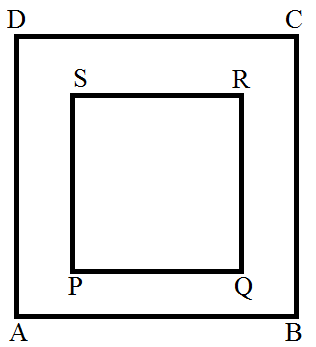
In the figure, a square dart board is shown. The length of a side of the larger square is $1.5$ times the length of a side of the smaller square. If a dart is thrown and lands on the larger square. What is the probability that it will land in the interior of the smaller square?
View full solution
Q 303 Marks Question3 Marks
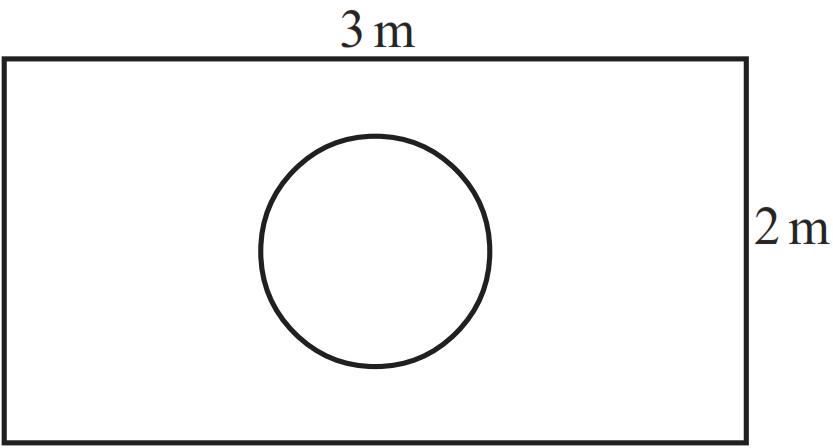
Suppose you drop a tie at random on the rectangular region shown in the given figure. What is the probability that it will land inside the circle with diameter 1m?
View full solution
A piggy bank contains hundred 50 paise coins, fifity ₹1 coins, twenty ₹2 coins and ten ₹5 coins. If it is equally likely that one of the coins will fall out when the bank is turned upside down, find the probability that the coin which fell:
  1. Will be a 50 paise coin.
  2. Will be of value more than ₹1.
  3. Will be of value less than ₹5.
  4. Will be a ₹1 or ₹2 coin.
View full solution
Cards numbered 1 to 30 are put in a bag. A card is drawn at random from this bag. Find the probability that the number on the drawn card is:
  1. Not divisible by 3.
  2. A prime number great than 7.
  3. Not a perfect square number.
View full solution
Cards marked with numbers 13, 14, 15, ....., 60 are placed in a box and mixed thoroughly. One card is drawn at random from the box. Find the probability that number on the card drawn is:
  1. Divisible by 5.
  2. A number is a perfect square.
View full solution
A bag contains 6 red balls and some blue balls. if the probability of a drawing a blue ball from the bag is twice that of a red ball, find the number of blue balls in the bag.
View full solution
All the black face cards are removed from a pack of 52 cards. The remaining cards are well shuffled and then a card is drawn at random. Find the probability to getting a:
  1. Face card.
  2. Red card.
  3. Black card.
  4. King.
View full solution
View full solution
View full solution
View full solution
View full solution
View full solution

Generate a Probability paper free

Pick question groups from the list above, set marks and difficulty, and export a branded PDF with step-by-step answer keys. First 3 chapters free — no signup.
Download App