Question
Computerised accounting system is the best form of accounting system. Do you agree? Comment.

Answer

Yes, Computerised accounting system is the best form of accounting system Advantages of Computerised Accounting System:
  1. High Speed: The accounting speed of a computer is much faster than that of a human being.
  2. High Reliability: The extent of reliability of the information generated by a computer is immense. The reliability remains the same despite the volume of the work whereas the reliability of a human work can be doubtful in case of voluminous work.
  3. Accuracy: The accuracy of a computer cannot be doubted once a particular program is fed. All the results based on such program would be 100% accurate whereas the results produced by a human being can vary due to fatigue, carelessness, etc.
  4. Updation of Information: All the related records in a computer get automatically updated once any information is punched in, whereas in case of manual accounts all the records will have to be altered one by one.
  5. Efficiency: The computer based accounting systems ensure better and efficient use of resources and time.
  6. Legibility: The data displayed on a computer screen is clear and legible thus avoiding errors caused by untidy writing in a manual accounting system.
  7. Lower Cost: The cost of maintaining accounts under the computerised system is much lower as compared to the manual system.

Need a full question paper?

Generate a complete, print-ready paper with questions like this in minutes — across 16+ boards, with answer keys.
Start Generating Free

Similar questions

Distinguish between capital and revenue expenditure and state whether the following statements are items of capital or revenue expenditure:
  1. Expenditure incurred on repairs and whitewashing at the time of purchase of an old building in order to make it usable.
  2. Expenditure incurred to provide one more exit in a cinema hall in compliance with a government order.
  3. Registration fees paid at the time of purchase of a building.
  4. Expenditure incurred in the maintenance of a tea garden which will produce tea after four years.
  5. Depreciation charged on a plant.
  6. The expenditure incurred in erecting a platform on which a machine will be fixed.
  7. Advertising expenditure, the benefits of which will last for four years.
The original cost of furniture amounted to ₹ 4,000 and it is decided to write off 5% on the original cost as Depreciation at the end of each year. Show the Ledger Account as it will appear during the first four years. Show also how the same account will appear if it was decided to write off 5% p.a. on the diminishing balance of the asset each year.
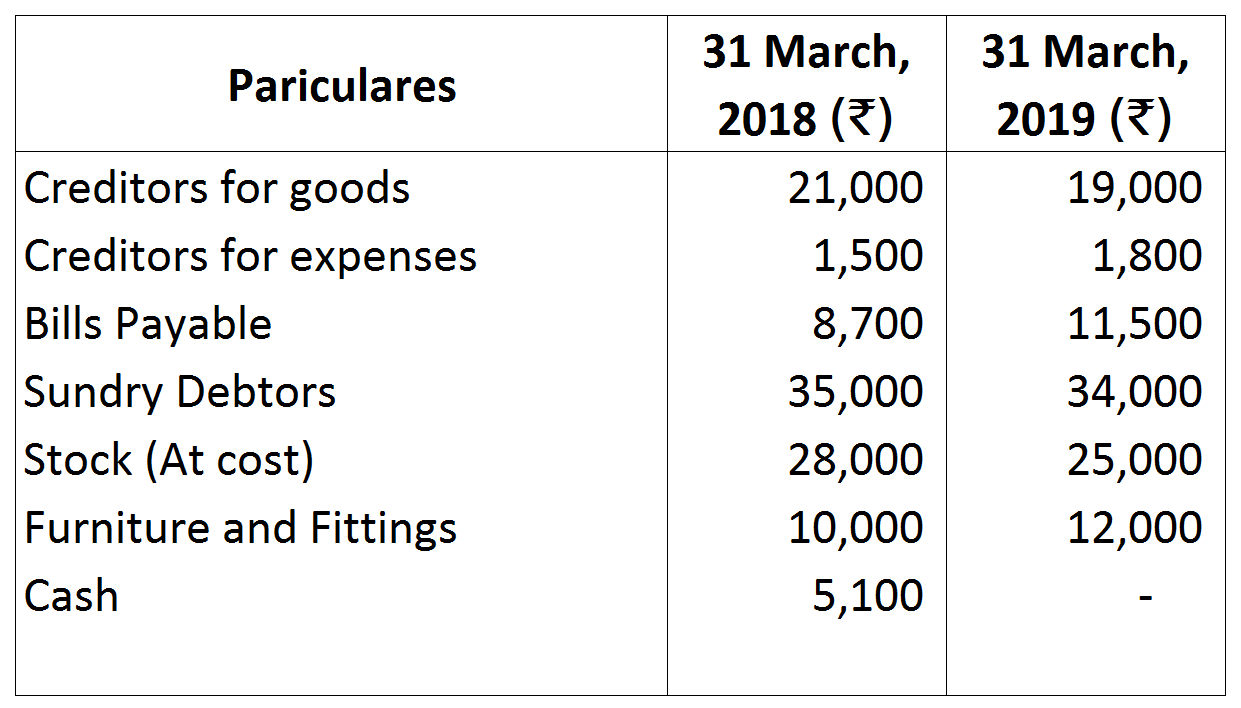
Surya does not keep a systematic record of his transactions. He is able to give you the following information regarding his assets and liabilities:
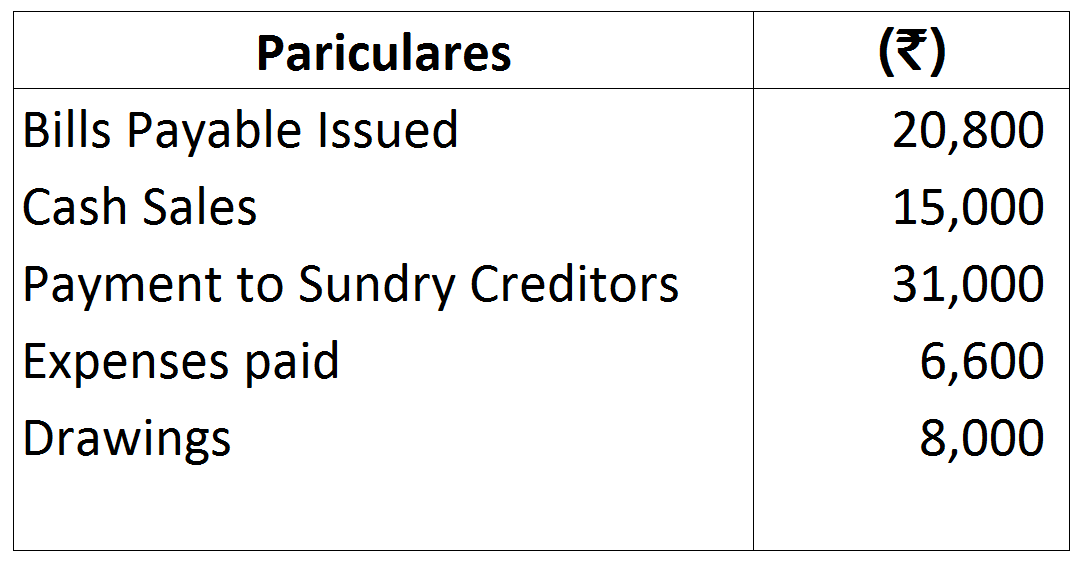
Following additional information is also available for the year ended 31st March, 2019:

Bad Debts during the year were ₹ 900. As regards sale, Surya tells you that he always sells goods at Cost plus 25%. Furniture and Fittings are to be depreciated at 10% of the value in the beginning of the year. Prepare Surya's Trading and Profit and Loss Account for the year ended 31st March, 2019 and his Balance Sheet on that date.
On 1st January, 2019, A drew a bill on B for ₹ 10,000 payable after 3 months. B accepted the bill and returned it to A. After 10 days, A endorsed the bill to his creditor C. On the due date, the bill was dishonoured and C paid ₹ 50 as noting charges.
Record the transactions in the books of A, B and C.
Write the following transactions in the Cash Book of Premium Stores, Kolkata (Proprietor Amrit Kumar):
2019
 
Jan. 1
Commenced business with cash
50,000
Jan. 2
Opened Bank Account and deposited cash in bank
20,000
 
Purchased goods in cash of ₹ 5,000 plus CGST and SGST @ 6% each
5,000
Jan. 4
Paid wages
500
Jan. 6
Cash sales of ₹ 2,000 plus CGST and SGST @ 6% each
2,000
 
Purchased goods for ₹ 10,000 plus CGST and SGST @ 6% each for cash
 
Jan. 10
Sold goods of ₹ 4,000 plus CGST and SGST @ 6% each and payment received by cheque which is deposited in Bank, allowed cash discount of ₹ 400
 
 
Received from Amit
5,900
 
Allowed him discount
100
Jan. 15
Paid to Bhaskar
2,800
 
Received discount
200
Jan. 18
Purchased goods from Kanchan, Delhi of ₹ 10,000 plus IGST @ 12%
 
Jan. 20
Goods were destroyed during transportation, Transport Company settled the claim for ₹ 10,000 in full
 
Jan. 27
Received cheque from the transport company
10,000
Jan. 28
Withdrew for office use
5,000
What do you understand union compatibility of relations? For which operations such compatibility is required and why?
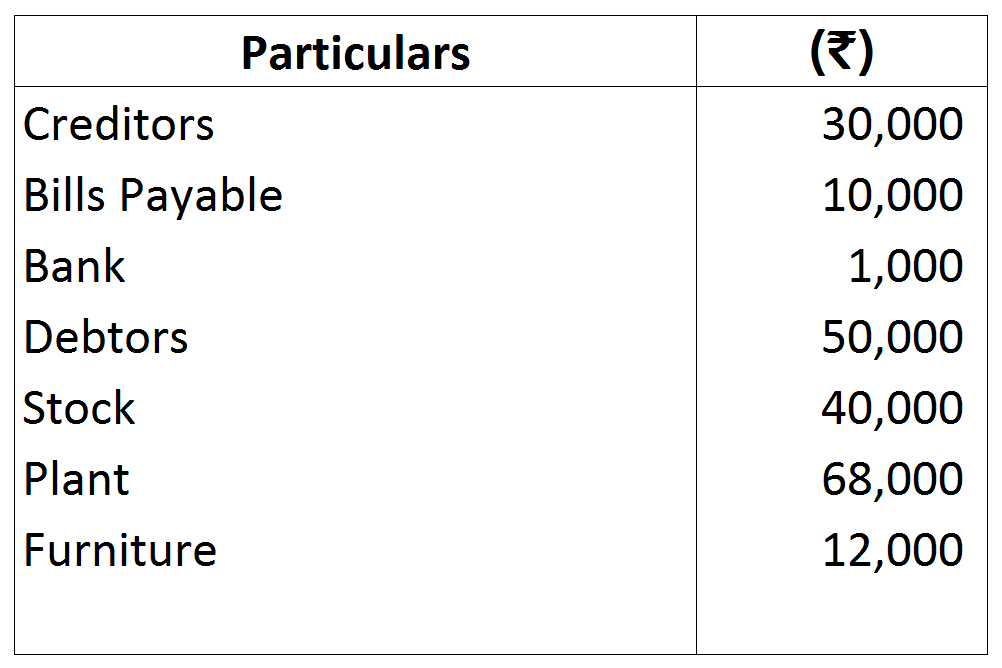
On April $1^{st}, 2016$, X started a business with ₹ $40,000$ as his capital. On March $31^{st}, 2017$, his position was as follows:

During the year $2016-17$ X drew ₹ $24,000$. On $1^{st}$ October $2016$, he introduced further capital amounting to ₹ $30,000$. You are required to ascertain profit or loss made by him during the year 2016-17.
Adjustments:
  1. Plant is to be depreciated at $10\%$.
  2. A Provision of $5\%$ is to be made against debtors.
Also prepare the Statement of Affairs as on March $31^{st} 2017$.
Rectify the following errors:
  1. Wages paid for the construction of office debited to the Wages Account, ₹ 5,000.
  2. Machinery purchased for ₹ 35,000 was passed through the Purchases Book.
  3. Old furniture sold for ₹ 1,000, passed through the Sales Book.
  4. ₹ 2,000 paid to Mehta Bros. against acceptance were debited to Malhotra Bros. Account.
  5. Sales of ₹ 204 to Ram debited to his account as ₹ 402 and purchases of ₹ 1,012 from Shyam credited to his account as ₹ 1,210.
Give Journal entries for the following adjustments in final accounts:
  1. Salaries ₹ 5,000 are outstanding.
  2. Insurance amounting to ₹ 2,000 is paid in advance.
  3. ₹ 4,000 for rent have been received in advance.
  4. Cornmission earned but not received ₹ 1,000.
  5. Interest on Capital ₹ 1,500.
  6. Interest on Drawings ₹ 300.
  7. Write off ₹ 2,000 as further debts.
  8. Closing Stock ₹ 3,000.
What are the advantages of Computerised Accounting?