Question
Concentration terms such as mass percentage, ppm, mole fraction and molality are independent of temperature, however molarity is a function of temperature. Explain.

Answer

Molarity of a solution is a weight by volume relationship to represent its strength and defined as 'The number of moles of solute dissolved in one litre of solution'. Since volume depends on temperature and undergoes a change with change in temperature, the molarity will also change with change in temperature. On the other hand, the other concentration terms such as mass percentage, ppm, mole fraction and molality are based upon mass by mass relationship of solute and solvent present in a binary solution. Mass does not change with change in temperature, as a result these concentration terms remain unchanged wth variation of temperature. According to the definition of all these terms, mass of the solvent used for making the solution is related to the mass of solute.

Need a full question paper?

Generate a complete, print-ready paper with questions like this in minutes — across 16+ boards, with answer keys.

Start Generating Free

Similar questions

Match the items of Column I and Column II.
 
Column I
 
Column II
i.
Lead storage battery
a.
Maximum efficiency.
ii.
Mercury cell
b.
Prevented by galvanisation.
iii.
Fuel cell
c.
Gives steady potential.
iv.
Rusting
d.
Pb is anode, $PbO_2$ is cathode.
  1. How are lipids classified? Give an example of each class.
  2. Explain the following terms:
  1. Mutarotation.
  2. Avitaminosis.
Describe the common name system and IUPAC system of naming amines.
$(i).$ Illustrate the following reactions giving suitable example in each case:
$a.$ Ammonolysis
$b.$ Coupling reaction
$c.$ Acetylation of amines
$(ii).$ Describe Hinsberg method for the identification of primary, secondary and tertiary amines. Also, write the chemical equations of the reactions involved.
Using IUPAC norms write the formulas for the following:
a. Tetrahydroxozincate(II)
b. Potassium tetrachloridopalladate(II)
c. Diamminedichloridoplatinum(II)
d. Potassium tetracyanonickelate(II)
e. Pentaamminenitrito-O-cobalt(III)
f. Hexaamminecobalt (III) sulphate
g. Potassium tri(oxalato) chromate(III)
h. Hexaammineplatinum(IV)
i. Tetrabromidocuprate(II)
j. Pentaamminenitrito-N-cobalt(III)
Describe the preparation of potassium permanganate. How does the acidified permanganate solution react with (i) iron(II) ions (ii) $SO_2$ and (iii) oxalic acid? Write the ionic equations for the reactions.
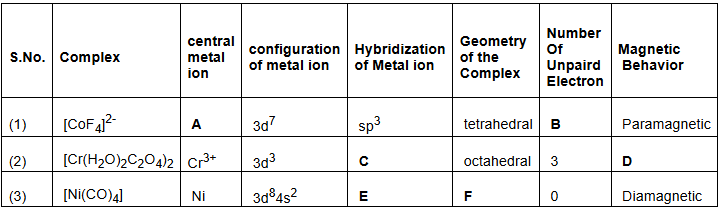
$(a).$ Using, Valence Bond Theory identify $A, B, C, D, E$ and $F$ in the following table:
Image
$(b).$ Write the ionic equations for the reaction of acidified $K_2Cr_2O_7$ with
$(i) \ H_2S$ and $(ii) \ FeSO_4$
  1. Draw the structures of the following:
  1. $H_2S_2O_8$.
  2. $HClO_4$.
  1. How would you account for the following:
  1. $NH_3$​​​​​​​ is a stronger base than $PH_3$​​​​​​​.
  2. Sulphur, has a greater tendency for ‘catenation than oxygen'.
  3. $F_2$​​​​​​​ is a stronger oxidising agent than $Cl_2​​​​​​​$​​​​​​​.
Answer the following question:
$g$ of benzoic acid $(C_6H_5COOH)$ dissolved in $25g$ of benzene shows a depression in freezing point equal to $1.62K.$ Molal depression constant for benzene is $4.9K\ kg\ mol^{-1}$. What is the percentage association of acid if it forms dimer in solution?
  1. Account for the following:
  1. Helium is used in diving apparatus.
  2. Fluorine does not exhibit positive oxidation state.
  3. Oxygen shows catenation behavior less than sulphur.
  1. Draw the structure of the following molecules.
  1. $XeF_2$.
  2. $H_2S_2O_8$.