Question
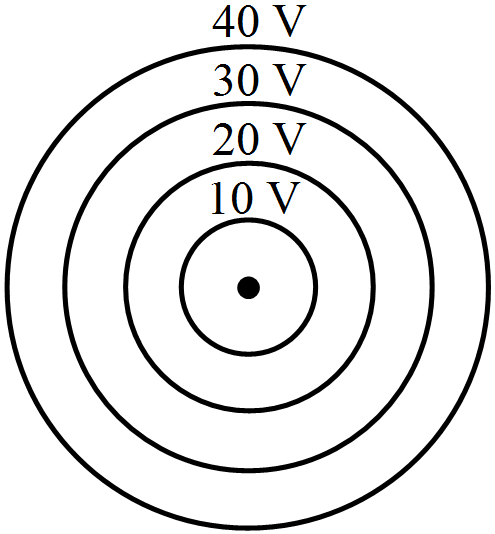
Concentric equipotential surfaces due to a charged body placed at the centre are shown. Identify the polarity of the charge and draw the electric field lines due to it.
Answer


For a single charge the potential is given by $\text{V}=\frac{1}{4\pi\varepsilon_0}\frac{\text{q}}{\text{r}}$


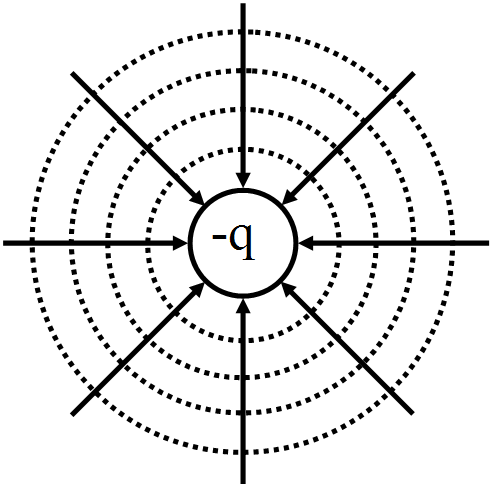
This shows that V is constant if r is constant. Greater the radius smaller will be the potential. In the given figure, potential is increasing. This shows that the polarity of charge is negative (-q). The direction of electric field will be radially inward. The field lines are directed from higher to lower potential.
Need a full question paper?

Generate a complete, print-ready paper with questions like this in minutes — across 16+ boards, with answer keys.
Start Generating Free

Similar questions

A light ray is incident at an angle of 45° with the normal to a $\sqrt{2}\text{cm}$ thick plate $(\mu = 2.0)$. Find the shift in the path of the light as it emerges out from the plate.
The kinetic energy of a charged particle decreases by 10J as it moves from a point at potential 100V to a point at potential 200V. Find the charge on the particle.
The neutron separation energy is defined as the energy required to remove a neutron from the nucleus. Obtain the neutron separation energies of the nuclei ${ }_{20}^{41} Ca$ and ${ }_{13}^{27} Al$ from the following data:
$\begin{array}{l} m \left({ }_{20}^{40} C a\right)=39.962591 u \\ 
m \left({ }_{20}^{41} C a\right)=40.962278 u \\ 
m \left({ }_{13}^{26} A l\right)=25.986895 u \\ 
m \left({ }_{13}^{27} A l\right)=26.981541 u \end{array}$
Two large, thin metal plates are parallel and close to each other. On their inner faces, the plates have surface charge densities of opposite signs and of magnitude 17.0 × 10⁻²² C/m2 . What is E:
  1. In the outer region of the first plate,
  2. In the outer region of the second plate, and
  3. Between the plates?
A coil of inductance 5.0mH and negligible resistance is connected to the oscillator of the previous problem. Find the peak currents in the circuit for $\omega=100\text{s}^{-1},500\text{s}^{-1},1000\text{s}^{-1}.$
Write and explain Kirchhoff's loop rule
The stopping potential in a photoelectric experiment is linearly related to the inverse of the wavelength $\Big(\frac{1}{\lambda}\Big)$ of the light falling on the cathode. The potential difference applied across an X-ray tube is linearly related to the inverse of the cutoff wavelength$\Big(\frac{1}{\lambda}\Big)$ of the X-ray emitted. Show that the slopes of the lines in the two cases are equal and find its value.
How many time constants will elapse before the charge on a capacitors falls to 0.1% of its maximum value in a discharging RC circuit?
A particle of mass 50g moves on a straight line. The variation of speed with time is shown in figure. Find the force acting on the particle at t = 2, 4 and 6 seconds.

A string of length L fixed at both ends vibrates in its fundamental mode at a frequency v and a maximum amplitude A.
  1. Find the wavelength and the wave number k.
  2. Take the origin at one end of the string and the X-axis along the string. Take the Y-axis along the direction of the displacement. Take t = 0 at the instant when the middle point of the string passes through its mean position and is going towards the positive y-directian. Write the equation describing the standing wave: