Question
Two large, thin metal plates are parallel and close to each other. On their inner faces, the plates have surface charge densities of opposite signs and of magnitude 17.0 × 10⁻²² C/m2 . What is E:
  1. In the outer region of the first plate,
  2. In the outer region of the second plate, and
  3. Between the plates?

Answer

Given,

Surface charge density, $\sigma$ = 17. 0 x 10-22 C /m2

  1. To the left of the plates, electric fields are equal and opposite as plates are close to each other electric field is zero as surface charge density in outer side is zero.
  2. To the right of the plates, electric fields are equal and opposite as plates are close to each other electric field is zero.
  3. Electric fields between the plates are in same direction as total E.F. on both sides of plate due to $\sigma$ surface charge density = $\frac{\sigma}{\in_0}$ electric field of inner side of plate =$\frac{\sigma}{2\in_0}$

and for both plate E $=\frac{\sigma}{2\in_0}+\frac{\sigma}{2\in_0}$

$\text{E}=\frac{\sigma}{\in_0}=\sigma\times4\pi\times9\times10^9$

E = 17.0 × 10-22 × 4 × 3.14 × 9 × 109

E = 1921.7 × 10-13

= 1.92 × 10-10 N/C.

Need a full question paper?

Generate a complete, print-ready paper with questions like this in minutes — across 16+ boards, with answer keys.

Start Generating Free

Similar questions

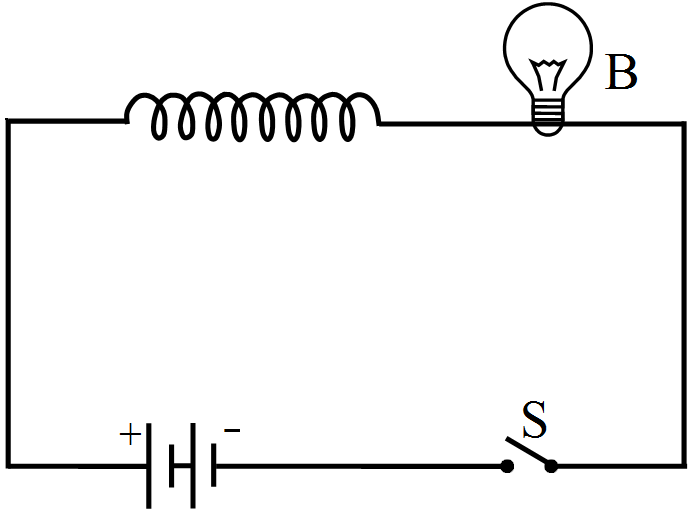
Figure shows a light bulb (B) and iron cored inductor connected to a dc battery through a switch (S).

  1. What will one observe when switch (S) is closed?
  2. How will the glow of the bulb change when the battery is replaced by an ac source of rms voltage equal to the voltage of dc battery? Justify your answer in each case.
How many time constants will elapse before the current in a charging RC circuit drops to half of its initial value? Answer the same question for a discharging RC circuit.
A thin prism of crown glass $(\mu_\text{r}=1.515,\mu_\text{v}=1.525)$ and a thin prism of flint glass $(\mu_\text{r}=1.612,\mu_\text{v}=1.632)$ are placed in contact with each other. Their refracting angles are 5.0° each and are similarly directed. Calculate the angular dispersion produced by the combination.
A block is kept on the floor of an elevator at rest. The elevator starts descending with an acceleration of 12m/s2. Find the displacement of the block during the first 0.2s after the start. Take g = 10m/s2.
A cell of emf E and internal resistance r is connected across a variable load resistor R. Draw the plots of the terminal voltage V versus (i) resistance R and (ii) current I.
It is found that when $R=4 \Omega$, the current is 1 A and when R is increased to $9 \Omega$, the current reduces to 0.5 A .Find the values of the emf E and internal resistance r.
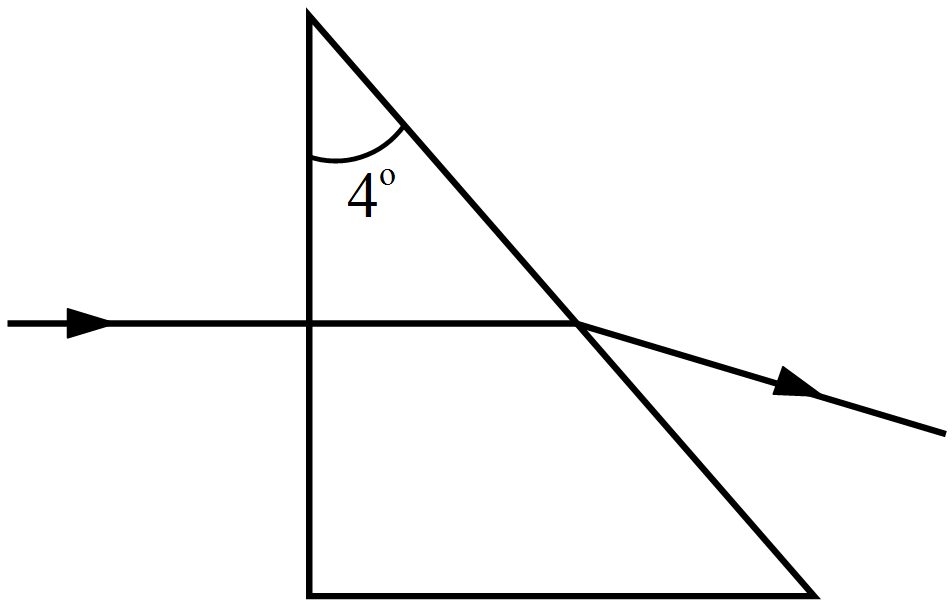
Find the angle of deviation suffered by the light ray shown in figure. The refractive index $\mu=1.5$ for the prism material.

An object is placed 15 cm in front of a convex lens of focal length 10 cm. Find the nature and position of the image formed. Where should a concave mirror of radius of curvature 20 cm be placed so that the final image is formed at the position of the object itself?
Three capacitors of capacitances 2 pF, 3 pF and 4 pF are connected in parallel.
  1. What is the total capacitance of the combination?
  2. Determine the charge on each capacitor if the combination is connected to a 100 V supply.
An electron and a positron moving at small speeds collide and annihilate each other. Find the energy of the resulting gamma photon.
Draw a graph showing change of alternating current with frequency in LCR series resonant circuit and obtain expression for bandwidth.