MCQ
Conduction electrons are almost uniformly distributed within a conducting plate. When placed in an electrostatic field $\overrightarrow E $, the electric field within the plate
  • Is zero
  • B
    Depends upon $E$
  • C
    Depends upon $\overrightarrow E $
  • D
    Depends upon the atomic number of the conducting element
Answer

Correct option: A.
Is zero
a
(a) Electric field inside a conductor is zero.

Need a full question paper?

Generate a complete, print-ready paper with questions like this in minutes — across 16+ boards, with answer keys.

Start Generating Free

Similar questions

A polaroid is placed at  $45^{o}$  to an incoming light of intensity ${I_0}$. Now the intensity of light passing through polaroid after polarisation would be
The magnetic field to a small magnetic dipole of magnetic moment M, at distance r from the centre on the equatorial line is given by (in M.K.S. system)
A thin convex lens of focal length 10 cm is placed in contact with a concave lens of same material and of same focal length. The focal length of combination will be
Photoelectric emission occurs only when the incident light has more than a certain minimum
Electromagnetic wave of intensity $1400\, W/m^2$ falls on metal surface on area $1.5\, m^2$ is completely absorbed by it. Find out force exerted by beam
A body having its centre of mass at the origin has three of its particles at $(a, 0, 0), (0, a, 0), (0, 0, a).$ The moments of inertia of the body about the $X$ and $Y$ axes are $0.20kg-m^2$ each. The moment of inertia about the $Z-$axis:
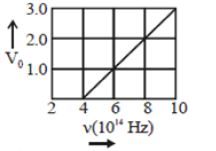
The stopping potential $V_0$ (in $volt$) as a function of frequency $(v)$ for a sodium emitter, is shown in the figure. The work function of sodium, from the data plotted in the figure, will be : ................. $eV$

(Given : Planck's constant $(h) = 6.63 \times 10^{-34}\, Js$, electron charge $e = 1.6 \times 10^{-19}\, C$)

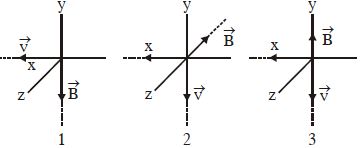
The figure shows three situations when an electron moves with velocity $\vec v$ travels through a uniform magnetic field $\vec B$. In each case, what is the direction of magnetic force on the electron
Particle like behavior of light arises from the fact that each quanta of light has definite $...X...$ and a fixed value of $...Y.. $ just like a particle, Here, $X$ and $Y$ refer to?
A small lamp is hung at a height of 8 feet above the centre of a round table of diameter 16 feet. The ratio of intensities of illumination at the centre and at points on the circumference of the table will be