MCQ
Conider the reaction

$\begin{array}{*{20}{c}}
  {C{H_3} - C{H_2} - CH - C{H_3}\xrightarrow{{C{H_3}{O^\Theta }}}X} \\ 
  {|\,\,\,\,\,\,\,\,\,\,\,\,\,\,\,} \\ 
  {F\,\,\,\,\,\,\,\,\,\,\,\,\,} 
\end{array}$ product

The alkene formed in major amount

  • A
    $CH_3-CH=CH-CH_3$
  • B
    $\begin{array}{*{20}{c}}
      {C{H_3} - C = C{H_2}} \\ 
      {|\,\,} \\ 
      {\,\,\,\,C{H_3}} 
    \end{array}$
  • $CH_3-CH_2-CH=CH_2$
  • D
    Both $(A)$ and $(C)$

Answer

Correct option: C.
$CH_3-CH_2-CH=CH_2$
c

Need a full question paper?

Generate a complete, print-ready paper with questions like this in minutes — across 16+ boards, with answer keys.

Start Generating Free

Similar questions

The order of ionisation potential between $He^+$ ion and $H-$ atom (both species are in  gaseous state) is
According to electrochemical series which one of following is strongest reductant :
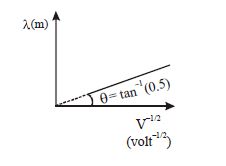
Observe the following graph for the de-Broglie wavelength of a hypothetical charged particle $(q = 1.6 × 10^{-19}\,C)$. Find the mass of the particle $(h = 6.0 × 10^{-34}\ J-s)$
The equilibrium constant for the reaction ${N_{2(g)}} + {O_{2(g)}}$ $\rightleftharpoons$ $2N{O_{(g)}}$ at temperature $T$ is $4 \times {10^{ - 4}}$. The value of ${K_c}$ for the reaction $N{O_{(g)}}$ $\rightleftharpoons$ $\frac{1}{2}{N_{2(g)}} + \frac{1}{2}{O_{2(g)}}$ at the same temperature is
Given below are two statements:

Statement $I:$ According to Bohr's model of hydrogen atom, the angular momentum of an electron in a given stationary state is quantised.

Statement $II:$ The concept of electron in Bohr's orbit, violates the Heisenberg uncertainty principle.

In the light of the above statements, choose the most appropriate answer from the options given below:

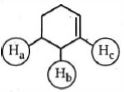
Rank the hydrogen atoms $(H_a , H_b, H_c,)$ in the following molecules according to their acidic strengths
The statement that is true for the long form of the periodic table is
Among the following which one has the highest cation to anion size ratio ?
STATEMENT-$1$: Molecules that are not superimposable on their mirror images are chiral because

STATEMENT-$2$: All chiral molecules have chiral centres.

How many optically active (Lactide) product $(s)$ are formed in given reaction ?

$\begin{array}{*{20}{c}}
  {OH\,\,\,\,\,\,\,\,\,\,\,\,\,\,\,} \\ 
  {|\,\,\,\,\,\,\,\,\,\,\,\,\,\,\,\,\,\,\,} \\ 
  {C{H_3} - CH - COOH\xrightarrow{\Delta }} 
\end{array}$