MCQ
Conservation of momentum in a collision between particles can be understood from:
  • A
    Conservation of energy.
  • B
    Newton’s first law only.
  • C
    Newton’s second law only.
  • Both Newton’s second and third law.

Answer

Correct option: D.
Both Newton’s second and third law.
  1. By newton's second law $\frac{\vec{\text{dp}}}{\text{dt}}=\vec{\text{f}}_\text{ext}$
As $\vec{\text{F}}_\text{ext}$ on law of conservation of momentam is zero.
$\text{i.e},\vec{\text{f}}_\text{ext}=0$
$\frac{\vec{\text{dp}}}{\text{dt}}=0$
$\Rightarrow\vec{\text{p}}$ is constant.
  1. By netton's third law action force is equal to reaction force in magnitude but in opposite direction.
$\therefore\vec{\text{F}}_12=-\vec{\text{F}}_21(\vec{\text{F}_\text{ext}}=0)$
$\frac{\vec{\text{dp}_{12}}}{\text{dt}}=\frac{\vec{\text{- dp}_{21}}}{\text{dt}}$ or $\vec{\text{dp}_{12}}=-\vec{\text{dp}_{21}}$
$\vec{\text{dp}}_{12}+\vec{\text{dp}_{21}}=0.$

Need a full question paper?

Generate a complete, print-ready paper with questions like this in minutes — across 16+ boards, with answer keys.
Start Generating Free

Similar questions

A projectile has initially the same horizontal velocity as it would acquire if it had moved from rest with uniform acceleration of $3\, ms^{-2}$ for $ 0.5\, minutes$. If the maximum height reached by it is $80\, m$, then the angle of projection is (Take $g = 10\, ms^{-2}$)
Two stones of masses $m$ and $2\,m$ are whirled in horizontal circles, the heavier one in a radius $\frac{r}{2}$ and the lighter one in radius $r.$ The tangential speed of lighter stone is $n$ times that of the value of heavier stone when they experience same centripetal forces. The value of $n$ is
Air in a cylinder is suddenly compressed by a piston, which is then maintained at the same position. With the passage of time
A $15 \,g$ ball is shot from a spring gun whose spring has a force constant of $600 \,N/m$. The spring is compressed by $5 \,cm$. The greatest possible horizontal range of the ball for this compression is .... $m$ ($g = 10 \,m/s^2$)
A mosquito is moving with a velocity $\overrightarrow{ v }=0.5 t ^{2} \hat{ i }+3 t \hat{ j }+9 \hat{ k }\, m / s$ and accelerating in uniform conditions. What will be the direction of mosquito after $2 \,s$ ?
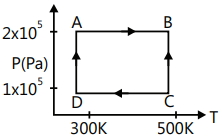
Two moles of helium gas are taken over the cycle $ABCDA$, as shown in the $P-T$ diagram. The net work done on the gas in the cycle $ABCDA$ is ...... $R$
A body cools in $7$ minutes from $60^{\circ}\,C$ to $40^{\circ}\,C$. The temperature of the surrounding is $10^{\circ}\,C$. The temperature of the body after the next $7$ minutes will be
An object, moving with a speed of $6.25\ m/s$, is decelerated at a rate given by:

$\frac{{dv}}{{dt}} = - 2.5\sqrt v $ where $v$ is the instantaneous speed. The time taken by the object, to come to rest, would be........$s$
The value of restitution coefficient e for perfectly elastic collision is:
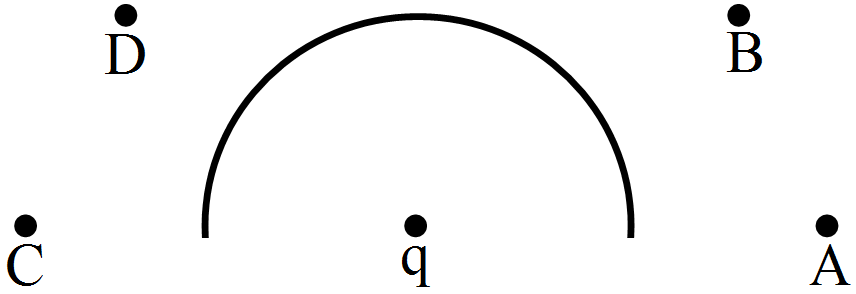
Figure shows a charge $q$ placed at the centre of a hemisphere. A second charge $Q$ is placed at one of the positions $A, B, C$ and $D$. In which position$(s)$ of this second charge, the flux of the electric field through the hemisphere remains unchanged?