MCQ
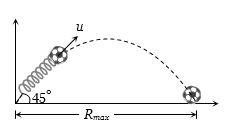
A $15 \,g$ ball is shot from a spring gun whose spring has a force constant of $600 \,N/m$. The spring is compressed by $5 \,cm$. The greatest possible horizontal range of the ball for this compression is .... $m$ ($g = 10 \,m/s^2$)
  • A
    $6.0$
  • $10.0$
  • C
    $12.0$
  • D
    $8.0$

Answer

Correct option: B.
$10.0$
b
(b) For getting horizontal range, there must be some inclination of spring with ground to project ball. 

${R_{max}} = \frac{{{u^2}}}{g}$      …..(i)

But $K.E.$ acquired by ball $= P.E.$ of spring gun 

$ \Rightarrow \frac{1}{2}m{u^2} = \frac{1}{2}k{x^2}$ 

==> ${u^2} = \frac{{k{x^2}}}{m}$…..(ii) 

From equation (i) and (ii) 

${R_{max}} = \frac{{k{x^2}}}{{mg}} = \frac{{600 \times {{(5 \times {{10}^{ - 2}})}^2}}}{{15 \times {{10}^{ - 3}} \times 10}}=10\,m.$

Need a full question paper?

Generate a complete, print-ready paper with questions like this in minutes — across 16+ boards, with answer keys.

Start Generating Free

Similar questions

The velocities of $A$ and $B$ are $\vec{v}_A=2 \hat{i}+4 \hat{j}$ and $\vec{v}_B=3 \hat{i}-7 \hat{j}$ Velocity of $B$ as observed by $A$ is ..........
Two straight metallic strips each of thickness $t$ and length $\ell$ are rivetted together. Their coefficients of linear expansions are $\alpha_1$ and $\alpha_2$. If they are heated through temperature $\Delta T$, the bimetallic strip will bend to form an arc of radius
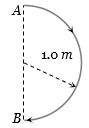
In $1.0\, s$ a particle goes from point $A$ to point $B$, moving in a semicircle of radius $1.0\, m$ (see figure). The magnitude of the average velocity is ......... $m/s$
A particle of mass $m$ projected with a velocity ' $u$ ' making an angle of $30^{\circ}$ with the horizontal. The magnitude of angular momentum of the projectile about the point of projection when the particle is at its maximum height $\mathrm{h}$ is :
Four masses are fixed on a massless rod as shown in the figure. The moment of inertia about the axis $PQ$ is about ........ $kg-m^2.$
In a Carnot engine, when ${T_2} = {0^o}C$ and ${T_1} = {200^o}C,$ its efficiency is ${\eta _1}$ and when ${T_1} = 0{\,^o}C$ and ${T_2} = - 200{\,^o}C$, Its efficiency is ${\eta _2}$, then what is ${\eta _1}/{\eta _2}$
If $\varepsilon_0$ is the permittivity of free space and $E$ is the electric field, then $\varepsilon_0 E^2$ has the dimensions
Initial angular velocity of a circular disc of mass $M$ is $\omega_{1}$. Then two small spheres of mass $m$ are attached gently to two diametrically opposite points on the edge of the disc. What is the final angular velocity of the disc?
The amplitude and the time period in a $S.H.M.$ is $0.5 \,cm$ and $0.4 \,sec$ respectively. If the initial phase is $\pi /2$ radian, then the equation of $S.H.M.$ will be
An object is taken $1.0\,km$ deep in sea. Density of sea $= 1.025 \times 10^3\,kg/m^3$ , Bulk modulus of object $= 1.6 \times 10^6\, KPa$ Find out percentage change in density of object....... $\%$