Consider a block of conducting material ofresistivity '$\rho$' shown in the figure. Current '$I$' enters at '$A$' and leaves from '$D$'. We apply superp osition principle to find voltage '$\Delta V$ ' developed between '$B$' and '$C$'. The calculation is done in the following steps:
$(i)$ Take current '$I$' entering from '$A$' and assume it to spread over a hemispherical surface in the block.
$(ii)$ Calculatefield $E(r)$ at distance '$r$' from $A$ by using Ohm's law $E = \rho j$, where j is the current per unit area at '$r$'.
$(iii)$ From the '$r$' dependence of $E(r)$, obtain the potential $V(r)$ at $r$.
$(iv)$ Repeat $(i), (ii)$ and $(iii)$ for current '$I$' leaving '$D$' and superpose results for '$A$' and '$D$'.
$(i)$ Take current '$I$' entering from '$A$' and assume it to spread over a hemispherical surface in the block.
$(ii)$ Calculatefield $E(r)$ at distance '$r$' from $A$ by using Ohm's law $E = \rho j$, where j is the current per unit area at '$r$'.
$(iii)$ From the '$r$' dependence of $E(r)$, obtain the potential $V(r)$ at $r$.
$(iv)$ Repeat $(i), (ii)$ and $(iii)$ for current '$I$' leaving '$D$' and superpose results for '$A$' and '$D$'.
For current entering at $A$, the electric field at a distance '$r$'
from $A$ is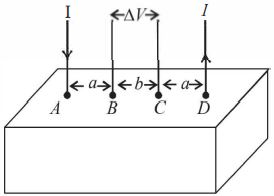
AIEEE 2008, Diffcult


Download our appand get started for free
Experience the future of education. Simply download our apps or reach out to us for more information. Let's shape the future of learning together!No signup needed.*
Similar Questions
- 1$A$ current $I$ flows through a uniform wire of diameter $d$ when the mean electron drift velocity is $V$. The same current will flow through a wire of diameter $d/2$ made of the same material if the mean drift velocity of the electron is :View Solution
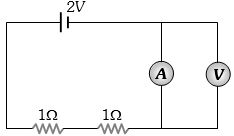
- 2In the circuit shown, $A$ and $V$ are ideal ammeter and voltmeter respectively. Reading of the voltmeter will be ............... $V$View Solution
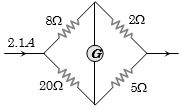
- 3In the given figure, when galvanometer shows no deflection, the current (in $A$) flowing through $5\,\Omega $ resistance will beView Solution
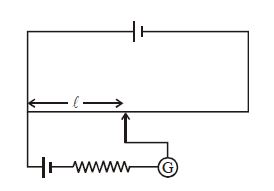
- 4In a potentiometer (see figure) a balance is obtained at a length of $400\ mm$ when using a known battery of emf $1.6\ V$. After removing this battery, another battery of unknown emf is used and balance is obtained at a length of $650\ mm.$ The emf of unknown battery is ............. $volt$View Solution
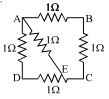
- 5$ABCD$ is a square where each side is a uniform wire of resistance $1\,\Omega$ . $A$ point $E$ lies on $CD$ such that if a uniform wire of resistance $1\,\Omega$ is connected across $AE$ and constant potential difference is applied across $A$ and $C$ then $B$ and $E$ are equipotential.View Solution
- 6An unknown resistance $R_1$ is connected in series with a resistance of $10 \,\Omega$. This combinations is connected to one gap of a meter bridge while a resistance $R_2$ is connected in the other gap. The balance point is at $50\, cm$. Now, when the $10 \,\Omega$ resistance is removed the balance point shifts to $40\, cm$. The value of $R_1$ is (in $ohm$)View Solution
- 7A battery is charged at a potential of $15\, V$ for $8$ hours when the current flowing is $10\, A$. The battery on discharge supplies a current of $5\, A$ for $15$ hours. The mean terminal voltage during discharge is $14\, V$. The "Watt-hour" efficiency of the battery is .............. $\%$View Solution
- 8The resistance of a rectangular block of copper of dimensions $2 \,mm \times 2 \,mm \times 5 \,m$ between two square faces is $0.02 \,\Omega$. What is the resistivity of copper?View Solution
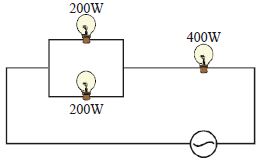
- 9Three electric bulbs of $200\,W,\,\,200\,W$ and $400\,W$ are shown in figure. The resultant power of the combination is ................ $W$View Solution
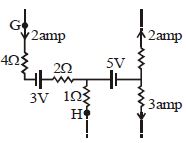
- 10In the part of a circuit shown in the figure, the potential difference $(V_G -V_H)$ between points $G$ and $H$ will be ............... $V$View Solution