A battery is charged at a potential of $15\, V$ for $8$ hours when the current flowing is $10\, A$. The battery on discharge supplies a current of $5\, A$ for $15$ hours. The mean terminal voltage during discharge is $14\, V$. The "Watt-hour" efficiency of the battery is .............. $\%$
AIPMT 2004, Medium


Download our appand get started for free
Experience the future of education. Simply download our apps or reach out to us for more information. Let's shape the future of learning together!No signup needed.*
Similar Questions
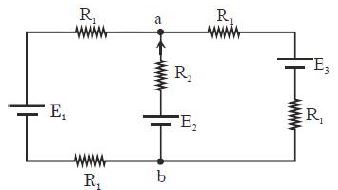
- 1For the circuit shown, with ${R_1} = 1.0\,\Omega $, ${R_2} = 2.0\,\Omega $, ${E_1} = 2\,V$ and ${E_2} = {E_3} = 4\,V$, the potential difference between the points $‘a’$ and $‘b’$ is approximately (in $V$)View Solution
- 2When two resistance are connected in parallel then the equivalent resistance is $\frac {6}{5}\Omega $ . When one of the resistance is removed then the effective resistance is $2\, \Omega $. The resistance of the wire removed will be ................ $\Omega$View Solution
- 3A resistor dissipates $192\, {J}$ of energy in $1\, {s}$ when a current of $4\, {A}$ is passed through it. Now, when the current is doubled, the amount of thermal energy dissipated in $5 \,{s}$ in $.....\,J.$View Solution
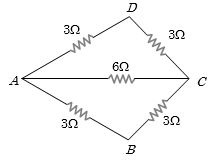
- 4The effective resistance between the points $A$ and $B$ in the figure is ............. $\Omega$View Solution
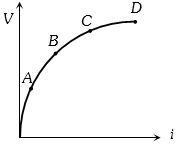
- 5Variation of current passing through a conductor as the voltage applied across its ends as varied is shown in the adjoining diagram. If the resistance $(R)$ is determined at the points $A$, $B$, $C$ and $D$, we will find thatView Solution
- 6The resistance of a wire of uniform diameter $d$ and length $L$ is $R$. The resistance of another wire of the same material but diameter $2d$ and length $4L$ will beView Solution
- 7Resistance in the two gaps of a meter bridge are $10\, ohm$ and $30\, ohm$ respectively. If the resistances are interchanged the balance point shifts by.............. $cm$View Solution
- 8View SolutionIf a high power heater is connected to electric mains, then the bulbs in the house become dim, because there is a
- 9A battery having $e.m.f.$ $5\,\,V$ and internal resistance $0.5$ $\Omega$ is connected with a resistance of $4.5 \,\Omega$ then the voltage at the terminals of battery is ............. $V$View Solution
- 10The current density is a solid cylindrical wire of radius $R ,$ as a function of radial distance $r$ is given by $J ( r )= J _{0}\left(1-\frac{ r }{ R }\right) .$ The total current in the radial region $r =0$ to $r =\frac{ R }{4}$ will beView Solution