Consider a block of conducting material ofresistivity '$\rho$' shown in the figure. Current '$I$' enters at '$A$' and leaves from '$D$'. We apply superp osition principle to find voltage '$\Delta V$ ' developed between '$B$' and '$C$'. The calculation is done in the following steps:
$(i)$ Take current '$I$' entering from '$A$' and assume it to spread over a hemispherical surface in the block.
$(ii)$ Calculatefield $E(r)$ at distance '$r$' from $A$ by using Ohm's law $E = \rho j$, where j is the current per unit area at '$r$'.
$(iii)$ From the '$r$' dependence of $E(r)$, obtain the potential $V(r)$ at $r$.
$(iv)$ Repeat $(i), (ii)$ and $(iii)$ for current '$I$' leaving '$D$' and superpose results for '$A$' and '$D$'.
$(i)$ Take current '$I$' entering from '$A$' and assume it to spread over a hemispherical surface in the block.
$(ii)$ Calculatefield $E(r)$ at distance '$r$' from $A$ by using Ohm's law $E = \rho j$, where j is the current per unit area at '$r$'.
$(iii)$ From the '$r$' dependence of $E(r)$, obtain the potential $V(r)$ at $r$.
$(iv)$ Repeat $(i), (ii)$ and $(iii)$ for current '$I$' leaving '$D$' and superpose results for '$A$' and '$D$'.
For current entering at $A$, the electric field at a distance '$r$'
from $A$ is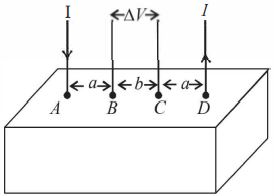
AIEEE 2008, Diffcult


Download our appand get started for free
Experience the future of education. Simply download our apps or reach out to us for more information. Let's shape the future of learning together!No signup needed.*
Similar Questions
- 1When two resistance are connected in parallel then the equivalent resistance is $\frac {6}{5}\Omega $ . When one of the resistance is removed then the effective resistance is $2\, \Omega $. The resistance of the wire removed will be ................ $\Omega$View Solution
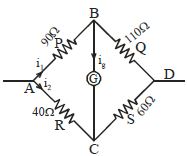
- 2In a Wheatstone bridge, $P = 90\,\Omega $, $Q = 110\,\Omega $ , $R = 40\,\Omega $ and $S = 60\,\Omega $ and a cell of $4\,V\,emf$. Then the potential difference between the diagonal along which a galvanometer is connected is ............. $V$View Solution
- 3It is preferable to measure the $e.m.f.$ of a cell by potentiometer than by a voltmeter because of the following possible reasons.View Solution
$(i)$ In case of potentiometer, no current flows through the cell.
$(ii)$ The length of the potentiometer allows greater precision.
$(iii)$ Measurement by the potentiometer is quicker.
$(iv)$ The sensitivity of the galvanometer, when using a potentiometer is not relevant.
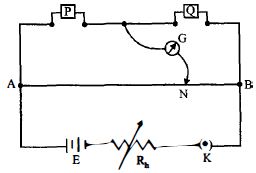
Which of these reasons are correct? - 4In a meter bridge experiment resistances are connected as shown in the figure. Initially resistance $P\, = 4\,\Omega $ and the neutral point $N$ is at $60\,cm$ from $A$. Now an unknown resistance $R$ is connected in series to $P$ and the new position of the neutral point is at $80\,cm$ from $A$ . The value of unknown resistance $R$ isView Solution
- 5We have two wires $A$ and $B$ of same mass and same material. The diameter of the wire $A$ is half of that $B$. If the resistance of wire $A$ is $24\, ohm$ then the resistance of wire $B$ will be ................ $Ohm$View Solution
- 6The electric field $E$, current density $J$ and conductivity $\sigma$ of a conductor are related asView Solution
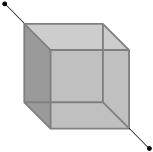
- 7Twelve wires of equal length and same cross-section are connected in the form of a cube. If the resistance of each of the wires is $R$, then the effective resistance between the two diagonal ends would beView Solution
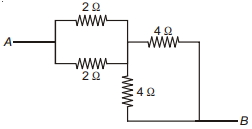
- 8Effective resistance across $A B$ in the network shown in .......... $\Omega$View Solution
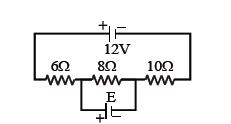
- 9In the circuit shown, the current through $8\,ohm$ issame before and after connecting $E$. The value of $E$ is .................... $\mathrm{V}$View Solution
- 10For a metallic wire, the ratio $V/i$ ($V = $ the applied potential difference, $i$ = current flowing) isView Solution