MCQ
Consider a compound slab consisting of two different materials having equal thickness and thermal conductivities $  K$ and $2K$ respectively. The equivalent thermal conductivity of the slab is
  • A
    $\sqrt {2K} $
  • B
    $3K$
  • $\frac{4}{3}K$
  • D
    $\frac{2}{3}K$

Answer

Correct option: C.
$\frac{4}{3}K$
c
(c) $K = \frac{{2{K_1}{K_2}}}{{{K_1} + {K_2}}} = \frac{{2.K.2K}}{{K + 2K}} = \frac{4}{3}K$

Need a full question paper?

Generate a complete, print-ready paper with questions like this in minutes — across 16+ boards, with answer keys.

Start Generating Free

Similar questions

A container holds $10^{26} molecules/m^3$ each of mass $3 \times 10^{-27}\,\,kg$. Assume that $1/6$ of the molecules move with velocity $2000 \,\,m/s$ directly towards one wall of the container while the remaining $5/6$ of the molecules move either away from the wall or in perpendicular direction, and all collisions of the molecules with the wall are elastic
A particle $A$ has charge $+q$ and particle $B$ has charge $+4 q$ with each of them having the same mass $m$. When allowed to fall from rest through the same electric potential difference, the ratio of their speeds $\frac{V_A}{V_B}$ will become
In $NPN$ transistor, $10^{10}$ electrons enters in emitter region in $10^{-6}$ sec. If $2\%$ electrons are lost in base region then collector current and current amplification factor ($\beta$) respectively are
A cylindrical wire of radius $0.5 \,mm$ and conductivity $5 \times 10^{7}\, S / m$ is subjected to an electric field of $10 \,mV / m .$ The expected value of current in the wire will be $x ^{3} \,\pi mA$. The value of $x$ is ......
Coefficient of real expansion of mercury is $ 0.18 \times 10^{-3}{°C^{-1}}$. If the density of mercury at $0°C$ is $13.6\, gm/cc$. its density at $473K$ is
A charge $q$ $coulomb$ moves in a circle at $n$ revolutions per second and the radius of the circle is $r$ $metre$. Then magnetic field at the centre of the circle is
An infinite nonconducting sheet of charge has a surface charge density of $10^{-7}\  C/m^2$. The separation between two equipotential surfaces near the sheet whose potential differ by $ 5\,V$  is
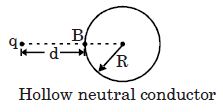
For the situation shown in the figure below, mark out the correct statement
Two radioactive substances $A$ and $B$ have decay constants $5\lambda $ and $\lambda $ respectively. At $t = 0$, a sample has the same number of the two nuclei. The time taken for the ratio of the number of nuclei to become $(\frac {1}{e})^2$ will be
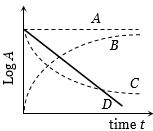
The graph which represents the correct variation of logarithm of activity $(log\, A)$ versus time, in figure is