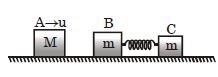
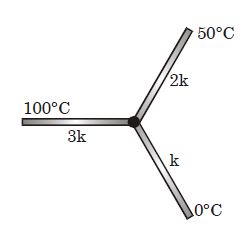
- A$\Big(\frac23\Big)\text{K}$
- B$\sqrt{2}\text{K}$
- C$3\text{K}$
- D$\Big(\frac{4}{3}\Big)\text{K}$
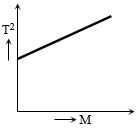
Explanation:
When slabs are connected in series, the equivalent thermal conductivity will be given by,
$\text{K}'=\frac{\sum\text{x}_\text{i}}{\sum\frac{\text{x}_\text{i}}{\text{K}_\text{i}}}$
$=\frac{\text{x}+\text{x}}{\frac{\text{x}}{\text{K}}+\frac{\text{x}}{2\text{K}}}=\frac{\text{2x}}{\frac{\text{3x}}{\text{2K}}}=\frac43\text{K}$
Generate a complete, print-ready paper with questions like this in minutes — across 16+ boards, with answer keys.
Assertion $A$ : Body $'P'$ having mass $M$ moving with speed $'u'$ has head-on collision elastically with another body $'Q'$ having mass $'m'$ initially at rest. If $m< < M,$ body $'Q'$ will have a maximum speed equal to $'2u'$ after collision.
Reason $R$ : During elastic collision, the momentum and kinetic energy are both conserved.
In the light of the above statements, choose the most appropriate answer from the options given below: