MCQ
Consider a compound slab consisting of two different materials having equal thickness and thermal conductivities $K$ and $2 K$ respectively. The equivalent thermal conductivity of the slab is
  • A
    $\sqrt{2 K}$
  • B
    $3 K$
  • $\frac{4}{3} K$
  • D
    $\frac{2}{3} K$

Answer

Correct option: C.
$\frac{4}{3} K$
(c) $\quad K=\frac{2 K_1 K_2}{K_1+K_2}=\frac{2 \cdot K \cdot 2 K}{K+2 K}=\frac{4}{3} K$

Need a full question paper?

Generate a complete, print-ready paper with questions like this in minutes — across 16+ boards, with answer keys.

Start Generating Free

Similar questions

The value of internal resistance of an ideal cell is
The radius of a circular loop is $r$ and a current $i$ is flowing in it. The equivalent magnetic moment will be
One mole of an ideal gas with $\gamma=1.4$, is adiabatically compressed so that its temperature rises from $27^{\circ} \mathrm{C}$ to $35^{\circ} \mathrm{C}$. The change in the internal energy of the gas is $(R=8.3 \mathrm{~J} / \mathrm{mol} . \mathrm{K})$
A sphere of mass $m$, moving with velocity $V$, enters a hanging ban of sand and stops. If the mass of the bag is $M$ and it is raised by height $h$, then the velocity of the sphere was
A particle of mass $m$ oscillates with simple harmonic motion between points $x_1$ and $x_2$, the equilibrium position being $O$. Its potential energy is plotted. It will be as given below in the graph
An object of length $6 \mathrm{~cm}$ is placed on the principle axis of a concave mirror of focal length $f$ at a distance of $4 f$. The length of the image will be
A particle of mass $m$ is moving in a horizontal circle of radius $r$ under a centripetal force equal to $-K / r^2$, where $K$ is a constant. The total energy of the particle is [IT 1977]
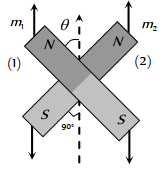
Two magnets of equal mass are joined at right angles to each other as shown the magnet $1$ has a magnetic moment $3$ times that of magnet $2.$ This arrangement is pivoted so that it is free to rotate in the horizontal plane. In equilibrium what angle will the magnet $1$ subtend with the magnetic meridian
Image
If the constant of gravitation $(G)$, Planck's constant $(h)$ and the velocity of light $$ be chosen as fundamental units. The dimension of the radius of gyration is
If the density of a small planet is the same as that of earth, while the radius of the planet is 0.2 times that of the earth, the gravitational acceleration on the surface of that planet is