MCQ 11 Mark
The radiation energy density per unit wavelength at a temperature $T$ has a maximum at a wavelength $\lambda$. At temperature $2 T$, it will have a maximum at a wavelength
- A
$4 \lambda$
- B
$2 \lambda$
- ✓
$\lambda / 2$
- D
$\lambda / 4$
AnswerCorrect option: C. $\lambda / 2$
(c) $\because\lambda_m T=\lambda_m^{\prime}T^{\prime}\Rightarrow\lambda_0T=\lambda^{\prime} \times 2 T \Rightarrow \lambda^{\prime}=\frac{\lambda_0}{2}$
View full question & answer→MCQ 21 Mark
The total energy radiated from a black body source is collected for one minute and is used to heat a quantity of water. The temperature of water is found to increase form $20^{\circ} \mathrm{C}$ to $20.5^{\circ} \mathrm{C}$. If the absolute temperature of the black body is doubled and the experiment is repeated with the same quantity of water at $20^{\circ} \mathrm{C}$, the temperature of water will be
- A
$21^{\circ} \mathrm{C}$
- B
$22^{\circ} \mathrm{C}$
- C
$24^{\circ} \mathrm{C}$
- ✓
$28^{\circ} \mathrm{C}$
AnswerCorrect option: D. $28^{\circ} \mathrm{C}$
The total energy radiated from a black body per minute.$Q\propto T^4\Rightarrow\frac{Q_2}{Q_1}=\left(\frac{2 T}{T}\right)^4=16 \Rightarrow Q_2=16 Q_1$
If $m$ be mass of water taken and $S$ be its specific heat capacity, then $Q_1=m s(20.5-20)$ and $Q_2=m s(\theta-20)$
$\theta^{\circ}\mathrm{C}=$ Final temperature of water $[\Rightarrow\frac{Q_2}{Q_1}=\frac{\theta-20}{0.5} \Rightarrow \frac{16}{1}=\frac{\theta-20}{0.5}\Rightarrow\theta=28^{\circ} \mathrm{C}]$
View full question & answer→MCQ 31 Mark
Solar radiation emitted by sun resembles that emitted by a black body at a temperature of $6000 \mathrm{~K}$. Maximum intensity is emitted at a wavelength of about $4800 \mathring A$. If the sun were to cool down from $6000 K$ to $3000 K$ then the peak intensity would occur at a wavelength
- A
$4800 \mathring A$
- ✓
$9600 \mathring A$
- C
$7200 \mathring A$
- D
$6400 \mathring A$
AnswerCorrect option: B. $9600 \mathring A$
$\lambda_{m_2}=\frac{\lambda_{m_1}{T_1}}{T_2}=\frac{4800 \times 6000}{3000}=9600\mathrm{~\mathring A}$
View full question & answer→MCQ 41 Mark
Three rods of the same dimension have thermal conductivities $3 K, 2 K$ and $K$. They are arranged as shown in fig. Given below, with their ends at $100 C, 50 C$ and $20 C$. The temperature of their junction is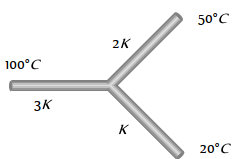
- A
$60^{\circ} \mathrm{C}$
- ✓
$70^{\circ} \mathrm{C}$
- C
$50 \mathrm{C}$
- D
$35 C$
AnswerCorrect option: B. $70^{\circ} \mathrm{C}$
View full question & answer→MCQ 51 Mark
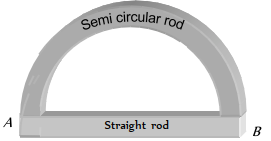
Two rods (one semi-circular and other straight) of same material and of same cross-sectional area are joined as shown in the figure. The points $A$ and $B$ are maintained at different temperature. The ratio of the heat transferred through a cross-section of a semicircular rod to the heat transferred through a cross section of the straight rod in a given time is
- ✓
$2: \pi$
- B
$1: 2$
- C
$\pi: 2$
- D
$3: 2$
AnswerCorrect option: A. $2: \pi$
(a) $\frac{d Q}{d t}=\frac{K A \Delta \theta}{l}$, For both rods $K, A$ and $\Delta \theta$ are same$\frac{d Q}{d t} \propto \frac{1}{l} \text { So } \frac{(d Q / d t)_{\text {semi circular }}}{(d Q / d t)_{\text {straight }}}=\frac{l_{\text {straight }}}{l_{\text {semicircular }}}=\frac{2 r}{\pi r}=\frac{2}{\pi} \text {. }$
View full question & answer→MCQ 61 Mark
The ratio of radiant energies radiated per unit surface area by two bodies is $16: 1$, the temperature of hotter body is $1000 K$, then the temperature of colder body will be
- A
$250 K$
- ✓
$500 \mathrm{~K}$
- C
$1000 K$
- D
$62.5 K$
AnswerCorrect option: B. $500 \mathrm{~K}$
(b)$Q \propto T^4 \Rightarrow \frac{Q_1}{Q_2}=\frac{T_1^4}{T_2^4}$
$\Rightarrow T_2^4=\left(\frac{E_2}{E_1}\right)T_1^4$
$\Rightarrow T_2^4=\frac{1}{16}\times(1000)^4=\left(\frac{1000}{2}\right)^4$
$ \Rightarrow T_2=500 \mathrm{~K}$
View full question & answer→MCQ 71 Mark
A body initially at $80 C$ cools to $64 C$ in 5 minutes and to $52 C$ in 10 minutes. The temperature of the body after 15 minutes will be
- ✓
$42.7 \cdot C$
- B
$35 \cdot \mathrm{C}$
- C
$47 \cdot C$
- D
$40 \cdot C$
AnswerCorrect option: A. $42.7 \cdot C$
View full question & answer→MCQ 81 Mark
In a room where the temperature is $30^{\circ} \mathrm{C}$, a body cools from $61^{\circ} \mathrm{C}$ to $59^{\circ} \mathrm{C}$ in 4 minutes. The time (in min.) taken by the body to cool from $51^0 C$ to $49^{\circ} \mathrm{C}$ will be
- A
$4 \mathrm{~min}$
- ✓
$6 \mathrm{~min}$
- C
$5 \mathrm{~min}$
- D
$8 \mathrm{~min}$
AnswerCorrect option: B. $6 \mathrm{~min}$
First case, $\frac{61-59}{4}=K\left[\frac{61+59}{2}-30\right]$
Second case,$(\frac{51-49}{t}=K\left[\frac{51+49}{2}-30\right]$
By solving equation (i) and (ii) $(t=6)\mathrm{~min}$.
View full question & answer→MCQ 91 Mark
When fluids are heated from the bottom, convection currents are produced because
- A
Molecular motion of fluid becomes aligned
- B
Molecular collisions take place within the fluid
- C
Heated fluid becomes more dense than the cold fluid above it
- ✓
Heated fluid becomes less dense than the cold fluid above it
AnswerCorrect option: D. Heated fluid becomes less dense than the cold fluid above it
View full question & answer→MCQ 101 Mark
The temperatures of two bodies $A$ and $B$ are respectively $727^{\circ} \mathrm{C}$ and $327^{\circ} \mathrm{C}$. The ratio $H_A: H_B$ of the rates of heat radiated by them is
- A
$727: 327$
- B
$5: 3$
- C
$25: 9$
- ✓
$625: 81$
AnswerCorrect option: D. $625: 81$
$(Q \propto T^4) \Rightarrow\frac{H_A}{H_B}=\left(\frac{273+727}{273+327}\right)^4=\left(\frac{10}{6}\right)^4=\left(\frac{5}{3}\right)^4=\frac{625}{81}$
View full question & answer→MCQ 111 Mark
A hot body will radiate heat most rapidly if its surface is
AnswerBlack and rough surfaces are good absorber that's why they emit well. (Kirchoff's law).
View full question & answer→MCQ 121 Mark
According to the experiment of Ingen Hausz the relation between the thermal conductivity of a metal rod is $K$ and the length of the rod whenever the wax melts is
- A
$K / I=$ constant
- B
$K^2 / l=$ constant
- ✓
$K / l^2=$ constant
- D
$K l=$ constant
AnswerCorrect option: C. $K / l^2=$ constant
View full question & answer→MCQ 131 Mark
When the body has the same temperature as that of surroundings
- A
- ✓
It radiates the same quantity of heat as it absorbs
- C
It radiates less quantity of heat as it receives from surroundings
- D
It radiates more quantity of heat as it receives heat from surroundings
AnswerCorrect option: B. It radiates the same quantity of heat as it absorbs
It radiates the same quantity of heat as it absorbs
View full question & answer→MCQ 141 Mark
The absolute temperatures of two black bodies are $2000 K$ and $3000 K$ respectively. The ratio of wavelengths corresponding to maximum emission of radiation by them will be
- A
$2: 3$
- ✓
$3: 2$
- C
$9: 4$
- D
$4: 9$
AnswerCorrect option: B. $3: 2$
$\lambda_mT=\lambda_m^{\prime}T^{\prime}\Rightarrow\frac{\lambda_m}{\lambda_m^{\prime}}=\frac{T^{\prime}}{T}=\frac{3000}{2000}=\frac{3}{2}$
View full question & answer→MCQ 151 Mark
A body takes 5 minutes to cool from $90^{\circ} \mathrm{C}$ to $60^{\circ} \mathrm{C}$. If the temperature of the surroundings is $20^{\circ} \mathrm{C}$, the time taken by it to cool from $60^{\circ} \mathrm{C}$ to $30^{\circ} \mathrm{C}$ will be.
- A
$5 \mathrm{~min}$
- B
$8 \mathrm{~min}$
- ✓
$11 \mathrm{~min}$
- D
$12 \mathrm{~min}$
AnswerCorrect option: C. $11 \mathrm{~min}$
(c)$\frac{90-60}{5}=K\left(\frac{90+60}{2}-20\right) \Rightarrow 6=K \times 55 \Rightarrow K=\frac{6}{55}$And, $\frac{60-30}{t}=\frac{6}{55}\left(\frac{60+30}{2}-20\right)\Rightarrow t=11\ minute.$
View full question & answer→MCQ 161 Mark
The value of Stefan's constant is
- ✓
$5.67 \times 10^{-8} \mathrm{~W} / \mathrm{m}^2-K^4$
- B
$5.67 \times 10^{-5} \mathrm{~W} / \mathrm{m}^2-K^4$
- C
$5.67 \times 10^{-11} \mathrm{~W} / \mathrm{m}^2-\mathrm{K}^4$
- D
AnswerCorrect option: A. $5.67 \times 10^{-8} \mathrm{~W} / \mathrm{m}^2-K^4$
View full question & answer→MCQ 171 Mark
The temperature of a body falls from $62^{\circ} \mathrm{C}$ to $50^{\circ} \mathrm{C}$ in $10$ minutes. If the temperature of the surroundings is $26^{\circ} \mathrm{C}$, the temperature in next $10$ minutes will become
- ✓
$42^{\circ} \mathrm{C}$
- B
$40^{\circ} \mathrm{C}$
- C
$56^{\circ} \mathrm{C}$
- D
$55^{\circ} \mathrm{C}$
AnswerCorrect option: A. $42^{\circ} \mathrm{C}$
(a)$\frac{62-50}{10}=K\left(\frac{62+50}{2}-26\right) \Rightarrow \frac{6}{5}=K \times 30 \Rightarrow K=\frac{1}{25}$And, $\frac{50-\theta}{10}=\frac{1}{25}\left(\frac{50+\theta}{2}-26\right) \Rightarrow \theta=42^{\circ} \mathrm{C}$.
View full question & answer→MCQ 181 Mark
If the temperature of the body is increased by $10 \%$, the percentage increase in the emitted radiation will be
- ✓
$46 \%$
- B
$40 \%$
- C
$30 \%$
- D
$80 \%$
AnswerCorrect option: A. $46 \%$
$Q \propto T^4 \Rightarrow \frac{Q_1}{Q_2}=\left(\frac{T_1}{T_2}\right)^4$If $(T_1=T)$ then $T_2=T+\frac{10}{100} T=1.1\ T$
$\Rightarrow\frac{Q_1}{Q_2}=\left(\frac{T}{1.1 T}\right)^4 \Rightarrow Q_2=1.46 Q_1 $
$\Rightarrow \% \text { increase in energy }=\frac{Q_2-Q_1}{Q_1} \times 100=46 \%$
View full question & answer→MCQ 191 Mark
Which of the following statement is correct
- A
A good absorber is a bad emitter
- B
Every body absorbs and emits radiations at every temperature
- C
The energy of radiations emitted from a black body is same for all wavelengths
- ✓
The law showing the relation of temperatures with the wavelength of maximum emission from an ideal black body is Plank's law
AnswerCorrect option: D. The law showing the relation of temperatures with the wavelength of maximum emission from an ideal black body is Plank's law
A good absorber is a good emitter hence option (a) is wrong. Every body stops absorbing and emitting radiation at $0 K$ hence option (b) is wrong.The energy of radiation emitted from a black body is not same for all wavelength hence option (c) is wrong.Plank's law relates the wavelength $(\lambda)$ and temperature $(T)$
according totherelation $(E_\lambda d_\lambda=\frac{8 \pi h c}{\lambda^5} \frac{1}{\left[e^{h c / k T}-1\right]} d_\lambda$). Hence option (d) is correct.
View full question & answer→MCQ 201 Mark
Which of the prism is used to see infra-red spectrum of light
Answer(a) Ordinary glass prism (crown, flint) absorbs the infrared radiation but rock salt prism transmit them. Hence it is used to obtain the spectrum of infrared radiation.
View full question & answer→MCQ 211 Mark
A black body at $200 K$ is found to exit maximum energy at a wavelength of $14 \mu \mathrm{m}$. When its temperature is raised to $1000 K$, the wavelength at which maximum energy is emitted is
- A
$14 \mu \mathrm{m}$
- B
$70 \mu F$
- ✓
$2.8 \mu \mathrm{m}$
- D
$2.8 \mathrm{~mm}$
AnswerCorrect option: C. $2.8 \mu \mathrm{m}$
(c) $\lambda_{m_1} T_1=\lambda_{m_2} T_2 \Rightarrow \lambda_{m_2}=\frac{\lambda_{m_1} T_1}{T_2}=\frac{14 \times 200}{1000}=2.8 \mu \mathrm{m}$
View full question & answer→MCQ 221 Mark
If between wavelength $\lambda$ and $\lambda+d \lambda, e_\lambda$ and $a_\lambda$ be the emissive and absorptive powers of a body and $E_\lambda$ be the emissive power of a perfectly black body, then according to Kirchoff's law, which is true
- A
$e_\lambda=a_\lambda=E_\lambda$
- B
$e_\lambda E_\lambda=a_\lambda$
- ✓
$e_\lambda=a_\lambda E_\lambda$
- D
$e_\lambda a_\lambda E_\lambda=$ constant
AnswerCorrect option: C. $e_\lambda=a_\lambda E_\lambda$
According to Kirchoff's law, the ratio of emissive power to absorptive power is same for all bodies is equal to the emissive power of a perfectly black body i.e.,
$\left(\frac{e}{a}\right)_{\text {body }}=E_{\text {Blackbody }} \text { for a particular wave length } $
$\left(\frac{e_\lambda}{a_\lambda}\right)_{\text{body}}=\left(E_\lambda\right)_{\text {Blackbody }} \Rightarrow e_\lambda=a_\lambda E_\lambda$
View full question & answer→MCQ 231 Mark
At a certain temperature for given wave length, the ratio of emissive power of a body to emissive power of black body in same circumstances is known as
- A
- ✓
- C
- D
Coefficient of reflection
View full question & answer→MCQ 241 Mark
The cause of Fraunhoffer lines is
- A
Reflection of radiations by chromosphere
- ✓
Absorption of radiations by chromosphere
- C
Emission of radiations by chromosphere
- D
Transmission of radiations by chromosphere
AnswerCorrect option: B. Absorption of radiations by chromosphere
(b) When the light emitted from the sun's photosphere passes through it's outer part Chromosphere, certain wave lengths are absorbed. In the spectrum of sunlight, a large number of dark lines are seen called Fraunhoffer lines.
View full question & answer→MCQ 251 Mark
If a liquid is heated in weightlessness, the heat is transmitted through
- ✓
- B
- C
- D
Neither, because the liquid cannot be heated in weightlessness
Answer(a) Convection is not possible in weightlessness. So the liquid will be heated through conduction.
View full question & answer→MCQ 261 Mark
Which of the following is the $v=T$ graph for a perfectly black body ( $v_{-}=$maximum frequency of radiation)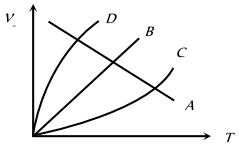
Answer(b) Wein's law $\lambda_m \propto \frac{1}{T} \quad$ or $\quad v_m \propto T$$v$ increases with temperature. So the graph will be straight line.
View full question & answer→MCQ 271 Mark
The earth radiates in the infra-red region of the spectrum. The spectrum is correctly given by
- A
- B
- ✓
Planck's law of radiation
- D
Stefan's law of radiation
AnswerCorrect option: C. Planck's law of radiation
View full question & answer→MCQ 281 Mark
Two black metallic spheres of radius $4 \mathrm{~m}$, at $2000 K$ and $1 \mathrm{~m}$ at 4000 $K$ will have ratio of energy radiation as
- ✓
$1: 1$
- B
$4: 1$
- C
$1: 4$
- D
$2: 1$
AnswerCorrect option: A. $1: 1$
(a) $\frac{Q_1}{Q_2}=\frac{r_1^2 T_1^4}{r_2^2 T_2^4}=\frac{4^2}{1^2}\times\left(\frac{2000}{4000}\right)^4=1$
View full question & answer→MCQ 291 Mark
When red glass is heated in dark room it will seem
Answer(a) Red and green colours are complementary to each other. When red glass is heated itabsorbs green light strongly, hence according to Kirchoff's law, the emissive power of red glassshould be maximum for green light. That's why when this heated red glass is taken in dark room it strongly emits green light and looks greenish.
View full question & answer→MCQ 301 Mark
There is a black spot on a body. If the body is heated and carried in dark room then it glows more. This can be explained on the basis of
Answer(c) According to Kirchoff's law, a good emitter is also a good absorber.
View full question & answer→MCQ 311 Mark
If the temperature of a hot body is increased by $50 \%$ then the increase in the quantity of emitted heat radiation will be
- A
$125 \%$
- B
$200 \%$
- C
$300 \%$
- ✓
$400 \%$
AnswerCorrect option: D. $400 \%$
(d)$Q \propto T^4$
$ \Rightarrow \frac{Q_1}{Q_2}=\left(\frac{T_1}{T_2}\right)^4 $
$\Rightarrow \frac{Q_1}{Q_2}=\left(\frac{T_1}{T_1+T2}\right)^4=\frac{16}{81}$
$\Rightarrow Q_2=\frac{81}{16} Q_1 $
$\% \text { increase in energy }=\frac{Q_2-Q_1}{Q_1} \times 100=400 \%$
View full question & answer→MCQ 321 Mark
A body takes 5 minute to cool from $80^{\circ} \mathrm{C}$ to $50^{\circ} \mathrm{C}$. How much time it will take to cool from $60^{\circ} \mathrm{C}$ to $30^{\circ} \mathrm{C}$, if room temperature is $20^{\circ} \mathrm{C}$.
- A
$40$ minute
- ✓
$9$ minute
- C
$30$ minute
- D
$20$ minute
AnswerCorrect option: B. $9$ minute
According to Newton's law of coolingin first case, $\frac{80-50}{5}=K\left[\frac{80+50}{2}-20\right]$
in second case, $\frac{60-30}{t}=K\left[\frac{60+30}{2}-20\right]$
Dividing equation (i) by (ii) we get, $\frac{t}{2}=\frac{45}{25} \Rightarrow t=9 \mathrm{~min}$.
View full question & answer→MCQ 331 Mark
A $5 \mathrm{~cm}$ thick ice block is there on the surface of water in a lake. The temperature of air is $-10^{\circ} \mathrm{C}$; how much time it will take to double the thickness of the block $\left(L=80 \mathrm{cal} / \mathrm{g}, K_{-}=0.004 \mathrm{Erg} / \mathrm{s}-k, d_\omega=0.92 \mathrm{~g} \mathrm{~cm}^{-3}\right)$
- A
$1$ hour
- B
$191$ hours
- ✓
$19.1$ hours
- D
$1.91$ hours
AnswerCorrect option: C. $19.1$ hours
$t=\frac{Q l}{K A}\left(\theta_1-\theta_2\right)=\frac{m L l}{K A}\left(\theta_1-\theta_2\right) =\frac{V \rho Ll}{K A}\left(\theta_1-\theta_2\right)$
$=\frac{5 \times A \times 0.92 \times 80 \times \frac{5+10}{2}}{0.004 \times A \times 10 \times 3600}=19.1 \text { hours. }$
View full question & answer→MCQ 341 Mark
Two spheres of same material have radius $1 \mathrm{~m}$ and $4 \mathrm{~m}$ and temperature $4000 K$ and $2000 K$ respectively. The energy radiated per second by the first sphere is
- A
Greater than that by the second
- B
Less than that by the second
- ✓
- D
The information is incomplete
Answer(c) $\text { Energy radiated per sec } \frac{Q}{t}=P=A \delta \sigma T^4 $
$P \propto r^2 T^4 $
$\Rightarrow \frac{P_2}{P_1}=\frac{r_2^2}{r_1^2} \cdot \frac{T_2^4}{T_1^4}=\frac{4^2}{1^2} \times\left(\frac{2000}{4000}\right)^4=1$
View full question & answer→MCQ 351 Mark
The original temperature of a black body is $727^{\circ} \mathrm{C}$. The temperature at which this black body must be raised so as to double the total radiant energy, is
- A
$971 K$
- ✓
$1190 K$
- C
$2001 K$
- D
$1458 K$
AnswerCorrect option: B. $1190 K$
(b)
$\frac{Q_2}{Q_1}=\left(\frac{T_2}{T_1}\right)^4 \Rightarrow \frac{2}{1}=\left(\frac{T_2}{T_1}\right)^4$
$\Rightarrow T_2^4=2 \times T_1^4=2 \times(273+727)^4 \Rightarrow T_2=1190 \mathrm{~K}$
View full question & answer→MCQ 361 Mark
In order that the heat flows from one part of a solid to another part, what is required
Answer(c) Heat energy always flow from higher temperature to lower temperature. Hence, temperature difference w.r.t. length (temperature gradient) is required to flow heat from one part of a solid to other part.
View full question & answer→MCQ 371 Mark
A black body is at a temperature $300 \mathrm{~K}$. It emits energy at a rate, which is proportional to
- A
$300$
- B
$(300)^2$
- C
$(300)^3$
- ✓
$(300)^4$
AnswerCorrect option: D. $(300)^4$
(d) $E \propto T^4$
View full question & answer→MCQ 381 Mark
On increasing the temperature of a substance gradually, which of the following colours will be noticed by you
MCQ 391 Mark
The ratio of energy of emitted radiation of a black body at $27^{\circ} \mathrm{C}$ and $927^{\circ} \mathrm{C}$ is
- A
$1: 4$
- B
$1: 16$
- C
$1: 64$
- ✓
$1: 256$
AnswerCorrect option: D. $1: 256$
(d) $\frac{Q_1}{Q_2}=\left(\frac{T_1}{T_2}\right)^4=\left(\frac{273+27}{273+927}\right)^4=\left(\frac{1}{4}\right)^4=\frac{1}{256}$
View full question & answer→MCQ 401 Mark
If the temperature of a black body be increased from $27^{\circ} \mathrm{C}$ to $327^{\circ} \mathrm{C}$ the radiation emitted increases by a fraction of
Answer$\frac{E_2}{E_1}=\frac{T_2^4}{T_1^4}=\left(\frac{237+22}{273+27}\right)^4=\left(\frac{600}{300}\right)^4=16$
View full question & answer→MCQ 411 Mark
A cane is taken out from a refrigerator at $0^{\circ} \mathrm{C}$. The atmospheric temperature is $25^{\circ} \mathrm{C}$. If $t$ is the time taken to heat from $0^{\circ} \mathrm{C}$ to $5^{\circ} \mathrm{C}$ and $t$ is the time taken from $10^{\circ} \mathrm{C}$ to $15^{\circ} \mathrm{C}$, then
- A
$t_1>t_2$
- ✓
$t_1 < t_2$
- C
$t_1=t_2$
- D
AnswerCorrect option: B. $t_1 < t_2$
$t_1 < t_2$
View full question & answer→MCQ 421 Mark
Which of the following law states that "good absorbers of heat are good emitters"
MCQ 431 Mark
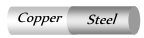
Heat current is maximum in which of the following (rods are of identical dimension)
Answer(a) Thermal resistance of $C u$ is lesser than the thermal resistance of steel. Hence only in option (a) thermal resistance is minimum so heat current is maximum.
View full question & answer→MCQ 441 Mark
Surface of the lake is at $2^{\circ} \mathrm{C}$. Find the temperature of the bottom of the lake
- A
$2^{\circ} \mathrm{C}$
- B
$3^{\circ} \mathrm{C}$
- ✓
$4^{\circ} \mathrm{C}$
- D
$1^{\circ} \mathrm{C}$
AnswerCorrect option: C. $4^{\circ} \mathrm{C}$
(c) A lake cools from the surface down. Above $4^{\circ} \mathrm{C}$, the cooled water at the surface flows to the bottom because of it's greater density. But when the surface temperature drops below $4^{\circ} \mathrm{C}$ (here it is $2^{\circ} \mathrm{C}$ ), the water near the surface is less dense than the warmer water below. Hence the downward flow ceases, the water at the bottom remains at $4^{\circ} \mathrm{C}$ until nearly the entire lake, is frozen.
View full question & answer→MCQ 451 Mark
There is a rough black spot on a polished metallic plate. It is heated upto $1400 K$ approximately and then at once taken in a dark room. Which of the following statements is true
- ✓
In comparison with the plate, the spot will shine more
- B
In camparison with the plate, the spot will appear more black
- C
The spot and the plate will be equally bright
- D
The plate and the black spot can not be seen in the dark room
AnswerCorrect option: A. In comparison with the plate, the spot will shine more
(a) The black spot on heating absorbs radiations and so emits them in the dark room while the polished shining part reflects radiation and absorbs nothing and so does not emit radiations and becomes invisible in the dark.
View full question & answer→MCQ 461 Mark
The heat is flowing through two cylindrical rods of same material. The diameters of the rods are in the ratio $1: 2$ and their lengths are in the ratio $2: 1$. If the temperature difference between their ends is the same, the ratio of rate of flow of heat through them will be
- A
$1: 1$
- B
$2: 1$
- C
$1: 4$
- ✓
$1: 8$
AnswerCorrect option: D. $1: 8$
(d)
$\frac{Q}{t}=\frac{K A \Delta \theta}{l} \Rightarrow \frac{Q}{t} \propto \frac{A}{l} \propto \frac{d^2}{l} \quad(d=\text { Diameter of rod })$
$\Rightarrow \frac{(Q / t)_1}{(Q / t)_2}=\left(\frac{d_1}{d_2}\right)^2 \times \frac{l_2}{l_1}=\left(\frac{1}{2}\right)^2 \times\left(\frac{1}{2}\right)=\frac{1}{8}$
View full question & answer→MCQ 471 Mark
The rate of loss of heat from a body cooling under conditions of forced convection is proportional to its $$ heat capacity surface area $$ absolute temperature $$ excess of temperature over that of surrounding : state if
AnswerCorrect option: C. Only $B$ and $D$ are correct Only $D$ is correct
(c) In forced convection rate of loss of heat $\frac{Q}{t} \propto A\left(T-T_0\right)$
View full question & answer→MCQ 481 Mark
Two identical square rods of metal are welded end to end as shown in figure (i), 20 calories of heat flows through it in 4 minutes. If the rods are welded as shown in figure (ii), the same amount of heat will flow through the rods in
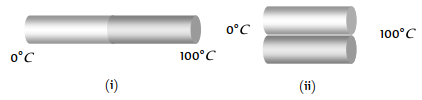
Answer(a)$\frac{Q}{t}=\frac{K A \Delta \theta}{l}=\frac{\Delta \theta}{(l / K A)}$
$=\frac{\Delta \theta}{R} \quad(R=\text { Thermal resistance }) $
$\Rightarrow t \propto R \quad(\because Q \text { and } \Delta \theta \text { are same }) $
$\Rightarrow \frac{t_P}{t_S}=\frac{R_P}{R_S}=\frac{R / 2}{2 R}=\frac{1}{4} $
$\Rightarrow t_P=\frac{t_S}{4}=\frac{4}{4}=1 \mathrm{~min} .$
(Series resistance $R_S=R_1+R_2$ and parallel resistance $ R_P=\frac{R_1 R_2}{R_1+R_2} $)
View full question & answer→MCQ 491 Mark
A bucket full of hot water cools from $75^{\circ} \mathrm{C}$ to $70^{\circ} \mathrm{C}$ in time $T_1$, from $70^{\circ} \mathrm{C}$ to $65^{\circ} \mathrm{C}$ in time $T_2$ and from $65^{\circ} \mathrm{C}$ to $60^{\circ} \mathrm{C}$ in time $T_3$, then
- A
$T_1=T_2=T_3$
- B
$T_1>T_2>T_3$
- ✓
$T_1
- D
$T_1>T_2
Answer(c) According to Newton's law of coolingRate of cooling $\propto$ Mean temperature difference$\begin{aligned}\Rightarrow & \frac{\text { Fall in temperatur e }}{\text { Time }} \propto\left(\frac{\theta_1\theta_2{2\theta_0\right\&\because\left(\frac{\theta_1+\theta_2}{2}\right)_1>\left(\frac{\theta_1+\theta_2}{2}\right)_2>\left(\frac{\theta_1+\theta_2}{2}\right)_3 \\& \Rightarrow T_1
View full question & answer→MCQ 501 Mark
It is hotter for the same distance over the top of a fire than it is in the side of it, mainly because
- A
Air conducts heat upwards
- B
- ✓
Convection takes more heat upwards
- D
Convection, conduction and radiation all contribute significantly transferring heat upwards
AnswerCorrect option: C. Convection takes more heat upwards
(c) Convection significantly transferring heat upwards (Gravity effect).
View full question & answer→