Question
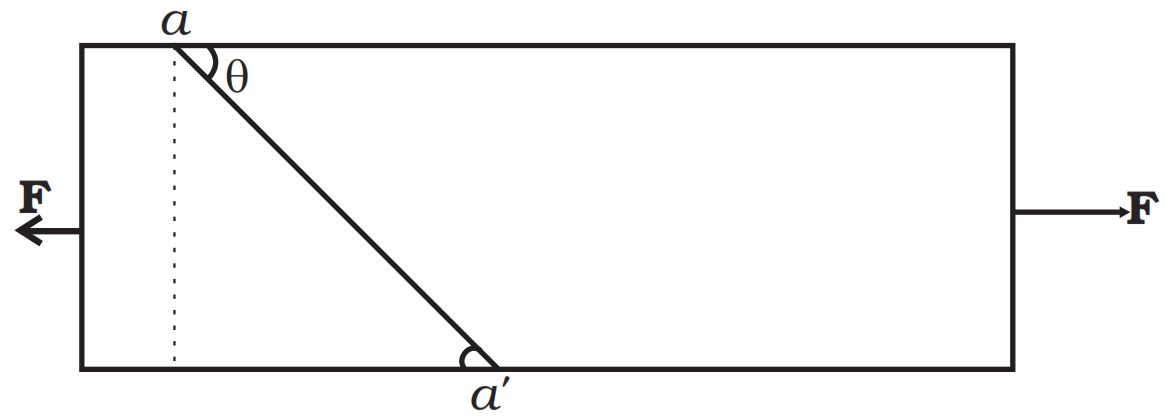
Consider a long steel bar under a tensile stress due to forces F acting at the edges along the length of the bar. Consider a plane making an angle $\Delta$ with the length. What are the tensile and shearing stresses on this plane?
  1. For what angle is the tensile stress a maximum?
  2. For what angle is the shearing stress a maximum?
Answer

According to the problem force F is applied along horizontal, so we resolve it in two perpendicular components - one is parallel to the inclined plane and other one is perpendicular to the inclined plane as shown in the diagram. Now, we can easily calculate the tensile and shearing stress. Here,$\text{F}_\bot=\text{F}\sin\theta,\text{F}_\parallel=\text{F}\cos\theta$
Let the cross - sectional area of the bar be A. Consider the equilibrium of the plane aa'. Here, $\text{F}_\bot$ produces tensile stress and $\text{F}_\parallel$ produces shear stress, on the plane aa'. Let the area of the face aa' be A, then$\therefore\ \sin\theta=\frac{\text{A}}{\text{A}'}\Rightarrow\text{A}'=\frac{\text{A}}{\sin\theta}$
Tensile stress on the plane aa'$\text{aa}'=\frac{\text{F}_\bot}{\text{A}'}=\frac{\text{F}\sin\theta}{\text{A}/\sin\theta}=\frac{\text{F}}{\text{A}}\sin^2\theta$
Shearing stress on the plane aa', Shearing stress $=\frac{\text{Parallel force}}{\text{Area}}$$=\frac{\text{F}_\parallel}{\text{A}'}=\frac{\text{F}\cos\theta}{\text{A}/\sin\theta}=\frac{\text{F}\sin\theta\cos\theta}{\text{A}}=\frac{\text{F}(2\sin\theta\cos\theta)}{2\text{A}}$
$=\frac{\text{F}\sin2\theta}{2\text{A}}$
  1. For tensile stress to be maximum,
$\sin^2\theta=0\Rightarrow\sin\theta=0\Rightarrow\theta=\frac{\pi}{2}\text{ or }\theta=90^0$
  1. For shearing stress to be maximum,
$\sin2\theta=1\Rightarrow2\theta=\frac{\pi}{2}\Rightarrow\theta=\frac{\pi}{4}\text{ or }\theta=45^0$

Need a full question paper?

Generate a complete, print-ready paper with questions like this in minutes — across 16+ boards, with answer keys.

Start Generating Free

Similar questions

It is required to find the volume of a rectangular block. A Vernier Caliper is used to measure the length, width and height of the block. The measured values are found to be 1.37cm, 4.11cm and 2.56cm respectively.
There is a layer of ice 10cm thick over the surface of a pond. Temperature above the surface is -5°C. How long will it take for the next 1mm of ice to form? The thermal conductivity of ice is 0.008 CGS units and its latent heat is 80 cal/g. Density of ice = 0.9 g/cc.
What do you mean by orbital velocity? Find the expression for orbital velocity.
A wire of length L and radius r is clamped rigidly at one end. When the other end of the wire is pulled by a force f, its length increases by l. Another wire of the same material of length 2L and radius 2r, is pulled by a force 2f. Find the increase in length of this wire.
The emf $\in$ and the internal resistance r of the battery, shown in the figure. are 4.3V and $1.0\Omega$ respectively. The external resistance R is $50\Omega.$ The resistances of the ammeter and voltmeter are $2.0\Omega$ and $200\Omega$ respectively. (a) Find the readings of the two $200\Omega$ respectively. (a) Find the readings of the two meters. (b) The switch is thrown to the other side. What will be the readings of the two meters now?
Six point masses of mass m each are at the vertices of a regular hexagon of side l. Calculate the force on any of the masses.
A gas mixture consists of $2.0$ moles of oxygen and $4.0$ moles of neon at temperature T. Neglecting all vibrational modes, calculate the total internal energy of the system. (Oxygen has two rotational modes.)
What is the principle of superposition? On what factors frequency and amplitude of the resultant wave depend? What effect can be produced by the superposi- tion of two sound waves? Exaplain interference of sound wave and analyze it mathematically.
A glass vessel measures exactly $10 \mathrm{~cm} \times 10 \mathrm{~cm} \times 10 \mathrm{~cm}$ at $0^{\circ} \mathrm{C}$. It is filled completely with mercury at this temperature. When the temperature is raised to $10^{\circ} \mathrm{C}, 1.6 \mathrm{~cm}^3$ of mercury overflows. Calculate the coefficient of volume expansion of mercury. Coefficient of linear expansion of glass $=6.5 \times 10^{-6}{ }^{\circ} \mathrm{C}$.
Assuming the length of a chain to be L and coefficient of static friction $\mu,$ calculate the maximum length of the chain which can be held outside a table without sliding.