Question
What is the principle of superposition? On what factors frequency and amplitude of the resultant wave depend? What effect can be produced by the superposi- tion of two sound waves? Exaplain interference of sound wave and analyze it mathematically.

Answer

SELF

Need a full question paper?

Generate a complete, print-ready paper with questions like this in minutes — across 16+ boards, with answer keys.

Start Generating Free

Similar questions

Two current-carrying wires may attract each other. In absence of other forces, the wires will move towards each other increasing the kinetic energy. Does it contradict the fact that the magnetic force cannot do any work and hence cannot increase the kinetic energy?
A body of mass m is attached to one end of a massless spring which is suspended vertically from a fixed point. The mass is held in hand so that the spring is neither stretched nor compressed. Suddenly the support of the hand is removed. The lowest position attained by the mass during oscillation is 4cm below the point, where it was held in hand.
  1. What is the amplitude of oscillation?
  2. Find the frequency of oscillation?
Two pendulums with identical bobs and lengths are suspended from a common support such that in rest position the two bobs are in contact. One of the bobs is released after being displaced by $10°$ so that it collides elastically head-on with the other bob.
  1. Describe the motion of two bobs.
  2. Draw a graph showing variation in energy of either pendulum with time, for where T is the period of each pendulum.
An equilateral triangle ABC is formed by two Cu rods AB and BC and one Al rod. It is heated in such a way that temperature of each rod increases by $\Delta\text{T}$. Find change in the angle ABC. $[$Coeff. of linear expansion for 1 Cu is $\alpha_1$ Coeff. of linear expansion for 2Al is $\alpha_2]$
A particle is executing S.H.M. If $v_1$ and $v_2$ are the speeds of the particle at distance $x_1$ and $x_2$ from the equilibrium position, show that the frequency of oscillations is
$\text{f}=\frac{1}{2\pi}\bigg(\frac{\text{v}^2_1-\text{v}^2_2}{\text{x}^2_2-\text{x}^2_1}\bigg)^{\frac{1}{2}}$
A rectangular box lies on a rough inclined surface. The coefficient of friction between the surface and the box is $\mu$. Let the mass of the box be m.
  1. At what angle of inclination $\theta$ of the plane to the horizontal will the box just start to slide down the plane?
  2. What is the force acting on the box down the plane, if the angle of inclination of the plane is increased to a $\theta>$?
  3. What is the force needed to be applied upwards along the plane to make the box either remain stationary or just move up with uniform speed?
  4. What is the force needed to be applied upwards along the plane to make the box move up the plane with acceleration a?
An electron of kinetic energy 100eV circulates in a path of radius 10cm in a magnetic field. Find the magnetic field and the number of revolutions per second made by the electron.
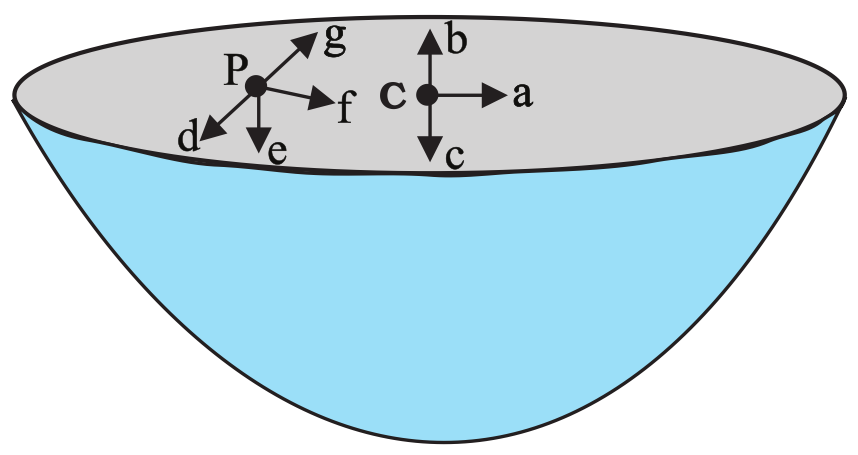
In the following two exercises, choose the correct answer from among the given ones: The gravitational intensity at the centre of a hemispherical shell of uniform mass density has the direction indicated by the arrow (see Fig.) (i) a, (ii) b, (iii) c, (iv) 0.
A neutron initially at rest, decays into a proton, an electron and an antineutrino. The ejected electron has a momentum of $1.4 \times 10^{-26}kg-m/s$ and the antineutrino $6.4 \times 10^{-27}kg-m/s$. Find the recoil speed of the proton:
  1. If the electron and the antineutrino are ejected along the same direction.
  2. If they are ejected along perpendicular directions. Mass of the proton $= 1.67 \times 10^{-27}kg$.
A mass m moving with a speed u collides with a similar mass m at rest, elastically and obliquely. Prove that they will move in directions making an angle $\frac{\pi}{2}$ with each other.