MCQ
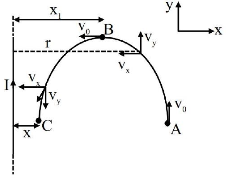
Consider a long thin conducting wire carrying a uniform current I. A particle having mass " M " and charge " q " is released at a distance " a " from the wire with a speed $v_{0}$ along the direction of current in the wire. The particle gets attracted to the wire due to magnetic force. The particle turns round when it is at distance $x$ from the wire. The value of x is [ $\mu_{0}$ is vacuum permeability]
  • A
    $a\left[1-\frac{m v_{o}}{2 q \mu_{o} I}\right]$
  • B
    $\frac{a}{2}$
  • C
    $\mathrm{a}\left[1-\frac{m v_{o}}{q \mu_{o} I}\right]$
  • D
    $\mathrm{ae}^{\frac{-4 \pi \mathrm{mv}_{0}}{\mathrm{qu}_{0} \mathrm{I}}}$
Answer

(D)
Image
$\mathrm{A} \rightarrow \mathrm{B}$
$\overrightarrow{\mathrm{V}}=-\mathrm{v}_{\mathrm{x}} \hat{\mathrm{i}}+\mathrm{v}_{\mathrm{y}} \hat{\mathrm{j}}$
$\overrightarrow{\mathrm{B}}=\frac{\mu_{0} \mathrm{I}}{2 \pi \mathrm{r}}(-\hat{\mathrm{k}})$
$\overrightarrow{\mathrm{F}}=\mathrm{q}(\overrightarrow{\mathrm{v}} \times \overrightarrow{\mathrm{B}})=\frac{\mu_{0} \operatorname{Iq}}{2 \pi \mathrm{r}}\left[-\mathrm{v}_{\mathrm{x}} \hat{\mathrm{j}}-\mathrm{v}_{\mathrm{y}} \hat{\mathrm{i}}\right]$
$\mathrm{a}_{\mathrm{x}}=-\frac{\mu_{0} \mathrm{Iq}}{2 \pi \mathrm{~m}} \cdot \frac{\mathrm{v}_{\mathrm{y}}}{\mathrm{r}}$
$\mathrm{a}_{\mathrm{y}}=-\frac{\mu_{0} \text { Iq }}{2 \pi \mathrm{~m}} \cdot \frac{\mathrm{v}_{\mathrm{x}}}{\mathrm{r}}$
$\frac{\mathrm{v}_{\mathrm{x}} \mathrm{dv}_{\mathrm{x}}}{\mathrm{dr}}=-\frac{\mu_{0} \mathrm{Iq}}{2 \pi \mathrm{~m}} \frac{\mathrm{v}_{\mathrm{y}}}{\mathrm{r}}$
$\frac{v_{x} \mathrm{dv}_{\mathrm{x}}}{\mathrm{v}_{\mathrm{y}}}=-\frac{\mu_{0} \mathrm{Iq}}{2 \pi \mathrm{~m}} \frac{\mathrm{dr}}{\mathrm{r}}$
$\int_{0}^{v_{0}} \frac{v_{x} d v_{x}}{\sqrt{v_{0}^{2}-v_{x}^{2}}}=-\frac{\mu_{0} I q^{2}}{2 \pi m_{a}} \int_{\mathrm{x}} \frac{d r}{r}$
Let, $z^{2}=v_{0}{ }^{2}-v_{x}^{2}$
$2 \mathrm{zd} \mathrm{z}=-2 \mathrm{v}_{\mathrm{x}} \mathrm{dv} \mathrm{v}_{\mathrm{x}}$
$\frac{\mathrm{v}_{\mathrm{x}} \mathrm{dv}_{\mathrm{x}}}{\sqrt{\mathrm{v}_{0}^{2}-\mathrm{v}_{\mathrm{x}}^{2}}}=\frac{-\mathrm{zdz}}{\mathrm{z}}=-\mathrm{dz}$
then integral becomes
$-\int_{\mathrm{v}_{0}}^{0} \mathrm{dz}=-\frac{\mu_{0} \mathrm{Iq}}{2 \pi \mathrm{~m}} \ln \frac{\mathrm{x}_{1}}{\mathrm{a}}$
$v_{0}=-\frac{\mu_{0} I q}{2 \pi m} \ln \frac{x_{1}}{a}$
$x_{1}=a e^{-\frac{2 \pi \mathrm{mv}_{0}}{\mu_{0} \mathrm{I}_{1}}}$
For B $\rightarrow$ C
$\overrightarrow{\mathrm{v}}=-\mathrm{v}_{\mathrm{x}} \hat{\mathrm{i}}-\mathrm{v}_{\mathrm{y}} \hat{\mathrm{j}}$
$\overrightarrow{\mathrm{B}}=\frac{\mu_{0} \mathrm{I}}{2 \pi \mathrm{r}}(-\hat{\mathrm{k}})$
$\vec{F}=q(\vec{v} \times \vec{B})=\frac{\mu_{0} I q}{2 \pi r}\left(-v_{x} \hat{j}+v_{y} \hat{i}\right)$
$\mathrm{a}_{\mathrm{x}}=+\frac{\mu_{0} \mathrm{Iq}}{2 \pi \mathrm{~m}} \frac{\mathrm{v}_{\mathrm{y}}}{\mathrm{r}}$
$a_{y}=-\frac{\mu_{0} I q}{2 \pi m} \cdot \frac{v_{x}}{r}$
$\frac{\mathrm{v}_{\mathrm{x}} \mathrm{dv}_{\mathrm{x}}}{\mathrm{dr}}=\frac{\mu_{0} \mathrm{Iq}}{2 \pi \mathrm{~m}} \frac{\mathrm{v}_{\mathrm{y}}}{\mathrm{r}}$
$\int_{v_{0}}^{0} \frac{v_{x} \mathrm{dv}_{\mathrm{x}}}{\sqrt{\mathrm{v}_{0}^{2}-\mathrm{v}_{\mathrm{x}}^{2}}}=\frac{\mu_{0} \mathrm{Iq}}{2 \pi \mathrm{~m}} \int_{\mathrm{x}_{1}}^{\mathrm{x}} \frac{\mathrm{dr}}{\mathrm{r}}$
$\frac{\mu_{0} \operatorname{Iq}}{2 \pi m} \ln \frac{x}{x_{1}}=-\int_{0}^{v_{0}} d z=-v_{0}$
$x=x_{1} e^{-\frac{2 \pi m v_{0}}{\mu_{0} \mathrm{Iq}^{2}}}$
From equation 1 and 2
$X=a e^{-\frac{4 \pi \mathrm{mv}_{0}}{\mu_{0} I_{q}}}$


Need a full question paper?

Generate a complete, print-ready paper with questions like this in minutes — across 16+ boards, with answer keys.

Start Generating Free

Similar questions

A thin lens made of glass (refractive index $= 1.5$) of focal length $f=16\; \mathrm{cm}$ is immersed in a liquid of refractive index $1.42 .$ If its focal length in liquid is $f_{l},$ then the ratio $f_{l} /f$ is closest to the integer
The angular frequency of alternating current in a $L-C-R$ circuit is $100\, rad / s$. The components connected are shown in the figure. Find the value of inductance of the coil and capacity of condenser.
A submarine has a window of area $30 \times 30 \,cm ^2$ on its ceiling and is at a depth of $100 \,m$ below sea level in a sea. If the pressure inside the submarine is maintained at the sea-level atmosphere pressure, then the force acting on the window is ............. $N$ (consider density of sea water $=1.03 \times 10^3 \,kg / m ^3$, acceleration due to gravity $=10 \,m / s ^2$ )
Both the nucleus and the atom of some element are in their respective first excited states. They get de-excited by emitting photons of wavelengths $\lambda _N,\,\lambda _A$  respectively. The ratio $\frac{{{\lambda _N}}}{{{\lambda _A}}}$  is closest to
An automobile travelling with a speed of $60\,\,km/h,$ can brake to stop within a distance of $20 \,m$. If the car is going twice as fast, i.e. $120\, km/h$, the stopping distance will be  ........... $m$
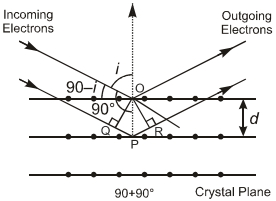
Wave property of electrons implies that they will show diffraction effects. Davisson and Germer demonstrated this by diffracting electrons from crystals. The law governing the diffraction from a crystal is obtained by requiring that electron waves reflected from the planes of atoms in a crystal interfere constructively (see figure).

Electrons accelerated by potential $V$ are diffracted from a crystal. If $d =1\; \mathring A$, and $i =30^{\circ}$. $V$ should be about ....... $V$

$\left( h =6.6 \times 10^{-34}\; J-s , m =9.1\times 10^{-31}\; kg , e =1.610^{-19} \;C \right)$

If three capacitors each of capacity $1\,\mu F$ are connected in such a way that the resultant capacity is $1.5\,\mu F$, then
A parachutist with total weight $75 \,kg$ drops vertically onto a sandy ground with a speed of $2 \,ms ^{-1}$ and comes to halt over a distance of $0.25 \,m$. The average force from the ground on her is close to ............ $N$
In Young's double slits experiment, the position of $5^{\text {th }}$ bright fringe from the central maximum is $5\,cm$. The distance between slits and screen is $1\,m$ and wavelength of used monochromatic light is $600\,nm$. The separation between the slits is $........\mu m$
A $50 \,W$ bulb connected in series with a heater coil is put to an $AC$ mains. Now the bulb is replaced by a $100 \,W$ bulb. The heater output will ...........