Sample QuestionsJEE Main 28-Jan-2025 Paper - Shift 1 questions
One sample from each question group in this chapter. Select any group above to see the full set with answer keys.
The area (in sq. units) of the region $\left\{(x, y): 0 \leq y \leq 2|x|+1,0 \leq y \leq x^{2}+1,|x| \leq 3\right\}$ is
- A
$\frac{80}{3}$
- B
$\frac{64}{3}$
- C
$\frac{17}{3}$
- D
$\frac{32}{3}$
View full solution →Three defective oranges are accidently mixed with seven good ones and on looking at them, it is not possible to differentiate between them. Two oranges are drawn at random from the lot. If $x$ denote the number of defective oranges, then the variance of x is :
- A
$28 / 75$
- B
$14 / 25$
- C
$26 / 75$
- D
$18 / 25$
View full solution →Let $O$ be the origin, the point $A$ be $z_{1}=\sqrt{3}+2 \sqrt{2 \mathrm{i}}$, the point $\mathrm{B}\left(\mathrm{z}_{2}\right)$ be such that $\sqrt{3}\left|z_{2}\right|=\left|z_{1}\right|$ and $\arg \left(z_{2}\right)=\arg \left(z_{1}\right)+\frac{\pi}{6}$. Then
Answer: D.
View full solution →Let ${ }^{n} C_{r-1}=28,{ }^{n} C_{r}=56$ and ${ }^{n} C_{r+1}=70$. Let $\mathrm{A}(4 \cos t, 4 \sin t), \mathrm{B}(2 \sin t,-2 \cos t)$ and $\mathrm{C}\left(3 \mathrm{r}-\mathrm{n}, \mathrm{r}^{2}-\mathrm{n}-1\right)$ be the vertices of a triangle $A B C$, where $t$ is a parameter. If $(3 x-1)^{2}+(3 y)^{2}=\alpha$, is the locus of the centroid of triangle ABC , then $\alpha$ equals :
Answer: A.
View full solution →Let for some function $y=f(x), \int_{0}^{x} t f(t) d t=x^{2} f(x)$, $x>0$ and $f(2)=3$. Then $f(6)$ is equal to :
Answer: A.
View full solution →Let $\mathrm{E}_{1}: \frac{\mathrm{x}^{2}}{9}+\frac{\mathrm{y}^{2}}{4}=1$ be an ellipse. Ellipses $\mathrm{E}_{\mathrm{i}}^{\prime}$ 's are constructed such that their centres and eccentricities are same as that of $E_{1}$, and the length of minor axis of $\mathrm{E}_{\mathrm{i}}$ is the length of major axis of $E_{i+1}(i \geq 1)$. If $A_{i}$ is the area of the ellipse $E_{i}$, then $\frac{5}{\pi}\left(\sum_{i=1}^{\infty} \mathrm{A}_{\mathrm{i}}\right)$, is equal to $\qquad$
View full solution →Let.
$f(x)=\left\{\begin{array}{cc}3 x, & x<0 \\ \min \{1+x+[x], x+2[x]\}, & 0 \leq x \leq 2 \\ 5, & x>2\end{array}\right.$
where [.] denotes greatest integer function. If $\alpha$ and $\beta$ are the number of points, where f is not continuous and is not differentiable, respectively, then $\alpha+\beta$ equals
View full solution →Let $\overrightarrow{\mathrm{a}}=\hat{\mathrm{i}}+\hat{\mathrm{j}}+\hat{\mathrm{k}}, \overrightarrow{\mathrm{b}}=2 \hat{\mathrm{i}}+2 \hat{\mathrm{j}}+\hat{\mathrm{k}}$ and $\overrightarrow{\mathrm{d}}=\overrightarrow{\mathrm{a}} \times \overrightarrow{\mathrm{b}}$. If $\vec{c}$ is a vector such that $\vec{a} \cdot \vec{c}=|\overrightarrow{\mathbf{c}}|,|\overrightarrow{\mathbf{c}}-2 \vec{a}|^{2}=8$ and the angle between $\overrightarrow{\mathrm{d}}$ and $\overrightarrow{\mathrm{c}}$ is $\frac{\pi}{4}$, then $|10-3 \overrightarrow{\mathrm{~b}} \cdot \overrightarrow{\mathrm{c}}|+|\overrightarrow{\mathrm{d}} \times \overrightarrow{\mathrm{c}}|^{2}$ is equal to $\ldots .$.
View full solution →If $\alpha=1+\sum_{\mathrm{r}=1}^{6}(-3)^{\mathrm{r}-1{ }^{12}} \mathrm{C}_{2 \mathrm{r}-1}$, then the distance of the point $(12, \sqrt{3})$ form the line $\alpha x-\sqrt{3} y+1=0$ is
View full solution →Let M denote the set of all real matrices of order $3 \times 3$ and let $S=\{-3,-2,-1,1,2\}$. Let
$\mathrm{S}_{1}=\left\{\mathrm{A}=\left[\mathrm{a}_{\mathrm{ij}}\right] \in \mathrm{M}: \mathrm{A}=\mathrm{A}^{\mathrm{T}}\right.$ and $\left.\mathrm{a}_{\mathrm{ij}} \in \mathrm{S}, \forall \mathrm{i}, \mathrm{j}\right\}$
$S_{2}=\left\{A=\left[a_{i j}\right] \in M: A=-A^{T}\right.$ and $\left.a_{i j} \in S, \forall i, j\right\}$
$\mathrm{S}_{3}=\left\{\mathrm{A}=\left[\mathrm{a}_{\mathrm{ij}}\right] \in \mathrm{M}: \mathrm{a}_{11}+\mathrm{a}_{22}+\mathrm{a}_{33}=0\right.$ and $\left.\mathrm{a}_{\mathrm{ij}} \in \mathrm{S}, \forall \mathrm{i}, \mathrm{j}\right\}$
If $n\left(S_{1} \cup S_{2} \cup S_{3}\right)=125 \alpha$, then $\alpha$ equals.
View full solution →A Carnot engine (E) is working between two temperatures 473 K and 273 K . In a new system two engines - engine $E_{1}$ works between 473 K to 373 K and engine $\mathrm{E}_{2}$ works between 373 K to 273 K . If $\eta_{12}$, $\eta_{1}$ and $\eta_{2}$ are the efficiencies of the engines $E, E_{1}$ and $\mathrm{E}_{2}$, respectively, then
(1) $\eta_{12}<\eta_{1}+\eta_{2}$ (2) $\eta_{12}=\eta_{1} \eta_{2}$
(3) $\eta_{12}=\eta_{1}+\eta_{2}$ (4) $\eta_{12} \geq \eta_{1}+\eta_{2}$
View full solution →A thin prism $P_{1}$ with angle $4^{\circ}$ made of glass having refractive index 1.54 , is combined with another thin prism $\mathrm{P}_{2}$ made of glass having refractive index 1.72 to get dispersion without deviation. The angle of the prism $\mathrm{P}_{2}$ in degrees is
Answer: B.
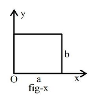
View full solution →The centre of mass of a thin rectangular plate (fig x ) with sides of length a and b , whose mass per unit area $(\sigma)$ varies as $\sigma=\frac{\sigma_{0} \mathrm{x}}{\mathrm{ab}}$ (where $\sigma_{0}$ is a constant), would be $\qquad$
- ✓
$\left(\frac{2}{3} a, \frac{b}{2}\right)$
- B
$\left(\frac{2}{3} a, \frac{2}{3} b\right)$
- C
$\left(\frac{\mathrm{a}}{2}, \frac{\mathrm{~b}}{2}\right)$
- D
$\left(\frac{1}{3} a, \frac{b}{2}\right)$
Answer: A.
View full solution →A proton of mass ' $m_{p}$ ' has same energy as that of a photon of wavelength ' $\lambda$ '. If the proton is moving at non-relativistic speed, then ratio of its de Broglie wavelength to the wavelength of photon is.
- A
$\frac{1}{c} \sqrt{\frac{2 E}{m_{p}}}$
- B
$\frac{1}{c} \sqrt{\frac{E}{m_{p}}}$
- ✓
$\frac{1}{c} \sqrt{\frac{E}{2 m_{p}}}$
- D
$\frac{1}{2 c} \sqrt{\frac{E}{m_{p}}}$
Answer: C.
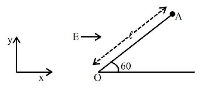
View full solution →A particle of mass ' $m$ ' and charge ' $q$ ' is fastened to one end ' $A$ ' of a massless string having equilibrium length $\ell$, whose other end is fixed at point ' $O$ '. The whole system is placed on a frictionless horizontal plane and is initially at rest. If uniform electric field is switched on along the direction as shown in figure, then the speed of the particle when it crosses the x -axis is
- A
$\sqrt{\frac{2 q E \ell}{m}}$
- B
$\sqrt{\frac{q E \ell}{4 m}}$
- ✓
$\sqrt{\frac{q E \ell}{m}}$
- D
$\sqrt{\frac{q E \ell}{2 m}}$
Answer: C.
View full solution →A double slit interference experiment performed with a light of wavelength 600 nm forms an interference fringe pattern on a screen with $10^{\text {th }}$ bright fringe having its centre at a distance of 10 mm from the central maximum. Distance of the centre of the same $10^{\text {th }}$ bright fringe from the central maximum when the source of light is replaced by another source of wavelength 660 nm would be $\qquad$ mm .
View full solution →Two iron solid discs of negligible thickness have radii $R_{1}$ and $R_{2}$ and moment of intertia $I_{1}$ and $I_{2}$, respectively. For $R_{2}=2 R_{1}$, the ratio of $I_{1}$ and $I_{2}$ would be $1 / \mathrm{x}$, where $\mathrm{x}=$ $\qquad$
View full solution →In a measurement, it is asked to find modulus of elasticity per unit torque applied on the system. The measured quantity has dimension of $\left[M^{a} L^{b} T^{c}\right]$. If $b=3$, the value of $c$ is $\qquad$
View full solution →The moment of inertia of a solid disc rotating along its diameter is 2.5 times higher than the moment of inertia of a ring rotating in similar way. The moment of inertia of a solid sphere which has same radius as the disc and rotating in similar way, is $n$ times higher than the moment of inertia of the given ring. Here, $\mathrm{n}=$_________ .
Consider all the bodies have equal masses.
View full solution →A tiny metallic rectangular sheet has length and breadth of 5 mm and 2.5 mm , respectively. Using a specially designed screw gauge which has pitch of 0.75 mm and 15 divisions in the circular scale, you are asked to find the area of the sheet. In this measurement, the maximum fractional error will be $\frac{\mathrm{x}}{100}$ where x is $\qquad$
View full solution →Ice and water are placed in a closed container at a pressure of 1 atm and temperature 273.15 K . If pressure of the system is increased 2 times, keeping temperature constant, then identify correct observation from following :
- A
Volume of system increases.
- B
Liquid phase disappears completely.
- C
The amount of ice decreases.
- ✓
The solid phase (ice) disappears completely.
Answer: D.
View full solution →In a multielectron atom, which of the following orbitals described by three quantum numbers with have same energy in absence of electric and magnetic fields?
A. $\mathrm{n}=1,1=0, \mathrm{~m}_{1}=0$
B. $\mathrm{n}=2,1=0, \mathrm{~m}_{1}=0$
C. $\mathrm{n}=2,1=1, \mathrm{~m}_{1}=1$
D. $n=3,1=2, m_{1}=1$
E. $n=3,1=2, m_{1}=0$
Choose the correct answer from the options given below :
Answer: D.
View full solution →What is the freezing point depression constant of a solvent, 50 g of which contain 1 g non volatile solute (molar mass $256 \mathrm{~g} \mathrm{~mol}^{-1}$ ) and the decrease in freezing point is 0.40 K ?
- ✓
$5.12 \mathrm{~K} \mathrm{~kg} \mathrm{~mol}^{-1}$
- B
$4.43 \mathrm{~K} \mathrm{~kg} \mathrm{~mol}^{-1}$
- C
$1.86 \mathrm{~K} \mathrm{~kg} \mathrm{~mol}^{-1}$
- D
$3.72 \mathrm{~K} \mathrm{~kg} \mathrm{~mol}^{-1}$
Answer: A.
View full solution →Match the List-I with List-II
| List-I edox Reaction)
| List-II(Type of RedoxReaction) |
| A | $\begin{array}{l} CH _{4(g)}+2 O _{2(g)}
\xrightarrow{\Delta} CO _{2(g)}+
2 H _2 O _{( l )}\end{array}$ | (I) | Disproportionation reaction |
| B | $\begin{array}{l}2 NaH _{( s )} \xrightarrow{\Delta}
2 Na _{( s )}+ H _{2(g)}\end{array}$ | (II) | Combination reaction |
| C | $\begin{array}{l} V _2 O _{5(s)}+5 Ca _{( s )}
\xrightarrow{\Delta} 2 V_{( s )}+
5 CaO _{( s )}\end{array}$ | (III) | Decomposition reaction |
| D | $\begin{array}{l}2 H _2 O _{2( aq )}
\xrightarrow{\Delta} 2 H _2 O _{( l )}
+ O _{2(g)}\end{array}$ | (IV) | Displacement reaction |
Choose the correct answer from the options given below : Answer: A.
View full solution →Given below are two statements :
Statement I : In the oxalic acid vs $\mathrm{KMnO}_{4}$ (in the presence of dil $\mathrm{H}_{2} \mathrm{SO}_{4}$ ) titration the solution needs to be heated initially to $60^{\circ} \mathrm{C}$, but no heating is required in Ferrous ammonium sulphate (FAS) vs $\mathrm{KMnO}_{4}$ titration (in the presence of dil $\mathrm{H}_{2} \mathrm{SO}_{4}$ )
Statement II : In oxalic acid vs $\mathrm{KMnO}_{4}$ titration, the initial formation of $\mathrm{MnSO}_{4}$ takes place at high temperature, which then acts as catalyst for further reaction. In the case of FAS vs $\mathrm{KMnO}_{4}$, heating oxidizes $\mathrm{Fe}^{2+}$ into $\mathrm{Fe}^{3-}$ by oxygen of air and error may be introduced in the experiment.
In the light of the above statements, choose the correct answer from the options given below :
- A
Statement I is false but Statement II is true
- ✓
Both Statement I and Statement II are true
- C
Statement I is true but Statement II is false
- D
Both Statement I and Statement II are false
Answer: B.
View full solution →The formation enthalpies, $\Delta \mathrm{H}_{\mathrm{f}}^{\ominus}$ for $\mathrm{H}_{(\mathrm{g})}$ and $\mathrm{O}_{(\mathrm{g})}$ are 220.0 and $250.0 \mathrm{~kJ} \mathrm{~mol}^{-1}$, respectively, at 298.15 K , and $\Delta \mathrm{H}_{\mathrm{f}}^{-}$for $\mathrm{H}_{2} \mathrm{O}_{(\mathrm{g})}$ is $-242.0 \mathrm{~kJ} \mathrm{~mol}^{-1}$ at the same temperature. The average bond enthalpy of the $\mathrm{O}-\mathrm{H}$ bond in water at 298.15 K is __________ $\mathrm{kJ} \mathrm{mol}^{-1}$ (nearest integer).
View full solution →The molarity of a $70 \%$ (mass/mass) aqueous solution of a monobasic acid ( X ) is ___________________ M(Nearest integer)
[Given : Density of aqueous solution of (X) is $1.25 \mathrm{~g} \mathrm{~mL}^{-1}$
Molar mass of the acid is $70 \mathrm{~g} \mathrm{~mol}^{-1}$ ]
View full solution →Quantitative analysis of an organic compound (X) shows following % composition.
C : 14.5 %
$\mathrm{Cl}: 64.46 %$
H: 1.8 %
(Empirical formula mass of the compound $(\mathrm{X})$ is
\______________ $\times 10^{-1}$
$\overline{\text { (Given }}$ molar mass in $\mathrm{g} \mathrm{mol}^{-1}$ of $\mathrm{C}: 12, \mathrm{H}: 1$, $\mathrm{O}: 16, \mathrm{Cl}: 35.5$ )
View full solution →Consider the following sequence of reactions :
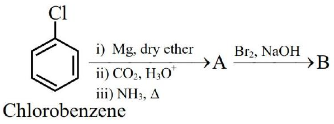
11.25 mg of chlorobenzene will produce_________ $\times 10^{-1} \mathrm{mg}$ of product B .
(Consider the reactions result in complete conversion.)
[Given molar mass of $\mathrm{C}, \mathrm{H}, \mathrm{O}, \mathrm{N}$ and Cl as 12,1 , 16,14 and $35.5 \mathrm{~g} \mathrm{~mol}^{-1}$ respectively] View full solution →Given below is the plot of the molar conductivity vs $\sqrt{\text { concentration }}$ for KCl in aqueous solution.
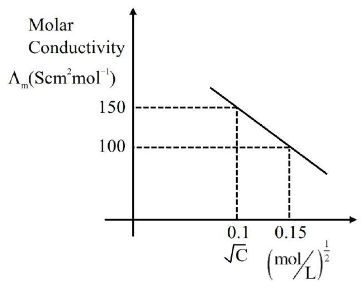
If, for the higher concentration of KCl solution, the resistance of the conductivity cell is $100 \Omega$, then the resistance of the same cell with the dilute solution is ' $x$ ' $\Omega$.
The value of $x$ is ___________ (Nearest integer) View full solution →