Question

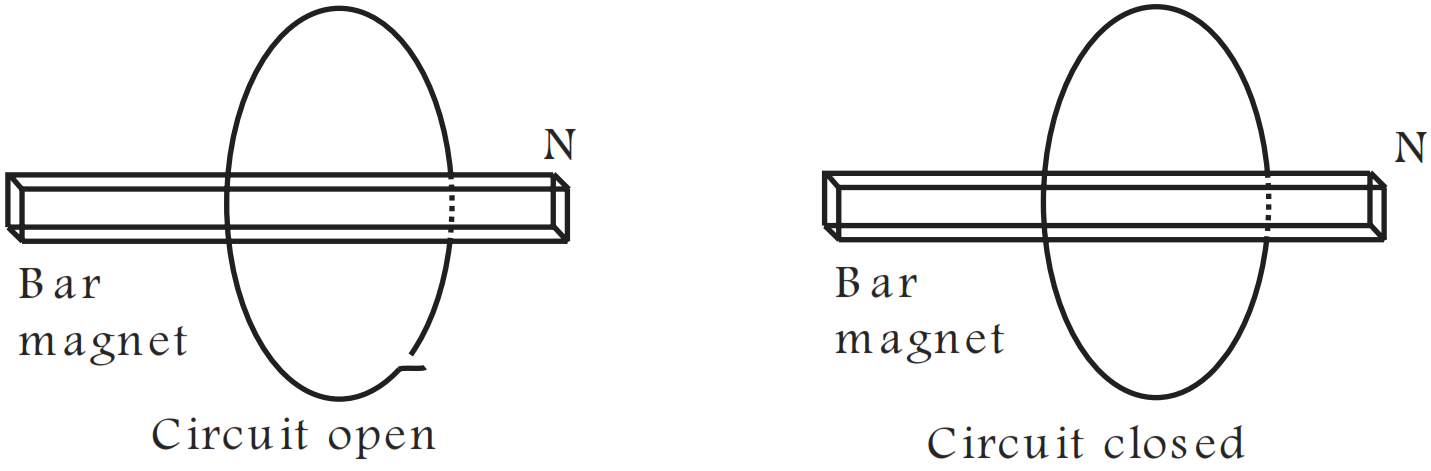
Consider a magnet surrounded by a wire with an on/off switch S (Fig). If the switch is thrown from the off position (open circuit) to the on position (closed circuit), will a current flow in the circuit? Explain.
Answer

Key concept: The total number of magenetic lines of force passing notmally through an area placed in a magnetic field is equal to the magnetic flux linked with that area.
$\phi_\text{m}=\vec{\text{B}}.\vec{\text{A}}=\text{BA}\cos\theta$
($\theta$ is the angle between area vector and magnetic field vector)
Whenever the number fo magnetic lines of force (magnetic flux) passing through a circuit changes an emf is produced in the circuit called induced emf.
The induced emf persists only as long as there is a change or cutting of flux.
The induced emf is given by rate of change of magnetic flux linked with the circuit i.e, $\text{e}=-\frac{\text{d}\phi}{\text{dt}}$. so flux linked will change when either magnetic field, area or the angle between B and A changes.
If the switch is closed, the circuit will complete. But to induce emf in the circuit, we need:
  1. A changing magnetic field, but the bar magnet is stationary so it is not possible in this situation.
  2. A changing area, which is also not possible because area is also constant as coil is not expanding or compressed.
  3. Angle between B bar and A bar changes, which is also not possible in this situation because orientation of bar magnet and coil is fixed.
Thus, no change in magnetic flux linked with coil occur, hence no electromotive force is induced in the coil and hence no current will flow in the circuit.

Need a full question paper?

Generate a complete, print-ready paper with questions like this in minutes — across 16+ boards, with answer keys.
Start Generating Free

Similar questions

Consider a particle moving in simple harmonic motion according to the equation $\text{x}=2.0\cos(50\pi\text{t}+\tan^{-1}0.75)$ where $x$ is in centimetre and $t$ in second. The motion is started at $t = 0$.
  1. When does the particle come to rest for the first time?
  2. When does the acceleration have its maximum magnitude for the first time?
  3. When does the particle come to rest for the second time?
A $60W$ load is connected to the secondary of a transformer whose primary draws line voltage. If a current of $0.54A$ flows in the load, what is the current in the primary coil? Comment on the type of transformer being used.
A beam of light converges at a point P. Now a lens is placed in the path of the convergent beam 12 cm from P. At what point does the beam converge if the lens is (a) a convex lens of focal length 20 cm, and (b) a concave lens of focal length 16 cm?
A rod, when suspended in a magnetic field, stays in the east-west direction. Can we be sure that the field is in the east-west direction? Can it be in the north-south direction?
Consider a metal ring kept on top of a fixed solenoid (say on a carboard) (Fig). The centre of the ring coincides with the axis of the solenoid. If the current is suddenly switched on, the metal ring jumps up. Explain.
Two moving coil meters, M1 and M2 have the following particulars:$\begin{array}{l} R _1=10 \Omega, N_1=30 \\
A_1=3.6 \times 10^{-3} m^2, B_1=0.25 T\end{array}$
$\begin{array}{l} R _2=14 \Omega, N_2=42 \\
A_2=1.8 \times 10^{-3} m^2, B_2=0.50 T\end{array}$
(The spring constants are identical for the two meters).
Determine the ratio of (a) current sensitivity and (b) voltage sensitivity of M2 and M1.
The electric field associated with a light wave is given by $\text{E}=\text{E}_0\sin[(1.57\times10^7\text{m}^{-1})(\text{x}-{\text{ct}})].$ Find the stopping potential when this light is used in an experiment on photoelectric effect with the emitter having work function $1.9\ \ce{ev}.$
Write Einstein's photoelectric equation and explain any two observations related to the photoelectric effect.
A group of hydrogen atoms are prepared in n = 4 states. List the wavelength that are emitted as the atoms make transitions and return to n = 2 states.
A thin paper of thickness $0.02\ mm$ having a refractive index $1.45$ is pasted across one of the slits in a Young's double slit experiment. The paper transmits $\frac{4}{9}$ of the light energy falling on it.
  1. Find the ratio of the maximum intensity to the minimum intensity in the fringe pattern.
  2. How many fringes will cross through the centre if an identical paper piece is pasted on the other slit also? The wavelength of the light used is 600nm.