Question
Write Einstein's photoelectric equation and explain any two observations related to the photoelectric effect.

Answer

The photoelectric equation of Einstein,
$\frac{1}{2} mv_{\max }^2=h v-\phi_0$
Observations related to photoelectric effect :
(1) On frequency of incident light is less than the threshold frequency or $v <v_0$, then from equation $\frac{1}{2} mv _{\max }^2= h \left( v - v _0\right)$, the value of kinetic energy of electron will be negative since kinetic energy is negative. So if $v<$ $v_0$, emission of photo-electrons is not possible, i.e. the frequency of incident light must be greater than or equal to the threshold frequency.
(2) The number of electrons emitted depends on the number of incident photons. In other words, we can say that the number of electrons emitted in unit time for light of fixed frequency from unit area of surface, depends on the number of photons incident on unit area in unit time on the surface i.e. the intensity of light.
(3) From eq. $\frac{1}{2} mv _{\max }^2= h \left(v-v_0\right)$ it is clear that kinetic energy of emitted photoelectrons depends on the frequency of the incident proton but not on the intensity of light.
(4) According to quantum theory, energy of light remains in the form of photons. Therefore as soon as a photon of sufficient energy strikes on the surface, an electron is emitted due to the absorptions, i.e. there is no time lag in the emission of photoelectrons.

Need a full question paper?

Generate a complete, print-ready paper with questions like this in minutes — across 16+ boards, with answer keys.
Start Generating Free

Similar questions

A rectangular wire loop of sides 8 cm and 2 cm having a small cut is moving out of a region of uniform magnetic field of magnitude 0.3 T directed normal to the loop. What is the emf developed across the cut if the velocity of the loop is $1 cm s ^{-1}$ in a direction normal to the (a) longer side (b) shorter side of the loop? For how long does the induced voltage last in each case?
  1. State Huygen’s principle. Using this principle draw a diagram to show how a plane wave front incident at the interface of the two media gets refracted when it propagates from a rarer to a denser medium. Hence verifiy Snell’s law of refraction.
  2. When monochromatic light travels from a rarer to a denser medium, explain the following, giving reasons:
    1. Is the frequency of reflected and refracted light same as the frequency of incident light?
    2. Does the decrease in speed imply a reduction in the energy carried by light wave?
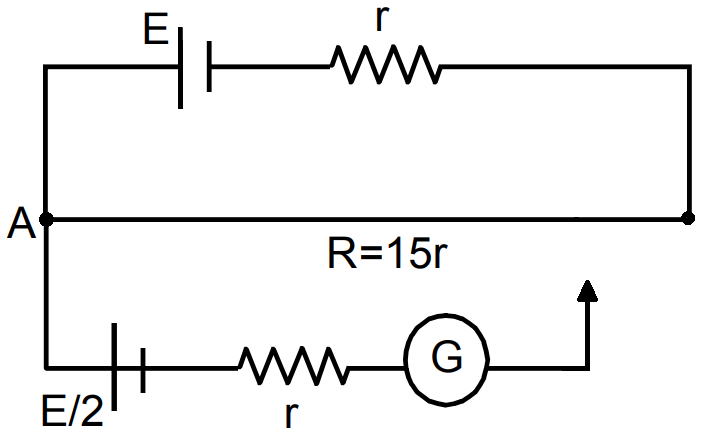
Consider the potentiometer circuit as arranged in the figure. The potentiometer wire is $600\ cm$ long. $(a)$ At what distance from the point $A$ should the jockey touch the wire to get zero deflection in the galvanometer? $(b)$ If the jockey touches the wire at a distance of $560\ cm$ from $A,$ what will be the current in the galvanometer?
A particle of mass m and charge $q$ is thrown at a speed u against a uniform electric field $E$. How much distance will it travel before coming to momentary rest?
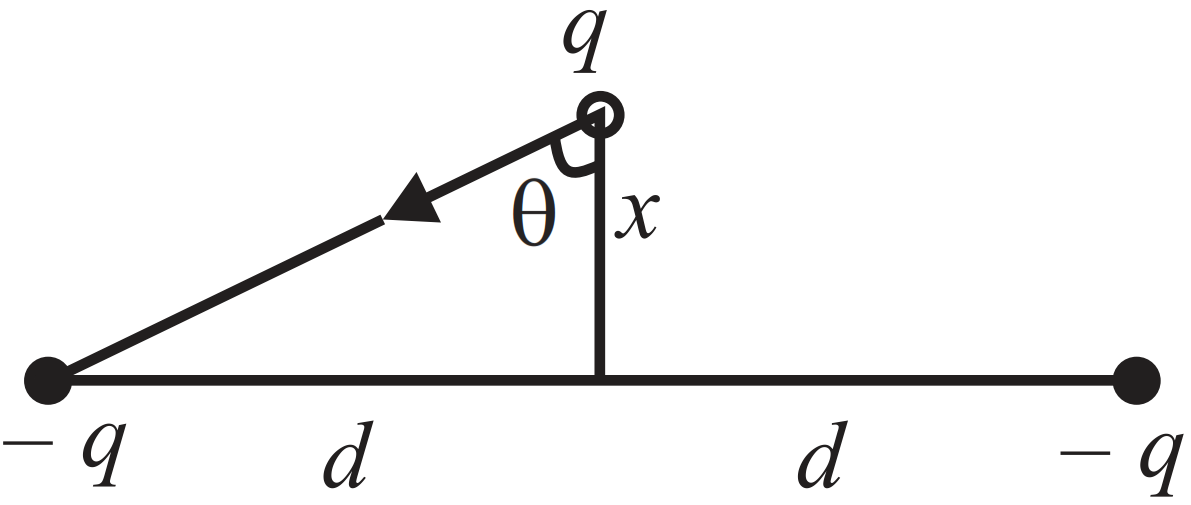
Two charges -q each are fixed separated by distance 2d. A third charge q of mass m placed at the mid-point is displaced slightly by x (x < < d) perpendicular to the line joining the two fixed charged as shown in Fig. Show that q will perform simple harmonic oscillation of time period.

$\text{T}=\Big[\frac{8\pi^3\epsilon_0\text{md}^3}{\text{q}^2}\Big]^\frac{1}{2}$.
  1. Explain briefly the principle on which a transistor $-$ amplifier works as an oscillator. Draw the necessary circuit diagram and explain its working.
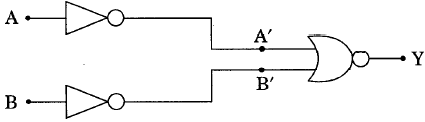
  2. Identify the equivalent gate for the following circuit and write its truth table.
The capacitance between the adjacent plates shown in figure is 50nF. A charge of $1.0\mu\text{C}$ is placed on the middle plate:
  1. What will be the charge on the outer surface of the upper plate?
  2. Find the potential difference developed between the upper and the middle plates.
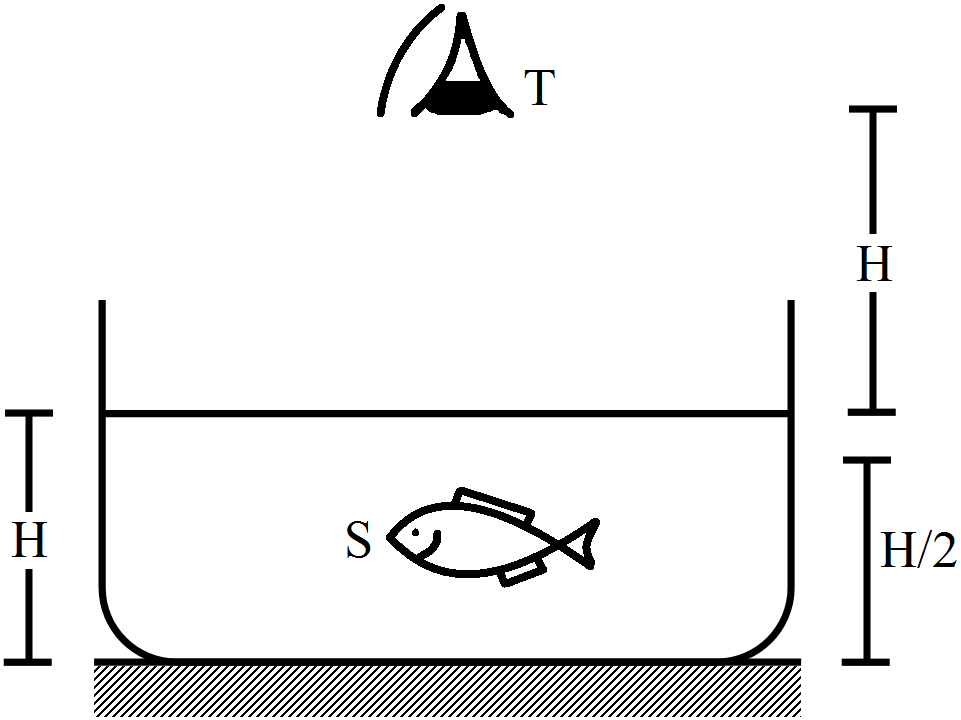
Consider the situation in figure. The bottom of the pot is a reflecting plane mirror, S is a small fish and T is a human eye. Refractive index of water is.
  1. At what distance(s) from itself will the fish see the image(s) of the eye?
  2. At what distance(s) from itself will the eye see the image(s) of the fish.
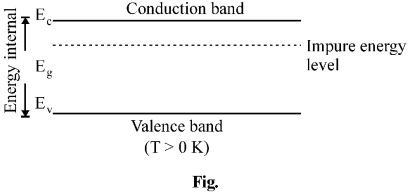
How many is energy states are present in one mole of sodium vapour? Are they all filled in normal conditions? "How many $3s$ energy states are present in one mole of sodium vapour? Are they all filled in normal conditions?