Question
✓
Answer
Key concept: The total number of magenetic lines of force passing notmally through an area placed in a magnetic field is equal to the magnetic flux linked with that area.
$\phi_\text{m}=\vec{\text{B}}.\vec{\text{A}}=\text{BA}\cos\theta$
($\theta$ is the angle between area vector and magnetic field vector)
Whenever the number fo magnetic lines of force (magnetic flux) passing through a circuit changes an emf is produced in the circuit called induced emf.
The induced emf persists only as long as there is a change or cutting of flux.
The induced emf is given by rate of change of magnetic flux linked with the circuit i.e, $\text{e}=-\frac{\text{d}\phi}{\text{dt}}$. so flux linked will change when either magnetic field, area or the angle between B and A changes.
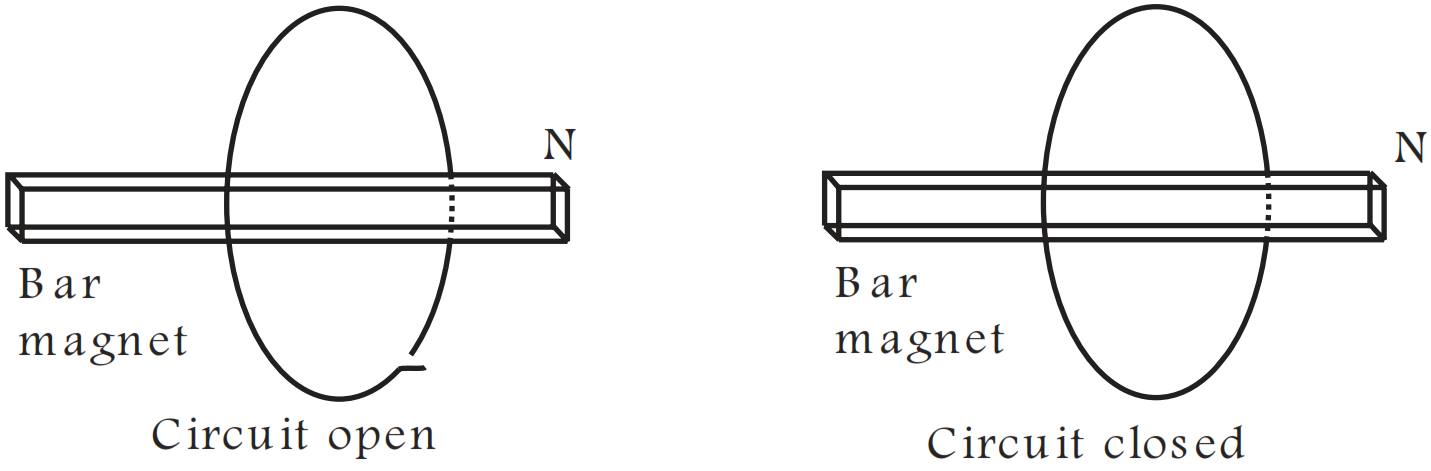
If the switch is closed, the circuit will complete. But to induce emf in the circuit, we need:
$\phi_\text{m}=\vec{\text{B}}.\vec{\text{A}}=\text{BA}\cos\theta$
($\theta$ is the angle between area vector and magnetic field vector)
Whenever the number fo magnetic lines of force (magnetic flux) passing through a circuit changes an emf is produced in the circuit called induced emf.
The induced emf persists only as long as there is a change or cutting of flux.
The induced emf is given by rate of change of magnetic flux linked with the circuit i.e, $\text{e}=-\frac{\text{d}\phi}{\text{dt}}$. so flux linked will change when either magnetic field, area or the angle between B and A changes.
If the switch is closed, the circuit will complete. But to induce emf in the circuit, we need:
- A changing magnetic field, but the bar magnet is stationary so it is not possible in this situation.
- A changing area, which is also not possible because area is also constant as coil is not expanding or compressed.
- Angle between B bar and A bar changes, which is also not possible in this situation because orientation of bar magnet and coil is fixed.
Need a full question paper?
Generate a complete, print-ready paper with questions like this in minutes — across 16+ boards, with answer keys.
Explore more
Similar questions
A conducting wire of length l, lying normal to a magnetic field B, moves with a velocity v, as shown in the figure.
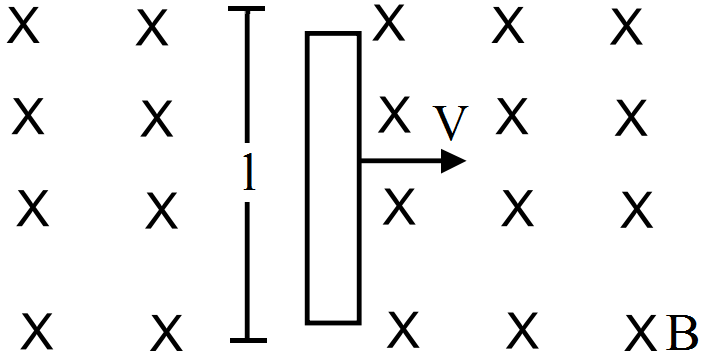
- Find the average magnetic force on a free electron of the wire.
- Due to this magnetic force, electrons concentrate at one end, resulting in an electric field inside the wire. The redistribution stops when the electric force on the free electrons balances the magnetic force. Find the electric field developed inside the wire when the redistribution stops.
- What potential difference is developed between the ends of the wire?
The flux of magnetic field through a closed conducting loop changes with time according to the equation, $\phi=\text{at}^2+\text{bt}+\text{c}.$
→- Write the SI units of a, band c.
- If the magnitudes of a, b and c are 0.20, 0.40 and 0.60 respectively, find the induced emf at t = 2s.
State ampere's law. Obtain expression for magnetic field at a point located (i) externally (ii) internally due to a long cylindrical solid current carrying conductor.###Calculate the value of magnetic field at points $(r>a)$ and $(r
→- Draw a ray diagram to show refraction of a ray of monochromatic light passing through a glass prism.
Deduce the expression for the refractive index of glass in terms of angle of prism and angle of minimum deviation.
- Explain briefly how the phenomenon of total internal reflection is used in fibre optics.
Obtain expressions for instantaneous values of alternating emf and current.
The work function of a photoelectric material is 4.0eV.
- What is the threshold wavelength?
- Find the wavelength of light for which the stopping potential is 2.5V.
A wave is described by the equation
→$\text{y}=(1.0\text{mm})\sin\pi\Big(\frac{\text{x}}{2.0\text{cm}}-\frac{\text{t}}{0.01\text{s}}\Big).$
- Find the time period and the wavelength.
- Write the equation for the velocity of the particles. Find the speed of the particle at x = 1.0cm at time t = 0.01s.
- What are the speeds of the particles at x = 3.0cm, 5.0cm and 7.0cm at t 0.01s?
- What are the speeds of the particles at x 1.0cm at t = 0.011, 0.012, and 0.013s?
Repeat part (a) of problem 6 if the push is applied horizontally and not parallel to the incline.
Consider a wire of length 4m and cross-sectional area 1mm2 carrying a current of 2A. If each cubic metre of the material contains 1029 free electrons, find the average time taken by an electron to cross the length of the wire.
A light beam of wavelength 400 run is incident on a metal plate of work function 2.2eV.
- A particular electron absorbs a photon and makes two collisions before coming out of the metal. Assuming that 10% of the extra energy is lost to the metal in each collision, find the kinetic energy of this electron as it comes out of the metal.
- Under the same assumptions, find the maximum number of collisions the electron can suffer before it becomes unable to come out of the metal.